For narrow lining seams, the key things are a guide that matches your pattern’s seam allowance, a controllable straight stitch and easy handling at corners. If you’re also sewing the outer fabric, interfacing or handle attachments, test how the machine feeds those exact layers. Features such as adjustable presser-foot pressure or specialist feet can help, depending on the model, but they don’t guarantee a particular result.
Which machine might suit you?
Precision when sewing the lining
If you need to keep to a specific, narrow seam allowance and guide the fabric edges around corners, your guide must match the pattern. Brother specifies a 1 cm seam allowance in one tote bag tutorial; this is different from the measurements of its quarter-inch presser feet.
Working with different fabric layers
If you’re sewing the outer fabric, interfacing or folded layers as well as the lining, controlled fabric feeding matters more than a wide choice of decorative stitches. Brother describes a walking foot for a particular project, while Janome lists adjustable presser-foot pressure for the 230DC Limited Edition.
Occasional projects and workspace
If you only sew occasionally, you can weigh up straightforward settings against extra controls. Janome describes a removable extension table, while W6 lists adjustable stitch length and two straight-stitch needle positions for the N 1235/61.
What to look for when buying
First, check the seam measurement on your pattern. Then test the guidance, fabric feed and handling with the materials you actually plan to sew.
| Buying priority |
What to check |
Who it matters most to |
| Guiding a narrow seam allowance |
Compare your pattern’s seam measurement with the needle position, the markings on the needle plate and the distance to a guide. Brother lists its quarter-inch feet as 6,4 mm and 3,2 mm. |
If I’m sewing to a narrow, set seam allowance, I want to guide the edge without having to measure it constantly. Around 36% of consumers cite precision as their main buying priority. |
| Feeding different layers |
Sew a test seam using the lining, outer fabric, interfacing and the actual folds. Check the presser-foot pressure and any feed assistance on the specific model. |
If my bag has several fabric layers at the joins, I want the fabric to feed through smoothly and under control. Around 29% of consumers prioritise handling changes in layers. |
| Handling corners and closed pieces |
Try the speed control and needle stop. For tubular pieces, check whether the free arm’s shape and circumference suit your project. |
If I need to stop and turn the fabric at tight corners, I want good control over the needle position and speed. Around 21% of consumers put this type of handling first. |
| Accessories and ongoing costs |
Check what’s included, which spare parts are available and whether an optional guide foot is approved for your exact model version. |
If I need extra accessories for a particular seam guide, I want to know before buying whether they’ll actually fit the machine. Around 14% of consumers prioritise total cost and accessories. |
Avoiding common buying mistakes
-
Assuming an imperial measurement will suit a metric pattern
Brother describes quarter-inch feet measuring 6,4 mm and 3,2 mm. That doesn’t automatically make them suitable for a different seam allowance. For example, one Brother tote bag tutorial uses a 1 cm allowance throughout.
Decide on your seam measurement first, then check the distance between the needle and the guide on a fabric offcut.
-
Assuming “Heavy Duty” guarantees neat fine stitching
The manufacturer’s information about the Singer Heavy Duty 4423 describes it as an option for heavier fabrics, but doesn’t show how it will perform with your particular combination of lining and interfacing.
Test the machine with the actual thin and thick layers you plan to use, rather than judging seam quality from the model name.
-
Ordering accessories for a similarly named model version
An accessories list for the Janome 230DC doesn’t automatically confirm compatibility with every version of the 230DC Limited Edition.
Before ordering, check the exact model version and whether the accessory is approved for it.
Brands to consider
Janome
The 230DC Limited Edition may appeal if you’re looking for a computerised machine with adjustable presser-foot pressure and extra work surface.
- Janome lists a speed controller, adjustable presser-foot pressure, an extension table and an edge foot as included with the Limited Edition.
- Don’t assume that feet listed separately are compatible with the exact Limited Edition version without checking first.
Brother
The Innov-is A16 is a computerised option if you want to limit the speed and use the needle stop at corners.
- Brother lists a speed controller and a needle up/down button for the A16.
- The measurements given for the separately described quarter-inch feet don’t prove they’ll suit every seam allowance or that they’re included with the A16.
W6 Wertarbeit
The mechanical N 1235/61 is one option if you prefer straightforward settings on a domestic sewing machine.
- W6 lists adjustable stitch length and two needle positions for straight stitching.
- Check that the guide suits your seam allowance, and test an actual change in fabric layers.
BERNINA
The B 325’s narrow free arm and guidance close to an edge are worth checking if you’re sewing small or tubular pieces.
- BERNINA describes the B 325 as having a narrow free arm; its instructions for the #10 edgestitch foot explain how to sew close to an edge.
- Before combining accessories, confirm which foot version you need and whether it’s compatible with your specific model.
Singer
Singer presents the Heavy Duty 4423 as an option for canvas and other heavier fabrics.
- Singer lists adjustable presser-foot pressure.
- The manufacturer’s information is no substitute for testing the layers in your bag, particularly for narrow lining seams.
Related products at Joybuy
The Joybuy products below range from compact domestic machines to a hand-operated machine for thicker materials. Check whether each machine’s design and features suit sewing a narrow lining seam.
 No image available
Compact domestic mini sewing machine, 12 stitch options, single- and twin-needle options
For occasional sewing projects where a compact design and adjustable sewing speed matter. Test it on a fabric sample to check whether it suits your seam measurement.
12 stitch options; two speed settings; free arm; built-in thread cutter; sewing kit included.
View at Joybuy
 No image available
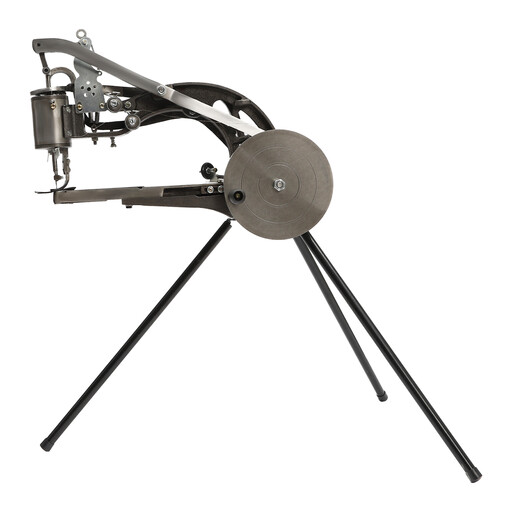
Hand-operated leather sewing machine, 6 mm stitch length, material thickness 3–5 mm
The product description lists bag repairs and thicker materials, 3–5 mm thick, as suitable uses. It doesn’t show that this machine can replace a domestic machine for precise stitching in thin lining fabric.
The maximum stitch length is listed as 6 mm, and the sewing head rotates 360°. Turn the hand crank clockwise, oil the moving parts regularly and keep your hands away from the needle.
View at Joybuy
 No image available
Portable sewing machine, 12 stitches, dual power, LED, pink
For occasional sewing projects if you want to adjust the speed and choose between different ways to start. Test the machine with your lining fabric.
Two speed settings; adjustable thread tension; LED light; starts with a foot pedal or manual button; adapter or battery powered; accessories included.
View at Joybuy
Frequently asked questions about sewing machines for bag linings
Can I use a quarter-inch foot for a narrow metric seam allowance?
Only if it matches the seam allowance on your pattern. Brother describes quarter-inch feet measuring 6,4 mm and 3,2 mm, while a Brother tutorial for a tote bag project uses a 1 cm allowance throughout. Check the distance from the needle on a fabric offcut.
How do I set up the machine and accessories for the seam?
Set the stitch, presser foot and needle according to the instructions for your specific model, then check the result with a test seam. Read the accessory instructions too: BERNINA specifically requires this for the #10 edgestitch foot.
What should I compare when checking accessories and spare parts?
Check what’s included, whether optional feet are compatible and which spare parts are available for the exact model version. Janome lists an edge foot as included with the 230DC Limited Edition; W6 lists spare parts for the N 1235/61.
What are my rights when buying a sewing machine online in Germany?
According to the Verbraucherzentrale, for a typical online consumer purchase you generally have a 14-day right to cancel after receiving the goods. You must notify the retailer that you wish to cancel. Your statutory rights if goods are faulty are separate from a voluntary manufacturer’s guarantee.
Is CE marking relevant to my buying decision?
It is relevant if an EU regulation requiring CE marking applies to the specific machine. The European Union explains that marking is only required for products covered by the relevant harmonised rules. On its own, it doesn’t tell you whether the machine can guide a narrow seam allowance accurately.


