If you’re sewing long bag panels
If you sew long, straight seams, consider how easily you can lay out and guide large pieces of fabric. Janome describes a spacious sewing area, while bernette lists an extension table for the 05 ACADEMY.


For long lengths of fabric, first check whether the sewing area supports the fabric in front of and behind the needle, and whether there is enough room to the right of the needle. An extension table can provide extra support. If layers shift against each other where the straps join, fabric feed is another factor to consider. If you’ll be sewing thick seams regularly, it’s worth testing your actual fabric layers first – manufacturer specifications are no substitute.
If you sew long, straight seams, consider how easily you can lay out and guide large pieces of fabric. Janome describes a spacious sewing area, while bernette lists an extension table for the 05 ACADEMY.
When working with canvas and multiple layers, fabric feed, presser-foot pressure and how the machine handles changes in fabric thickness all matter. SINGER describes the Heavy Duty 4423 as suitable for denim and canvas; PFAFF lists integrated top and bottom feed for the passport 3.0.
For simple projects, straightforward settings and a speed you can control may matter more than a large stitch selection. TÜV SÜD lists easy-to-use basic stitch types as a buying consideration; bernette says the speed of the 05 ACADEMY can be limited.
For long shopping bags, fabric support, feeding over multiple layers and ease of control are separate buying considerations.
| Buying priority | What to look for | Who it matters most to |
|---|---|---|
| Guiding long lengths of fabric | Check the support in front of and behind the needle, as well as the space to its right; find out whether an extension table is included. | When I’m sewing long lengths, I want to support the fabric without it pulling at the needle. Around 36% of consumers say stable fabric support is their top priority. |
| Feeding multiple layers | Check for integrated top feed or a compatible walking foot; sew a test stitch across the planned change in fabric thickness. | At thick strap joins, I want to avoid the fabric layers shifting against each other. Around 29% of consumers say this is their main feeding requirement. |
| Getting started with confidence | Check the basic stitches and how easy the settings are to understand; look for a speed limiter if you need one. | When I’m just starting to make bags, I want to be able to control the stitch selection and speed easily. Around 21% of consumers put ease of use first. |
| Sewing different fabrics | Check for adjustable presser-foot pressure and suitable needles; test stitches using the fabrics you plan to sew. | When I combine different materials for the outer fabric and lining, I want to be able to adjust the settings to suit them. Around 14% of consumers prioritise being able to sew different fabrics. |
The number of stitches doesn’t tell you how easily you can lay out and guide a long length of fabric.
Before comparing stitch options, check the sewing area, the space to the right of the needle and whether an extension table is included.
The manufacturer’s description of the SINGER Heavy Duty 4423 as suitable for canvas doesn’t set a universal limit for the specific combination of layers you plan to sew.
Test your fabric, thread, needle and the thickest seam you plan to make together.
Additional feed can help when layers shift against each other, but it doesn’t create more space to the right of the needle.
If you’re sewing wide bundles of fabric, check the feed and the clearance separately.
Janome describes the 1522RD and 1522BL models as having a spacious sewing area and three-step adjustable presser-foot pressure.
bernette describes the 05 ACADEMY as having an extension table, 165 mm of space to the right of the needle and adjustable sewing speed.
According to the manufacturer, the passport 3.0 combines integrated top and bottom feed with a compact design.
SINGER describes the Heavy Duty 4423 as suitable for projects using denim and canvas.
The Joybuy products below include a hand-operated machine for thick materials and electric models for beginners. Check that each product’s material specifications and operating method suit your bag-making project.
 No image available
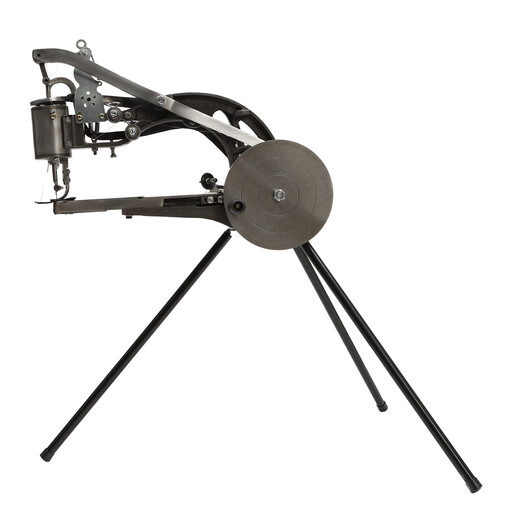
For bags and thick materials, if a hand-cranked machine suits the way you work.
The product specifications state that it can handle materials up to 5 mm thick, with a maximum stitch length of 6 mm. It’s operated by hand crank rather than an electric motor.
 No image available
Described as an electric machine for beginners; check its material limits carefully, especially when sewing thick strap seams.
The specifications list two speeds and forward and reverse sewing. The maximum material thickness is stated as 2.5 mm; the claim of up to six layers applies only to thin denim.
 No image available
Described as a portable model for beginners, suitable for simple repairs and everyday sewing.
The product specifications list two speeds and operation using either a foot pedal or a button.
Not necessarily: a free arm doesn’t automatically provide more support for long, flat lengths of fabric. Check the space to the right of the needle and whether an extension table is included. bernette lists an extension table and 165 mm of space to the right of the needle for the 05 ACADEMY.
Follow the instructions for your specific model. bernette says to switch off the machine before attaching a presser foot; the Janome Continental M8 instructions say to unplug the machine before cleaning it.
Distance-selling contracts generally come with a statutory right of cancellation, subject to exceptions. Under §§ 312g, 355 and 356 BGB, the cancellation period is normally 14 days and, for a standard purchase of goods, generally begins when you receive them; the statutory conditions apply. If the product is faulty, the seller is responsible, as explained by the Verbraucherzentrale (German consumer advice centre). This is separate from any voluntary manufacturer’s guarantee.
The European Union states that products sold in the EU must comply with the applicable product safety rules. Check the product information and instructions for the specific machine rather than assuming anything about its safety or sewing performance based on the brand name.