What should you look for when choosing?
CHIP Test Centre lists adjustable stitch length and presser-foot pressure as important considerations for sturdy fabrics. What matters most is testing the actual combination of materials you plan to use for your bags.
| Priority |
What to check when buying |
Who is it important for? |
| Sturdy and folded layers of fabric |
Test-sew with your own fabric, webbing and thread layers; check the feed and stitch quality at the thickest point. |
When I sew canvas and webbing together at a strap attachment, I want to see whether the fabric feeds evenly; around 36% of consumers put sewing sturdy layers of fabric first. |
| Ease of use when users change |
Check whether the speed control and settings you need are easy to find and adjust slowly. |
When several people with different levels of sewing experience use the machine, clear controls matter to me; around 29% of consumers prioritise different users and controllable speed. |
| Support surface for large pieces |
Check the work surface and storage space; find out whether an extension table is included. |
When sewing large bag pieces, I want to be able to support the fabric at the side without it pulling at the needle; around 21% of consumers focus mainly on the support surface. |
| Use and maintenance |
Read the manual for cleaning and changing the needle; check the intended use and warranty terms for how you plan to use the machine. |
When a machine is shared, I want to know how everyone can use it safely and who is responsible for maintenance and faults; around 14% of consumers put use and maintenance first. |
Joybuy products
The Joybuy products below are sewing machine options for manual and basic household sewing. Whether a model is suitable for your shopping bags depends on the specific materials you plan to use and the functions you need.
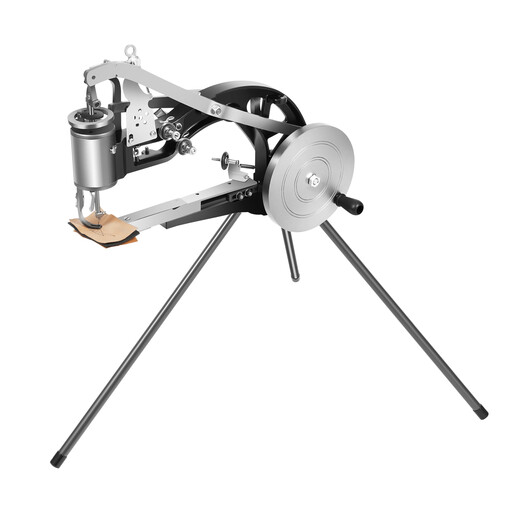 Image unavailable
Hand-cranked shoe and leather sewing machine, stitch length up to 6 mm
Consider it for shopping bags only if its design and seam guidance suit your project; test-sew the actual strap intersection.
The product title specifies a stitch length of up to 6 mm and a material thickness of 3–5 mm. The product description lists hand-cranked operation, 360° adjustment, and bags, canvas and tent material as suitable uses; it recommends regularly lubricating moving parts.
View on Joybuy
 Image unavailable
Compact household sewing machine, 12 stitch types
The two speed settings may be useful when different people share the machine; test how it feeds the thickest seam in your bag.
The product specifications list 12 stitch types and single- and twin-needle operation. This does not confirm that it can sew a specific strap intersection.
View on Joybuy
 Image unavailable
Electric beginner sewing machine, 12 stitch programmes
The foot pedal and hand switch give you two ways to operate the machine; before sewing a bag, test whether it feeds the material layers at their thickest point.
The product specifications list two speeds and forward and reverse sewing. The maximum material thickness is given as 2.5 mm; the description says it can sew up to six layers of thin denim.
View on Joybuy
 Image unavailable
Portable mini sewing machine, 12 stitches, pink
Foot-pedal and button controls may be useful when different people share the machine; separately test how it feeds your folded fabric and webbing layers.
The product description lists two speed settings, adjustable thread tension, forward and reverse sewing, and accessories.
View on Joybuy
 Image unavailable
IAGREEA portable mechanical sewing machine
If a basic straight stitch is all you need, this model could be an option; note that the product description does not mention a reverse function.
The product specifications list two speed settings, a fixed straight stitch with fixed stitch width and length, and 6 V and 1 A. Mains or battery operation with 4 AA batteries and a foot pedal are also listed.
View on Joybuy
Frequently asked questions
How can I check whether a machine will sew my bag straps?
Before choosing, test-sew with the fabric, webbing and thread you plan to use, including the layers folded as they will be in your finished bag. At the thickest intersection, check for an even feed and skipped stitches; a manufacturer’s mention of canvas alone does not answer the question.
What should we bear in mind when changing the needle and cleaning a shared machine?
Follow the manual for the specific model. The Janome 230DC Limited Edition manual says to switch off the machine when working near the needle and to unplug it after use and before cleaning. Make sure all users know these steps.
Are a warranty and statutory rights the same thing?
No. When a consumer buys goods in Germany, they have statutory rights against the seller if the goods are faulty; a warranty is an additional voluntary benefit with its own terms. If a commercial workshop operator buys the machine, they should check the relevant contract and warranty terms separately. The Verbraucherzentrale distinguishes between statutory rights and voluntary warranties.
What should I check for electrical sewing machine safety?
Check the labelling and product information for the specific machine; a CE mark is not an independent certification mark. The EU explains that CE marking is required only for products covered by relevant harmonised EU rules that explicitly require it, and that the manufacturer is responsible for compliance. According to EUR-Lex, the Machinery Regulation will replace Directive 2006/42/EC from 20 January 2027.


