What should you look for when buying?
First, decide whether you’ll mainly be recording one person or occasionally several. Then compare the connection, positioning and controls available with the recording setup you plan to use.
The percentages below relate to consumers choosing a microphone for short news recordings at a shared desk.
| Priority |
What to check before buying |
Who it matters most to |
| Clear solo voice |
Polar pattern, speaking direction and how close you can position the microphone; listen to a test recording made at your workspace. |
When I record a solo bulletin between conversations and desk noise, I want my voice to remain clear. Around 36% of consumers say this is their top priority. |
| Quick, repeatable setup |
USB or XLR connection, the cables and interface you’ll need, and a stand or arm for your recording space. |
When different people use the space, I want to be able to set it up again without unnecessary reconnections. Around 29% of consumers prioritise a straightforward setup. |
| Control while recording |
Headphone output, gain and mute controls, and whether they’re available with your chosen connection. |
If I don’t want to repeat a short bulletin because of the wrong level or an accidental mute, having immediate control is important. Around 21% of consumers put this first. |
| Additional voices and expandability |
Decide whether people will record one at a time or together, and whether you’ll need separate inputs. |
If you occasionally record additional voices or want to connect existing audio equipment, you’ll need a suitable recording setup. Around 14% of consumers prioritise recording multiple people or expandability. |
Joybuy product options
These Joybuy product options include dynamic USB/XLR microphones, USB condenser microphones and a set with an audio mixer. Check that each model’s connection and positioning suit your recording space.
 No image available
FIFINE K688CTW, XLR/USB with boom arm
For solo voice recordings where you can position the microphone close to your voice.
Dynamic microphone with XLR/USB connection, mute button, volume control and headphone output according to the product name. The description says the controls are active in USB mode; an XLR cable isn’t included for XLR use.
Joybuy
 No image available
FIFINE AM8, USB/XLR with desk stand
An option for recording voices on a computer if you want to choose between USB and an XLR setup.
Dynamic microphone with USB/XLR, mute button, headphone output and desk stand according to the product name. The description says the controls are active in USB mode; an XLR cable and boom arm aren’t included.
Joybuy
 No image available
USB condenser microphone with RGB lighting, 7-piece set
This could suit you if you’re looking for a USB microphone with a mute button and accessory set. Before buying, check that the included items will work for your space.
The product name lists a condenser microphone for PC and streaming, a mute button, a Type-C adapter and a 7-piece set.
Joybuy
 No image available
USB condenser microphone with cardioid pattern
A possible choice for solo voice recordings on a computer. A test recording will show how it handles the noise in your particular space.
The product name lists a cardioid pattern and latency-free monitoring. It doesn’t establish that the microphone will block out colleagues’ noise.
Joybuy
 No image available
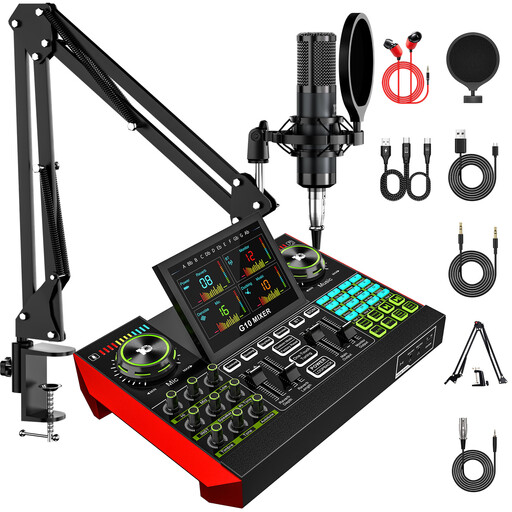
Yinkaer G10-P15-XB microphone set with audio mixer
This could be worth considering if you’re looking for a microphone and audio mixer as a set for your recording space.
The product name lists a 3.5 mm condenser microphone and a boom arm stand. Check in advance that the mixer’s connections will work with your computer or existing setup.
Joybuy
Frequently asked questions
How do I set up a microphone for a short solo bulletin?
Point the speaking side towards your mouth, set the level and listen to a test recording with the usual desk noise before you start. For the PodMic USB, RØDE recommends a model-specific distance of around 5–10 cm. Don’t assume this measurement will be right for other models.
Is an XLR microphone alone enough to record on a computer?
With an XLR-only model such as the RØDE PodMic, the microphone and connection alone aren’t enough. According to RØDE, you’ll need an XLR cable and an audio interface to connect it to a computer. With a USB/XLR hybrid, you can use the USB connection instead; features may vary depending on which connection you choose.
What should I check is included with a microphone?
Check whether the stand, cables and, if needed, an interface are included for your planned setup. Sennheiser lists different items for the Profile with desk stand and the Streaming Set with arm, so it’s important to check the exact set name.
Can a microphone at a shared workplace record other people’s conversations?
Under § 201 StGB, unauthorised recording of another person’s privately spoken words is a criminal offence. Recording employees also involves data protection requirements; the Federal Commissioner for Data Protection and Freedom of Information points out that consent in an employment relationship must be genuinely voluntary. Whether a particular recording is lawful depends on the circumstances; a directional microphone doesn’t remove the need to check.


