House sharers without their own oven
You need a freestanding appliance with a tray large enough for the chicken and vegetables you plan to cook, without taking up too much of the shared worktop.


If there’s already a suitable built-in oven in your shared kitchen, first check whether its tray can hold the amount you plan to cook. A countertop oven will still need space of its own. If there isn’t a suitable oven and you can safely set up a countertop model, base your choice on usable tray area, cooking functions and how easy it is to clean—not just capacity in litres or wattage. For raw chicken, the German Federal Institute for Risk Assessment recommends a core temperature of at least 70 °C for at least two minutes, whatever type of oven you use.
You need a freestanding appliance with a tray large enough for the chicken and vegetables you plan to cook, without taking up too much of the shared worktop.
You can use an existing oven or have a say in choosing one for a permanent kitchen setup. The key considerations are whether the tray fits, how much space is available for installation and whether the oven is practical to clean as part of your shared routine.
You tend to make smaller traybakes, so you’ll need to weigh up how much worktop space you’re willing to give up for a compact oven or extra cooking functions.
For a traybake in a shared kitchen, make sure the tray, the space where you’ll put the oven and your cleaning routine all work with the appliance.
| What matters | What to look for | Who should consider it? |
|---|---|---|
| Usable tray area | Compare the oven’s internal dimensions and the supplied tray’s measurements with the tray you plan to use; check the shelf positions too. | If you want to cook chicken and vegetables together on one tray, the usable area matters more than the oven’s capacity in litres. Around 36 % of consumers say getting the right tray area is their top priority. |
| Space for the oven | Check the appliance’s external dimensions against the available space. For a built-in model, check the installation dimensions and connection requirements. | If you share the worktop or don’t have a suitable space for a built-in oven, the appliance needs to fit somewhere appropriate. Around 29 % of consumers say finding space for the oven is their top concern. |
| Cleaning and hygiene | Check which parts can be removed and read the care instructions. Plan to use separate utensils and clean thoroughly after handling raw poultry. | If several people share the kitchen and appliance, you’ll want to be able to remove residue easily and handle poultry hygienically. Around 21 % of consumers put cleaning and hygiene first. |
| Energy consumption | Only compare consumption figures when they use the same measurement basis and cooking mode; don’t treat watts as equivalent to kWh per cooking cycle. | If you want to compare energy use when choosing an oven, look for figures per standardised cooking cycle. Around 14 % of consumers say energy consumption is their top priority. |
The oven’s capacity alone won’t tell you whether your tray will fit. Internal and external dimensions vary between models.
Measure the tray you plan to use and compare it with the internal dimensions and the accessories supplied with the specific model.
The scope described by the European Commission does not automatically cover small and portable ovens. If a model doesn’t have a label, you’ll need to check its appliance category before drawing conclusions.
Check the appliance category and only compare consumption figures when the measurement basis and cooking mode are the same.
An oven function doesn’t replace cleaning your hands, utensils and surfaces after they’ve come into contact with raw poultry. According to Bosch, the cleaning assistant on the HBA3140B4 is intended for light soiling.
Keep raw poultry separate from ready-to-eat food, clean any surfaces it touches thoroughly and follow the oven’s care instructions too.
These models differ in design and features. Whether an appliance suits your traybake also depends on its exact internal dimensions and where you plan to put it.
The BG 1805/E is a freestanding compact oven designed for larger portions.
The HBA3140B4 is a built-in option if you have a suitable cabinet space.
The 42815 combines a mini oven with additional cooking functions.
The TO 2068 is a baking and toast oven with fan-assisted cooking.
The KB M19 is a compact oven for smaller portions.
This selection includes built-in ovens for kitchens with suitable installation space, as well as compact countertop models. For each one, check that the space available and the tray you plan to use are a good fit.
 No image available
Built-in appliance for a kitchen with a suitable installation space.
71 l, 3D hot air, pyrolytic self-cleaning, AutoPilot 10 and LED touch controls; black.
 No image available
Built-in appliance for a kitchen with suitable installation space.
70 l, 3 kW, Rotating Heat, grill, pizza function, AquaClean steam cleaning, LED display with timer and ECO mode; energy class A.
 No image available
Built-in appliance for a kitchen with suitable cabinet space.
60 cm wide, pyrolytic cleaning, AirFry and 3D hot air; stainless steel.
 No image available
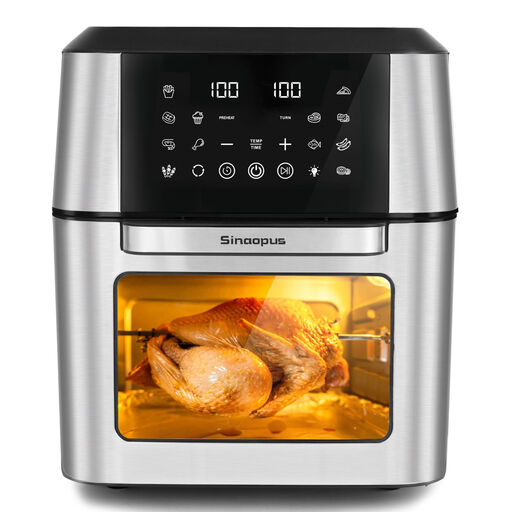
Compact combination appliance with baking and roasting functions.
12 l, 1,800 W, touchscreen, timer and 12 programmes; accessories are listed in the product title.
 No image available
Countertop appliance for a kitchen where you don’t want to install a built-in oven.
32 l, 1,600 W, timer, crumb tray and temperature range from 100 to 250 °C; for baking and grilling.
The German Federal Institute for Risk Assessment recommends a core temperature of at least 70 °C for at least two minutes. Check the temperature at the centre of the meat, as the oven setting won’t confirm that it has reached this temperature. Keep raw poultry separate from ready-to-eat food, and clean any surfaces and utensils it touches thoroughly.
Compare the appliance’s external dimensions and connection requirements with the instructions for the specific model, and check that you have a suitable place for it. Also make sure it can stay on the shared worktop permanently if that’s where you plan to put it. Internal capacity and external dimensions answer different questions.
For appliances covered by the EU oven energy label, you can compare kWh per standardised cooking cycle and cooking mode. The European Commission lists small and portable ovens as outside the scope described, so don’t assume every countertop oven will have the same label. Wattage measures power, not the energy used to cook your recipe.