Curry cooks with limited space in a shared flat
If you need to put the hob away after your meal, its dimensions and a suitable, level surface are important. Also follow the set-up instructions and consider the shared power supply.


A portable single induction hob is enough for potato curry, provided your existing pan has an induction-compatible base and fits the hob. If you want to keep using your current pan, you could consider a cast-iron hob or an electrically heated ceramic-glass hob. A double hob is only worthwhile if you regularly need to heat two pans at once and have enough space and a suitable electrical connection. TÜV SÜD explains the requirements for induction cookware, while the Institute for Loss Prevention and Loss Research documents a fire risk caused by an overloaded extension lead in a shared-flat kitchen.
If you need to put the hob away after your meal, its dimensions and a suitable, level surface are important. Also follow the set-up instructions and consider the shared power supply.
If you want to keep using your current pan, check its base and diameter against the requirements for the hob you’re considering. TÜV SÜD points out that induction requires ferromagnetic cookware.
If you want to heat your curry and a side dish at the same time, a double hob may be a good fit. It takes up more space, and the electrical connection must be suitable for the power rating of the specific appliance and the other appliances being used at the same time.
First, make sure the heating method is compatible with your existing pan. Then check whether one or two cooking zones, the controls for simmering and the electrical connection in your kitchen suit your everyday needs.
| Consideration | What to check before buying | Who is this particularly important for? |
|---|---|---|
| From bringing to the boil to simmering | Check the power settings and controls on the specific model. A timer does not mean the hob is suitable for cooking unattended. | If I want to simmer the curry on a lower heat after bringing it to the boil, I look for easy-to-use settings. Around 25% of consumers are likely to consider this type of control their top priority. |
| Keeping the pan I already own | Check the pan base and diameter against the requirements for the specific model. Induction requires a suitable ferromagnetic base. | If I don’t want to buy another curry pan, the heating method needs to work with the pan I already own. Around 20% of consumers are likely to have this as their main concern. |
| Space and electrical connection | Check the appliance dimensions, set-up instructions and rated power; take account of the actual electrical connection and circuit at your home. | In a shared kitchen, I want to set up the hob safely and avoid plugging it in with other appliances without checking first. Around 25% of consumers are likely to put space and the electrical connection first. |
| Two pans at once | Compare the number of cooking zones, appliance dimensions and total power. A second zone is only necessary if you actually want to heat two pans at the same time. | If I want to heat curry and a side dish at the same time, I need space for both pans and a suitable electrical connection. Around 15% of consumers are likely to prioritise cooking two dishes in parallel. |
| Cleaning and putting it away | Check the surface material, cleaning instructions and residual-heat warnings. Ceramic glass alone does not tell you how the hob heats up. | If I want to clear the shared kitchen space soon after eating, cleaning and cooling instructions matter. Around 15% of consumers are likely to prioritise tidying up. |
Ceramic glass describes the surface, not necessarily the heating technology. An induction hob and a hob with an electrically heated radiant element have different requirements for the pan.
Check the heating method in the technical specifications and make sure it is compatible with your pan base.
The rated power alone doesn’t tell you how easily you can adjust the heat when simmering. For curry, being able to control the heat after bringing it to the boil may be important.
Check the controls and power settings on the specific model, and adjust the heat as you cook.
The Institute for Loss Prevention and Loss Research documents a fire in a shared-flat kitchen caused by an overloaded extension lead. Having spare sockets does not mean there is enough electrical capacity for more appliances.
Check the electrical connection requirements and which appliances will be used at the same time. If you’re unsure, ask a qualified professional to assess the set-up.
Electrically heated cooking zones can stay hot after being switched off. An induction surface can also warm up from a hot pan.
Follow the cooling instructions, and don’t touch or clean the surface until it has cooled sufficiently.
With the Touch 2000, CASO Design offers a portable single induction hob with adjustable power settings.
Depending on the model, the range includes single and double induction hobs as well as a cast-iron hob.
Rommelsbacher offers the AK 1599/E cast-iron single hob and the CT 2203/TC ceramic-glass hob with a radiant heating element.
The EKI 3569 is a portable single induction hob with touch controls.
The PC-EKI 1062 is a portable single induction hob for use with a suitable pan.
The selection includes portable single cast-iron and induction hobs, as well as double induction hobs. Before buying, check that the heating method, pan and electrical connection are suitable for your shared kitchen.
 No image available
An option if you need a single cooking zone and variable temperature control.
Cast-iron hotplate with an 18 cm heating ring, 1,500 W and variable temperature control.
The hotplate gets very hot during use; allow it to cool completely before cleaning.
 No image available
A single induction hob for cooking curry, provided your pan has a suitable ferromagnetic base and fits within the stated size range.
Nine heat settings, an 8-hour timer and a 28 cm cooking surface; according to the product description, it is suitable for magnetic cookware with a diameter of 12–26 cm.
The stated dimensions are 35 × 28 × 4.4 cm and the weight is 1.9 kg.
 No image available
A double hob for when you want to heat curry and a side dish at the same time in two suitable pans.
Two cooking zones rated at 1,500 W and 1,000 W, with five temperature settings.
The stated dimensions are 48 × 23.5 × 7.5 cm. As an induction appliance, it requires suitable cookware with a ferromagnetic base.
 No image available
A compact single hob for one cooking zone, provided your pan is suitable for induction.
Five heat settings and a rotary control; the stated dimensions are 21.5 × 21.5 × 4.7 cm.
 No image available
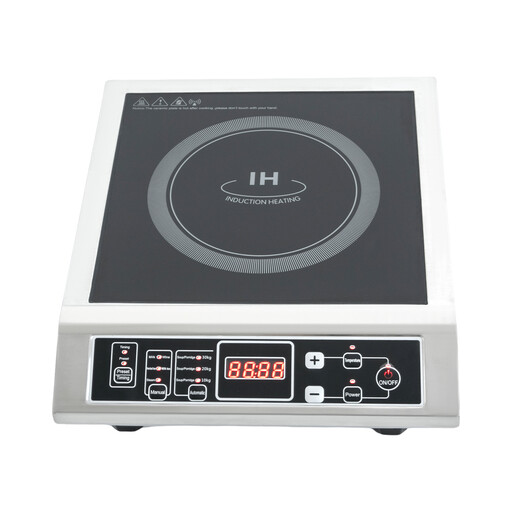
A portable single induction hob with adjustable power. Check that your pan and electrical connection are suitable before use.
The product description lists ten power settings, ten temperature settings and a timer.
At 3,500 W, you need to take account of the other appliances using the shared kitchen connection at the same time. A suitable ferromagnetic pan base is required.
The pan base must be ferromagnetic and fit within the hob’s size range. Check the information on your pan and the specifications for the specific model. For the CASO Touch 2000, the manufacturer lists a pan size range of 12–24 cm.
Wait until the cooking surface has cooled sufficiently and follow the appliance’s cleaning and cooling instructions. An induction surface can also warm up from a hot pan; according to the manufacturer, the electrically heated Rommelsbacher CT 2203/TC has a residual-heat indicator.
There’s no general answer without knowing the specific electrical connection. The Institute for Loss Prevention and Loss Research documents a fire in a shared-flat kitchen caused by an overloaded extension lead. Check the connection instructions and the power consumption of appliances being used at the same time. If in doubt, ask a qualified professional to assess the electrical set-up.
No. Your statutory rights for faulty goods apply against the seller, while a manufacturer’s guarantee is a voluntary additional promise with its own terms and conditions. According to the Verbraucherzentrale, the statutory warranty period for new goods is generally two years.
According to the Bundesnetzagentur, the manufacturer uses the CE marking to declare that the product complies with the relevant requirements. The mark alone does not prove that the product has been independently tested. Also check that the appliance can be identified, manufacturer details are provided and the German-language instructions include the necessary warnings.