Start by choosing a dishwasher based on how many cups and other dishes will build up before the next wash, then check the available space, design and connections. A 60 cm household dishwasher could suit you if you regularly have larger, well-filled loads; a 45 cm model is worth considering if space is tight. If you need several time-critical washes, a professional model may be a good fit – but according to Miele, the short cycle time of the Miele PFD 101 i depends on the connection conditions. Compare programme duration, noise and consumption for the specific model: the North Rhine-Westphalia Consumer Advice Centre lists Eco consumption and programme duration as separate buying criteria.
Which design could suit you?
For kitchens with lots of shared cups
If lots of cups and other dishes build up throughout the day, you’ll want to be able to make good use of each load. The German Environment Agency considers a 60 cm model efficient for households of two or more, provided it is always run with a full load.
For kitchens with limited space
If the available width determines your choice of appliance, you’ll need to weigh up a narrower design against the space available per load. According to Bosch, the Bosch SPS6EMI21E is 450 mm wide.
For kitchens with a tight washing schedule
If you need clean cups again before the next wash, programme duration matters. The North Rhine-Westphalia Consumer Advice Centre lists the Eco programme duration as a buying criterion; Miele’s short cycle time for the PFD 101 i applies only under the specified connection conditions.
Which buying criteria matter in a shared kitchen?
60 cm household dishwasher
A good fit if: you have lots of cups and other dishes, enough space for a wider appliance and can regularly fill a load efficiently.
Consider: the appliance needs more width, and Eco consumption figures don’t tell you how long other programmes take.
45 cm household dishwasher
A good fit if: space is limited or you only have a smaller load before the next wash. The German Environment Agency lists 45 cm as one of the standard appliance widths.
Consider: there’s less room for cups washed together, and basket layouts and cup racks vary by model.
Professional dishwasher
A good fit if: you genuinely need several time-critical washes and can check the operating conditions for short programmes. Miele offers the PFD 101 i for tea rooms and business kitchens.
Consider: the cycle time quoted by Miele depends on the model and connections. It doesn’t mean that every shared kitchen needs a professional dishwasher.
| What matters |
What to check before buying |
Who is it important to? |
| Number of cups and loading |
Place settings, the upper basket and cup racks on the specific model; arrange cups so they don’t get in one another’s way. |
When lots of cups and extra dishes build up after a shared break, I want to know how easily they’ll fit in a load. Around 40% of consumers say cup capacity is their most important buying consideration. |
| Space and connections |
Check the appliance and niche dimensions, whether it’s freestanding or integrated, the furniture door, and the water, drainage and electrical connections. |
When space is limited, the appliance needs to fit without losing sight of load capacity. For around 30% of consumers, the available space is the most important buying consideration. |
| Wash time and noise |
Compare the Eco programme duration and noise rating; check the cycle time and connection requirements of any quick programme separately. |
If cups need to be clean before they’re needed again, I care about how long the programme I’ll actually use takes. Around 20% of consumers prioritise having clean cups ready on time and the noise level while the appliance is running. |
| Electricity, water and care |
Compare electricity use per 100 Eco cycles and water use per Eco cycle, as shown on the EU energy label; check the programme duration and guidance on water hardness and dishwasher salt. |
If I use the dishwasher regularly, I want to compare consumption figures on the same programme basis and consider the care it needs. Around 10% of consumers make running costs and maintenance their most important buying consideration. |
Common buying misconceptions
-
Assuming the place-setting capacity tells you how many cups will fit
The stated capacity doesn’t tell you how many cups of a particular shape will fit in the upper basket.
Compare the loading diagrams, cup racks and upper basket of the specific model with the cups used in your kitchen.
-
Comparing Eco consumption figures with a quick programme
Energy label figures relate to the Eco programme. A short cycle time may apply to a different programme and depend on the connection conditions.
Check the duration and connection requirements of the programme you’ll actually use as part of your planned washing schedule.
A different programme that you use more often day to day may use more or less electricity and water than the Eco figures suggest.
-
Assuming freestanding and integrated models are interchangeable
These designs have different requirements when it comes to the niche, furniture door and installation.
Check the dimension drawing and what’s included against the space you have in mind and your existing kitchen fittings.
An integrated model may require extra coordination to ensure the furniture door and installation are a good fit.
Brands and model ranges to consider
Siemens
The freestanding 60 cm SN23EC03ME is a specific example of a model for larger shared loads.
- For the SN23EC03ME, Siemens lists an efficiency class of B, water consumption of 9.0 l per Eco cycle and a varioFlex basket; the appliance is 600 mm wide.
- These details apply to the SN23EC03ME, not to every Siemens dishwasher.
Bosch
The freestanding 45 cm SPS6EMI21E is an option if space is tight.
- Bosch lists a Vario-Flex Pro basket, water consumption of 8.7 l per Eco cycle and dimensions of 845 × 450 × 600 mm for this model.
- A narrower design doesn’t remove the need to check how many of your cups will fit in the basket.
Miele
Miele offers the integrated professional PFD 101 i for daily washes in tea rooms and business kitchens.
- According to Miele, the PFD 101 i washes 13 place settings in 17 minutes.
- Miele notes that different connection conditions can lead to longer programme times. The manufacturer’s figure is not an independent comparison test.
Beko
The freestanding 45 cm SGS0445PS is another slimline design to consider.
- Beko lists a capacity of 10 place settings and a half-load function for this model.
- The model is also listed as having an efficiency class of F, using 10.5 l per Eco cycle and producing 51 dB(A); these details don’t apply to the brand as a whole.
Joybuy models for small and narrow loads
This selection includes tabletop dishwashers for smaller loads and freestanding 45 cm models. The right design for you will depend mainly on the number of cups and the space available.
 No image available
AIRMSEN tabletop dishwasher with 5-l water tank
For smaller shared loads, if a tabletop model with a water tank could work for you.
The integrated water tank holds 5 l; the product listing specifies 9 wash programmes and energy class D.
A separately available adapter may be needed to connect it to a tap.
View at Joybuy
 No image available
Heinrich's HTG 8855 tabletop dishwasher
A tabletop option for small loads, whether you want to connect the appliance to a water supply or use it without one.
The product details list 3 place settings, 7 programmes, 56.3 dB and energy class C.
View at Joybuy
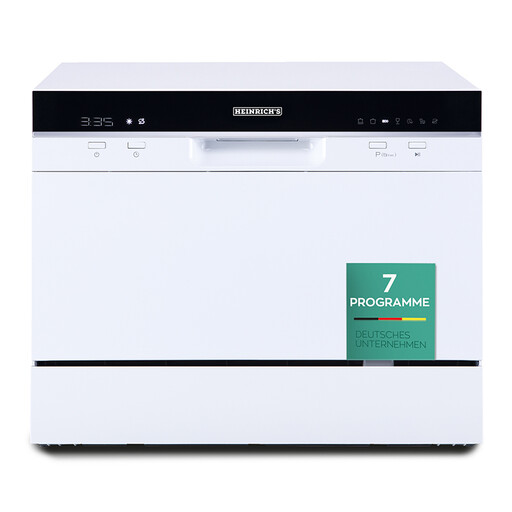 No image available
Heinrich's HTG 8840 tabletop dishwasher, white
For smaller loads, if you’re looking for a tabletop model with programmes for glassware.
The product details list 6 place settings, 7 programmes, a delay start of up to 24 hours, 47 dB and energy class D.
View at Joybuy
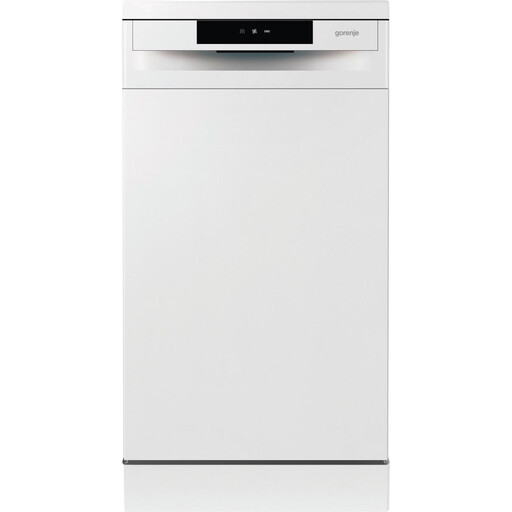 No image available
Gorenje GS520E15W freestanding dishwasher, 45 cm
A slimline freestanding model for kitchens where a tabletop appliance isn’t the right solution.
The product details list a width of 45 cm, 9 place settings and 5 programmes.
View at Joybuy
 No image available
Beko BDFS26040XQ freestanding slimline dishwasher
A slimline freestanding model to consider if its stated capacity suits your shared load.
The product details list a width of 45 cm, 10 place settings and energy class C.
View at Joybuy
Frequently asked questions
Does the glass-and-fork symbol on a cup mean it’s dishwasher-safe?
No, the symbol alone doesn’t confirm that a cup is dishwasher-safe. It indicates that the item is suitable for contact with food; for machine washing, follow the care instructions or the manufacturer’s guidance for the cup, as the Consumer Advice Centre explains.
Which dishwasher consumption figures can I compare directly?
For household dishwashers, compare the EU energy label figures on the same programme basis: electricity per 100 Eco cycles and water per Eco cycle. The European Commission also lists programme duration and noise; Eco figures can’t be applied to quick programmes unless separate figures are provided.
What should I check before installing an integrated dishwasher?
Check that the niche height and width, furniture door and plinth are suitable for the specific design. Also check the required connections and the installation instructions for the model you’ve chosen.
Can I skip dishwasher salt if I use dishwasher tablets?
Not in every case. The German Environment Agency points out that soft, low-limescale water is important for good washing results. Set the water softener and use salt according to the water hardness, detergent and appliance instructions.


