Listeners who want an easy shared experience
Several people want to play live albums without having to guide the tonearm manually each time. Denon and Sony describe the respective models mentioned as offering automatic start and return.


For listening to live albums in a shared living space, a fully automatic turntable is the better choice if several people want to play records without manually guiding the tonearm, and its outputs are compatible with your existing system. If you want to adjust the tracking force or anti-skating yourself, or change the cartridge, and are happy to do a little more manually, you could choose a manual model. An end lift alone does not provide automatic start-up. Audio-Technica recommends placing the turntable on a level surface, away from speakers, to account for vibration and sound pressure.
Several people want to play live albums without having to guide the tonearm manually each time. Denon and Sony describe the respective models mentioned as offering automatic start and return.
If you want to connect your turntable to existing speakers or an amplifier, check the phono and line inputs, and whether the turntable has a built-in preamp. Audio-Technica and Denon describe the respective models mentioned as having switchable phono preamps.
If you don’t mind a few extra steps, you can adjust settings such as tracking force and anti-skating yourself, and plan for a cartridge change later on. Audio-Technica and Dual list these options for the respective models mentioned.
First, work out who will operate the tonearm and which inputs your existing system has. The space available and how much adjustment you’re prepared to do will help narrow down your options.
| What matters | What to look for when buying | Who is this especially important for? |
|---|---|---|
| Ease of use | Check start-up, automatic return and a simple end lift separately. | If several people will be playing records, I want to start playback and return the tonearm without having to guide it manually. Around 33% of consumers put ease of use first. |
| Connecting to your system | Check that your system’s inputs match the model’s outputs, and set the phono/line switch correctly. | With an existing system, I want to be sure the inputs and outputs are compatible and the signal path is right. Around 27% of consumers prioritise having the right connection. |
| Positioning in your living space | Plan for a level surface with some space between the turntable and the speakers. | If the turntable is in a shared room, I need a level spot away from the speakers. Around 20% of consumers prioritise a position with minimal vibration. |
| Adjustability and cartridge changes | For the specific model, check whether it has a replaceable stylus, a replaceable cartridge or a removable headshell. | If I want to adjust the tracking force and anti-skating myself, or change the cartridge later, I’m happy to do a little more manually. Around 20% of consumers prioritise adjustability and upgrade options. |
The right signal path depends on the inputs your existing system has and whether its built-in preamp is switched on.
Before buying, compare the connections on the turntable and your system, and set any built-in phono preamp accordingly.
If the phono signal path isn’t right, you may need a separate phono preamp.
An end lift raises the tonearm at the end of a record, but it doesn’t start playback automatically. Technics describes the SL-1500C as having an end lift; Denon also lists automatic start and return for the DP-300F.
For the specific model, check separately whether it starts playback, lifts the tonearm at the end and returns it.
Audio-Technica notes that vibration and sound pressure can affect playback.
Plan for a level surface with some space between the turntable and the speakers.
You may need a separate spot for the turntable, which takes up space in a shared room.
The models mentioned cover both automatic operation and manual adjustment options.
The DP-300F is an option for shared listening, with automatic operation and a wired connection to your system.
The SL-1500C combines direct drive with built-in phono equalisation and a supplied cartridge.
The CS 518 is designed for people looking for a manual model with adjustment options and the flexibility to change the cartridge later.
According to Sony, the PS-LX310BT combines automatic playback with Bluetooth and phono/line connections.
Joybuy products for shared living spaces, including turntables.
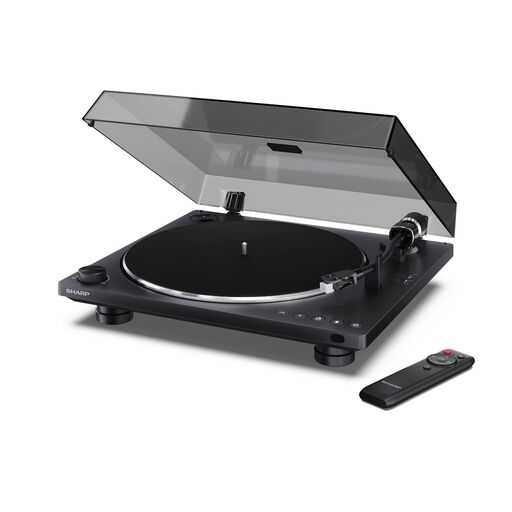 No image available
For shared listening when several people would rather not guide the tonearm manually.
Fully automatic; Bluetooth 5.4; USB-C recording function; Audio-Technica cartridge; dust cover.
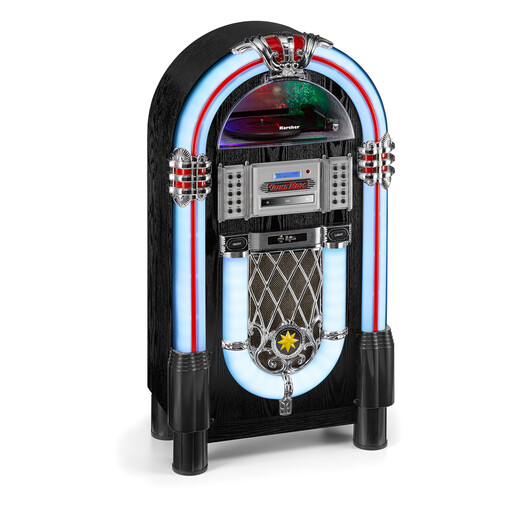 No image available
A jukebox with a turntable for rooms where you want to play CDs or stream audio over Bluetooth as well as listen to records.
CD player; Bluetooth audio streaming; FM and DAB+ radio; MP3 playback via USB or SD card.
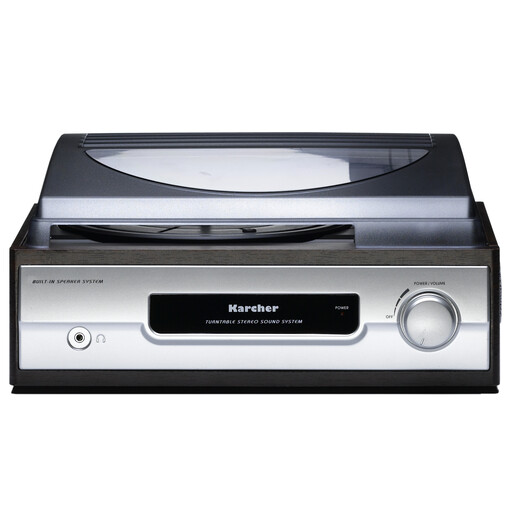 No image available
A playback option with built-in stereo speakers and a line output for an external sound system.
33/45 rpm; auto-stop function; headphone socket; line out.
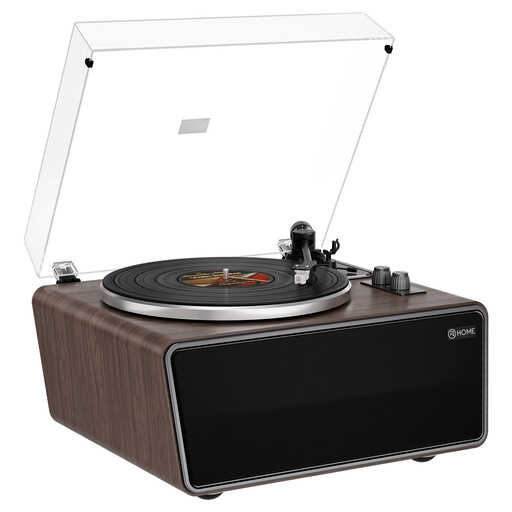 No image available
For listening together without a separate speaker system, with the option to connect to your existing system.
Four built-in speakers; phono preamp; AT-3600L (MM) cartridge.
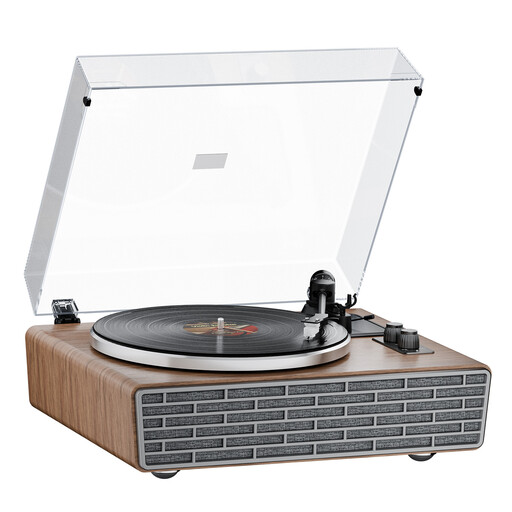 No image available
For listening together, with built-in speakers and Bluetooth as an additional connection option.
Belt drive; four built-in speakers; transparent dust cover; AT cartridge.
Yes, if the speakers have a suitable line input and the built-in preamp is set to Line. Audio-Technica describes this connection method for the AT-LP70XBT. For other models, check the outputs and inputs, and whether you need a separate phono preamp.
Place it on a level surface, not on or right next to the speakers. Audio-Technica cites vibration and sound pressure as reasons to do this, but does not specify a minimum distance.
No. The Technics SL-1500C is confirmed to lift the tonearm automatically at the end of a record; for the Denon DP-300F, the manufacturer also describes automatic start and return.