A team with changing users
When lots of people use the machine, straightforward controls and clearly assigned cleaning tasks are important. WMF lists user profiles for the Perfection 880L; according to WMF, the range is designed for home use.


For a shared office, a bean-to-cup machine with a clearly specified Doppio programme is an obvious option if lots of people need to make their own drinks. However, you’ll still need to check that the specific model is suitable for office use. A portafilter machine is better suited to a team where trained users can take care of grinding, dosing and cleaning. A capsule machine can be easy to use for occasional drinks, but ties you to a particular capsule system. You should also work out your actual daily demand, decide what you mean by ‘double’ and agree how cleaning and electrical safety checks will be organised.
When lots of people use the machine, straightforward controls and clearly assigned cleaning tasks are important. WMF lists user profiles for the Perfection 880L; according to WMF, the range is designed for home use.
A portafilter machine is an option if users want control over dosing and extraction, and are happy to share responsibility for the grinder, preparation and cleaning. Sage specifies a 54 mm portafilter and 18 g of coffee for the Bambino Plus.
A capsule machine can be a good fit for occasional, straightforward drinks, provided the team is happy to use a particular system. Nespresso states that the VERTUO Pop+ works exclusively with VERTUO capsules.
A good fit if: different people need to make drinks as independently as possible. WMF lists a Doppio programme and user profiles for the Perfection 880L.
Bear in mind: WMF describes the Perfection range as designed for home use, so you should check whether it can handle the demands of your particular office.
A good fit if: trained users want to prepare and adjust their espresso themselves. Sage specifies a 54 mm portafilter with 18 g of coffee for the Bambino Plus.
Bear in mind: grinding, dosing and cleaning involve extra steps; Sage describes the Bambino Plus as a machine for making coffee at home.
A good fit if: a small number of people prefer the convenience of an 80 ml serving. Nespresso lists a Double Espresso in this serving size for the VERTUO Pop+.
Bear in mind: according to Nespresso, the machine only works with VERTUO capsules. An 80 ml serving doesn’t automatically mean twice as much coffee or caffeine as its own 40 ml Espresso capsule.
| Buying consideration | What to check | Who is most affected? |
|---|---|---|
| What does ‘double’ mean? | Check whether the machine makes a Doppio for one cup or simply fills two separate cups. | I want to be sure the machine makes the double serving I’m looking for, rather than just filling two cups. Around 31% of consumers put this precise definition of the drink first. |
| Shared use and capacity | Estimate the number of drinks needed per working day and at peak times; check the controls, containers and the manufacturer’s recommended use. | When several people use the machine, easy operation and enough time to make drinks during breaks matter to me. Around 25% of consumers whose main concern is smooth shared use feel the same way. |
| Cleaning and safe use | Agree who will refill and clean the machine, and coordinate workplace safety checks with the people responsible. | I want the team’s cleaning routine to be reliable and electrical appliances to be used safely in the office. Around 25% of consumers give the highest priority to cleaning that’s easy to organise. |
| Ongoing costs and system compatibility | Compare consumables based on the expected number of servings, and check capsule compatibility carefully. | If I need to keep an eye on ongoing costs and the supply of consumables, I want to compare these commitments in advance. Around 19% of consumers see ongoing costs as their most important buying consideration. |
With Nespresso VERTUO, the Double Espresso capsule makes an 80 ml drink. Nespresso states that it contains neither twice as much ground coffee nor twice as much caffeine as its own 40 ml Espresso capsule.
First decide whether you’re looking for a larger drink or a particular dose and yield of coffee. Then compare the relevant feature on each system.
WMF lists a Doppio programme and user profiles for the Perfection 880L, but describes the Perfection range as designed for home use. NIVONA states that the NICR 1040 is designed to make up to 50 cups a day; the manufacturer’s website doesn’t confirm a dedicated Doppio programme.
For the specific model, check both that it offers the drink you want and that it’s designed to handle the demands of office use.
For regular use, you’ll also need to factor in capsules or beans, as well as the cleaning products required for the model.
Compare systems based on the same expected number of servings, and check which consumables and cleaning products you’ll actually need.
The Perfection 880L is a model with a clearly specified Doppio programme and user profiles.
The Bambino Plus is a portafilter option for teams who want to make their own espresso.
The VERTUO Pop+ with a compatible capsule is an option for convenient 80 ml drinks.
The NICR 1040 is an example from the manufacturer of a machine designed for heavier office use.
The Series 2200 EP2223/40 is an example of a bean-to-cup machine with an accessible brew group.
This selection includes bean-to-cup machines, a portafilter machine and a capsule machine. Models differ in the type of double serving they offer, so check the drinks menu for each one.
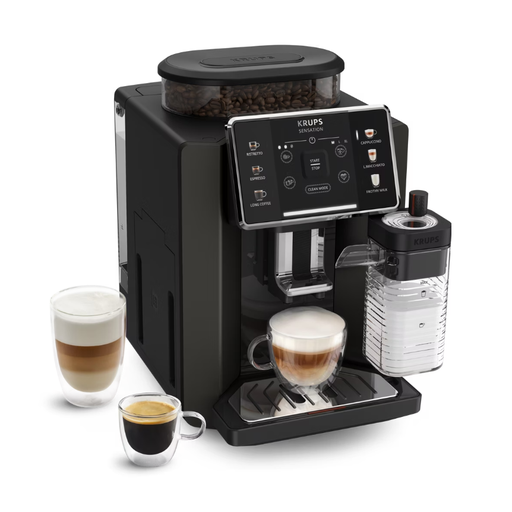 No product image available
Could suit a team looking for touch controls and a function that makes two cups at once.
The product description lists a touch control panel, a two-cup function, an automatic cleaning programme and a removable, dishwasher-safe milk container.
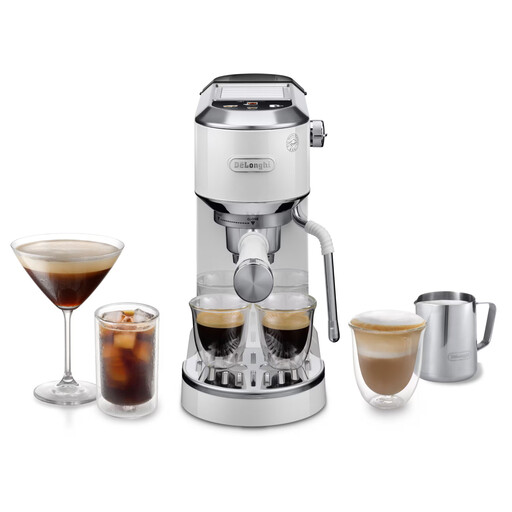 No product image available
Better suited to users who want to prepare their own drinks and use ground coffee in the portafilter.
The product description lists a Double Espresso option and a width of 15 cm. It doesn’t specify an integrated grinder, so ground coffee is placed in the portafilter.
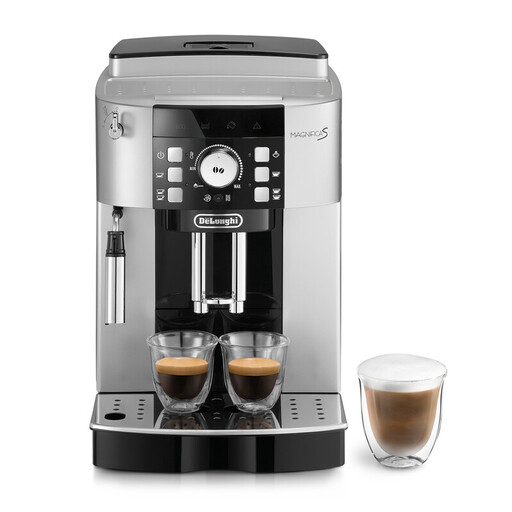 No product image available
Could suit shared use if you’re looking for direct selection buttons and a removable brew group.
The product description lists adjustable coffee and water volumes, direct selection buttons, a dial and a removable brew group.
 No product image available
If your team is looking for a clearly named Doppio option, the product description lists ‘doppio +’ as a direct selection.
It also lists a function for making two espressos at once, a control panel with direct selection, removable dishwasher-safe parts and an automatic milk system cleaning function.
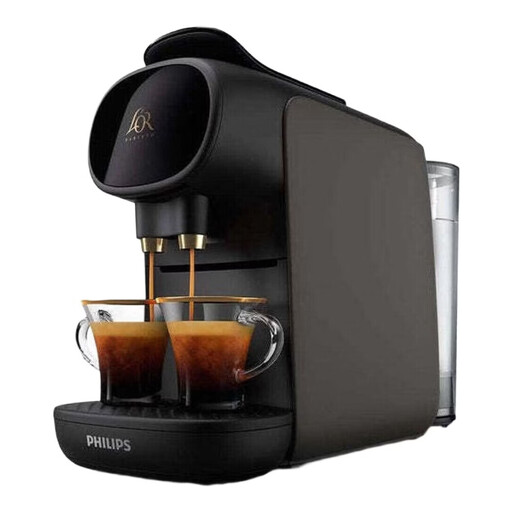 No product image available
Could suit occasional use if you’re looking for a capsule machine with a choice of Espresso and Double Espresso.
The product description lists one-touch buttons, a 1.0-litre water tank, and L’Or and other compatible capsules. Before buying, check which capsules are suitable for the drinks you want to make.
No. Two filled cups don’t automatically make one double serving in a single cup. Kaffeemacher describes a Doppio made with a portafilter in terms of a larger dose and yield of coffee, so check the specific drinks function on the machine. The weight of the drink in grams and its volume in millilitres aren’t directly comparable because of the crema.
Agree who will refill the machine, empty the containers and take care of cleaning, and follow the instructions for your chosen model. Philips describes the brew group on the EP2223/40 as removable; this feature can’t automatically be assumed to apply to other bean-to-cup machines.
Compare consumables based on the expected number of servings, and check capsule compatibility carefully if you’re considering a capsule machine. The Verbraucherzentrale distinguishes between statutory consumer rights and a voluntary guarantee. If a business is placing the order, check the specific contract and service terms that apply.
If employees are allowed to use their own coffee machines at work, the German Statutory Accident Insurance (DGUV) says these must also be tested regularly. The inspection interval depends on the appliance and the conditions in which it’s used; Section 14 of the German Ordinance on Industrial Safety and Health refers to the intervals determined under Section 3(6).