Anyone storing clothes in a cool shared room
If the room is repeatedly damp, your choice shouldn’t depend on the size of the wardrobe alone. Trotec describes desiccant dehumidifiers as a possible solution for lower room temperatures.


When storing clothes in a shared room, your choice depends on whether the damp affects the cool room or mainly the clothes storage area. If the room is repeatedly damp, a suitably sized electric desiccant dehumidifier may be an option; for a small storage area, a non-electric moisture absorber may be more suitable. Trotec also describes desiccant dehumidifiers as suitable for lower room temperatures, while UHU lists wardrobes as a place to use its absorber. Also consider noise, floor space, electricity use or refilling, and safe positioning. As the German Environment Agency points out, a dehumidifier does not identify or resolve the cause of structural damp.
If the room is repeatedly damp, your choice shouldn’t depend on the size of the wardrobe alone. Trotec describes desiccant dehumidifiers as a possible solution for lower room temperatures.
A non-electric absorber may be suitable for a wardrobe or cupboard, provided you check the collection container and refill material regularly. UHU lists wardrobes as a possible place to use its Original device.
Wet laundry and lots of people in the room can add to the moisture levels. The German Environment Agency recommends paying particular attention to regular ventilation when there are additional sources of moisture, such as wet laundry.
First, decide whether the damp affects the whole room or mainly the clothes storage area. Temperature, changes in moisture levels and ongoing maintenance all affect which solution is right for your shared room.
Suitable if: The damp affects more than just the wardrobe and repeatedly builds up in a cool or intermittently unheated room, with a suitable spot near a power socket available.
Consider: Electricity use, airflow, operating noise and emptying the tank are all part of using the device. Trotec notes that the amount of water collected depends on the surrounding conditions.
Suitable if: You mainly want to protect a small clothes storage area and would prefer a device with no cable or operating noise.
Consider: You’ll need to check the refill material and collected liquid. UHU warns that spills can cause stains and damage leather or metal.
Also consider if: The room is heated and you need to actively dehumidify the whole space. Trotec describes compressor dehumidifiers as a common choice for heated living spaces.
Consider: At low room temperatures, a compressor dehumidifier may remove less moisture. Check the specifications for the particular model under the conditions you’ll be using it in.
| What you need | What to check before buying | Who is it most relevant to? |
|---|---|---|
| Damp in a cool room | Measure the temperature, room size and changes in moisture levels; check the model specifications for these conditions. | If the room is cool and the damp keeps coming back, I want to consider the whole room rather than just the wardrobe. Around 33% of consumers prioritise dehumidifying a cool room. |
| Protecting clothes storage | Choose a stable spot away from delicate fabrics; check the collection container and make sure you have the right refills. | If clothes are stored directly in the wardrobe, I’d rather have a quiet, cable-free solution than treat the whole room. Around 27% of consumers focus on protecting a small storage area. |
| Additional sources of moisture | Monitor moisture levels at different times; take account of sources of moisture and ventilation options. | If laundry is drying in the shared room or lots of people gather there, I need to account for the extra moisture. Around 20% of consumers prioritise dealing with this additional moisture. |
| Ongoing maintenance | For an electric device, consider power consumption and running time; for an absorber, allow for refills and emptying. | If I’m weighing up electricity use against regular refilling, I want to bear in mind the work involved when sharing the device. Around 20% of consumers focus primarily on ongoing maintenance. |
The absorption capacity quoted for granules and the daily extraction rate of an electric dehumidifier measure different things. UHU gives an approximate water absorption figure for its granules, while Trotec lists a daily extraction rate for a specific model.
First, decide whether you want to treat the storage area or the whole room. Then compare only figures with clear test conditions and equivalent measurements.
Leaking liquid can cause stains; UHU also warns that it may damage leather and metal.
Place the container on a stable surface, away from and not directly above delicate fabrics. Check it regularly.
A dehumidifier won’t tell you why moisture levels are rising. The German Environment Agency recommends identifying and addressing the causes of excess moisture if mould is present.
Monitor moisture levels, check for possible sources of damp and ventilate regularly. Don’t rely on a dehumidifier alone to deal with visible mould.
Trotec offers electric desiccant dehumidifiers for cooler rooms. The manufacturer says the TTR 57 E is suitable for spaces up to 20 m² or 50 m³ and has a laundry-drying function.
Meaco offers electric desiccant models such as the DD8L Pro and DD8L Zambezi.
For the DNS65, De’Longhi lists a humidistat, tank control and a laundry-drying function.
UHU’s Original is a non-electric, refillable absorber, which the manufacturer lists for use in wardrobes, among other places.
Pro Breeze describes its non-electric, refillable Osmo absorber as suitable for use in wardrobes.
WENKO’s Cube and Drop are non-electric, refillable calcium chloride absorbers.
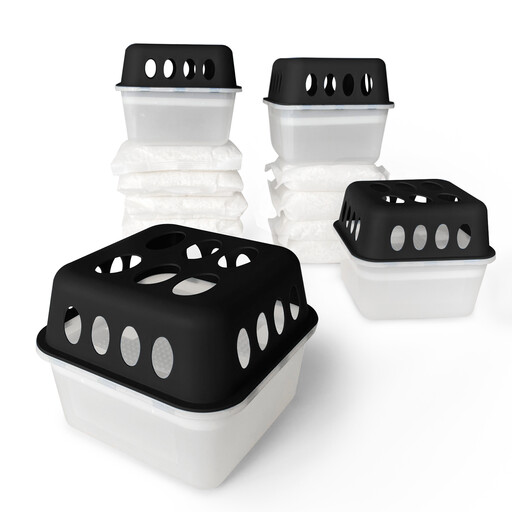
This selection features a non-electric, refillable moisture absorber for wardrobes and storage areas. It’s designed to protect clothes storage, not to electrically dehumidify the whole shared room.
 No image available
For clothes in a small storage area: the product description lists wardrobes and storage spaces as suitable places to use it.
Four reusable boxes and eight refill bags; described as working without electricity, batteries or cables.
Place the boxes on a stable surface and keep the granules and collected liquid away from children and pets.
The Verbraucherzentrale recommends a relative humidity of 40 to 60 % for a comfortable indoor climate at around 18 to 22 °C, and suggests using a thermo-hygrometer. Monitor levels near the clothes storage area too: a single reading elsewhere in the room won’t necessarily reflect conditions in cool or poorly ventilated spots.
Follow the instructions for the specific model. The Meaco DD8L Zambezi manual specifies a stable, level surface, protection from standing water and cable placement that won’t create a tripping hazard. For absorbers, UHU warns that spilled liquid can cause stains and damage.
No. The German Environment Agency recommends regular ventilation, especially when there are additional sources of moisture, such as wet laundry. If mould is present, the German Environment Agency says you need to identify and address the causes of excess moisture.
For an electric device, check its power consumption and expected running time. For an absorber, factor in the right refill material and regular emptying. UHU notes that the lifespan of its absorber depends on room size, temperature and humidity.