
Lieferung heute & morgen

Qualitätsgarantie

Willkommens-Angebote freischalten: KOSTENLOSE Lieferung | Bis zu 80 % RABATT | Kostenlose 30-Tage-JoyPlus-Testphase
App herunterladen
Finding a new shelf seems simple at first glance. But reality often looks different: what appeared stable online turns out to be a wobbly construction, the promised load capacity can barely hold more than a few paperbacks, or assembly becomes a true test of patience. As your Joybuy Product Recommendation Officer, I'm here to help you navigate these common pitfalls and make an informed decision that suits your living space and your needs.
We'll focus on the facts that truly matter, cutting through the marketing hype. Here are the most common problems and how to avoid them:
Before you decide on a model, you should check three crucial aspects. These will help you objectively evaluate a shelf's quality and suitability.
The material determines not only the look but, more importantly, the stability and lifespan of your shelf.
The choice of type depends on your available space and intended use.
Always check the manufacturer's specified maximum load capacity per shelf. A shelf for decorative items has different requirements than a bookcase that needs to hold heavy coffee table books. Measure the intended space accurately (width, height, depth) and plan for sufficient clearance from doors and windows.
Here are some recommendations tailored to different needs and living situations.
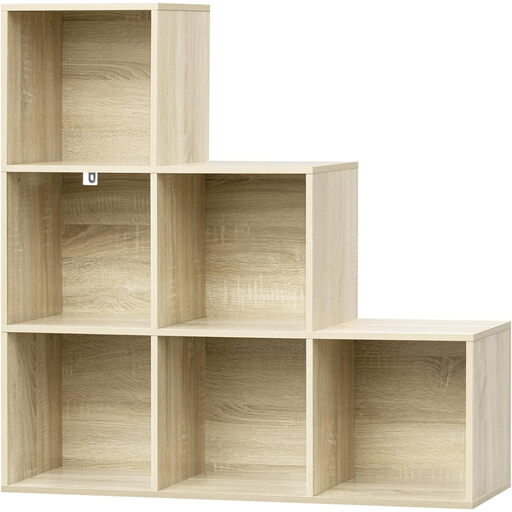
Why it's a great fit: Ideal for a first apartment or a student room. The stepped design is modern, and the six compartments offer flexible storage for books, binders, or decorative boxes. Its compact dimensions also fit well in smaller rooms.
The cube construction with continuous dividing walls provides greater inherent stability than simple shelves. The specified total load capacity of 60 kg is a clear and realistic figure for this price range.
The staircase design makes it versatile, for example, under a sloped ceiling or as a low room divider. The light oak finish is timeless and easy to coordinate with other furniture.
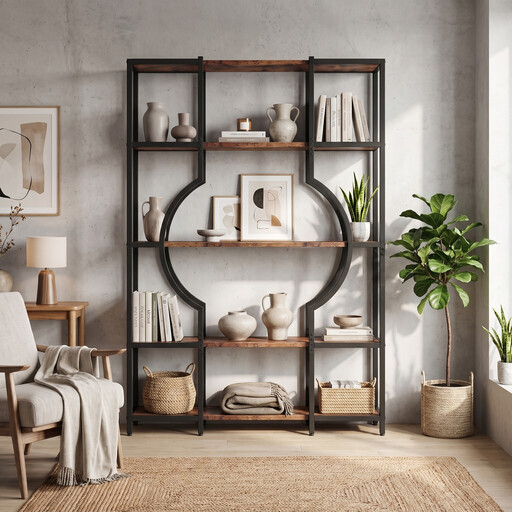
Why it's a great fit: For anyone looking for a piece of furniture with character. The combination of dark wood-effect and a black metal frame in an industrial style is a real eye-catcher. The curved silhouette sets it apart from standard shelves.
The sturdy metal frame provides significantly higher stability and load capacity (up to 113 kg) than pure engineered wood constructions, preventing wobbling and shelf sag.
The 12 asymmetrically arranged compartments offer versatile decoration possibilities. It's not just storage, but a true design element for the living room or home office.
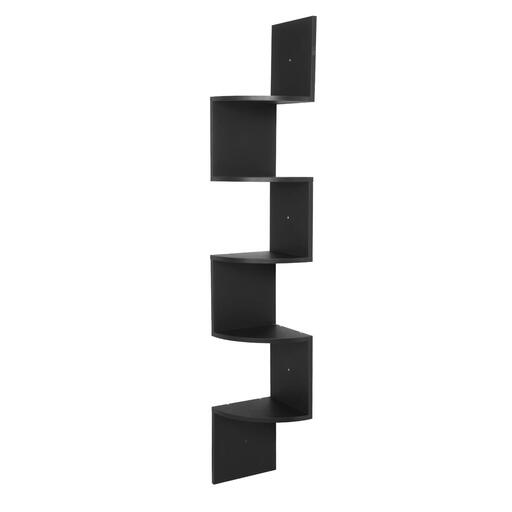
Why it's a great fit: This corner shelf is the solution for unused corners in hallways, bathrooms, or living rooms. It transforms "dead" space into practical and decorative storage without blocking valuable floor space.
The manufacturer clearly states that the shelf is not suitable for plasterboard/drywall. This transparency prevents installation errors and instability—a common problem with wall-mounted shelves.
The zig-zag design is not only visually appealing but also ensures a stable construction. With five tiers, it offers plenty of vertical storage in a minimal footprint for CDs, books, or plants.
We've compiled a complete, up-to-date list of products that fully meet these strict selection criteria and rigorous safety standards.
The load capacity varies greatly depending on the material, construction, and mounting method. Always check the manufacturer's specification for the maximum load capacity per shelf. Distribute the weight evenly and place heavier items on the lower shelves to increase stability.
The safety of a wall-mounted shelf depends on correct installation. First, identify your wall type (e.g., concrete, brick, drywall). Use the appropriate wall plugs and screws for your wall. A spirit level is essential to ensure the shelf hangs straight. Always follow the manufacturer's included assembly instructions.
Both are engineered wood products. MDF (Medium-Density Fibreboard) is pressed from finer wood fibres, making it denser, more uniform, and more stable. Particleboard is made from coarser wood chips, is lighter, and generally more cost-effective, but can break or sag more easily under load. The quality of the surface coating is crucial for the durability of both materials.