
Lieferung heute & morgen

Qualitätsgarantie

Willkommens-Angebote freischalten: KOSTENLOSE Lieferung | Bis zu 80 % RABATT | Kostenlose 30-Tage-JoyPlus-Testphase
App herunterladen
Clutter rarely happens because there isn’t enough space. More often, what’s missing is a suitable shelving system that takes into account ceiling height, load capacity and intended use. Whether it’s a heavy-duty rack for tools, a bookcase for the living room or a shoe rack for the hallway – shelving systems and storage racks differ significantly in material, weight capacity, assembly and safety features.
When buying, three typical pitfalls often lead to poor decisions:
For a cellar, garage, workshop or storage room, the maximum static load per shelf is crucial. A heavy-duty shelf with 130 kg per shelf is suitable for toolboxes, provisions or seasonal items. The weight should be distributed as evenly as possible. Point loads from heavy machinery or filled containers can put more strain on MDF or chipboard shelves than evenly distributed boxes.
With a shelf that has 5 levels, a stated total load capacity doesn’t automatically mean that each shelf can be loaded independently to its maximum. So always check both values: load capacity per shelf and maximum total load.
Measure the available width, depth and height, including skirting boards, radiator pipes and doors. A height-adjustable shelf is particularly practical if you need to store boxes, canisters or ring binders of different sizes. Stackable shelves with adjustable levels can often be adapted to suit the contents.
For small flats, hallways or cupboards, a space-saving shelf with a shallow depth can be a good idea. A narrow bookcase with 6 levels makes use of the room’s height without taking up much floor space. For shoes, however, you should check the width of each compartment to make sure larger sizes or boots will fit.
A metal shelf with a powder-coated steel frame is often the most practical choice for cellars and garages. MDF or chipboard shelves provide a flat storage surface, but should be protected from prolonged damp. For living spaces, appearance, edge finishing and the right depth also matter.
Look out for:
Tall shelves should be secured to the wall according to the assembly instructions. This is especially important in homes with children or pets. When assembling, it’s a good idea to wear work gloves, as metal edges or connecting parts can cause injury.
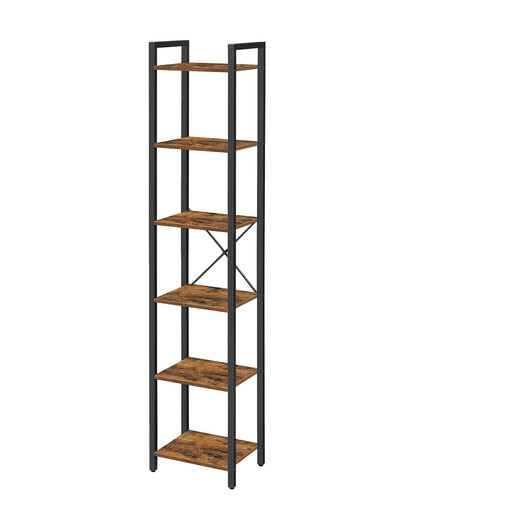
Why this product fits the profile: This narrow freestanding shelf at 30 × 40 × 187.5 cm is ideal for books, decoration and everyday items in small living spaces, studies or hallways.
The dimensions and maximum load of 50 kg are clearly stated. X-braces, adjustable feet and an anti-tip kit address typical stability issues.
Six shelves, a steel frame and chipboard shelves; suitable for vertical storage on a limited footprint.
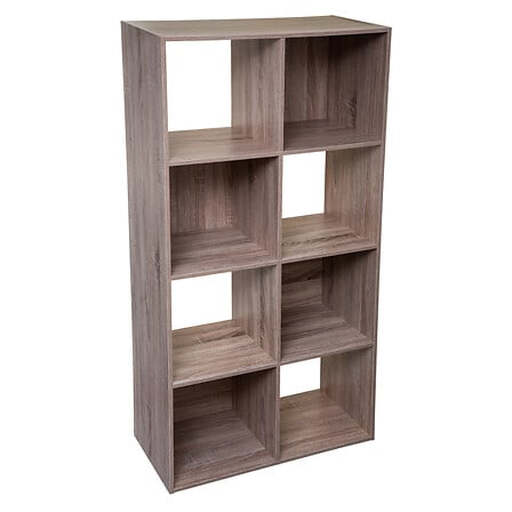
Why this product fits the profile: The eight open compartments combine storage with display and work well in living rooms, offices or studies.
The open construction makes the compartment layout visible, rather than describing storage space only through a general size specification. Before buying, you should compare the floor space with the stated product dimensions.
Eight compartments and a wood-effect finish for books, picture frames and decoration; the open design makes access easy.
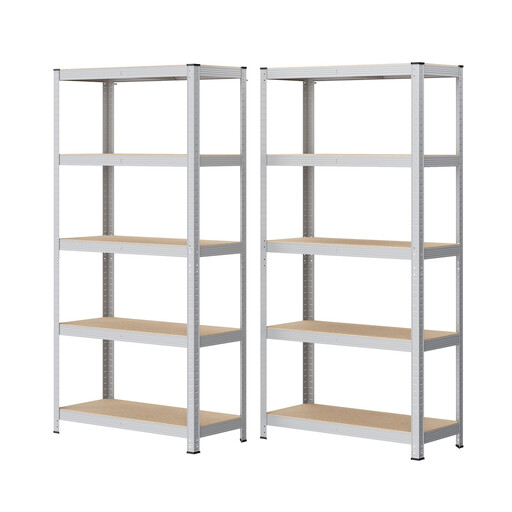
Why this product fits the profile: This two-piece cellar shelf is designed for garages, sheds, workshops or storage rooms and can be split into two separate units.
The load values are stated separately: 175 kg per shelf and 875 kg total. Height-adjustable shelves and anti-tip kits complete the construction.
Two units, five adjustable shelves per unit and a steel frame; suitable for extensive storage space.
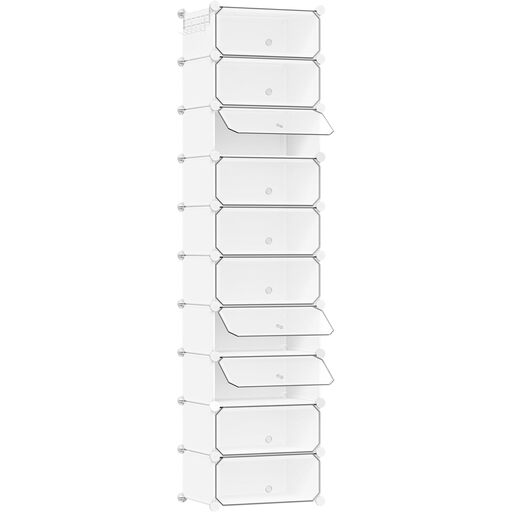
Why this product fits the profile: Ten closed compartments with doors are ideal for hallways, bedrooms or living areas where you want to store shoes in a dust-free, space-saving way.
The compartment size of 40 × 30 × 17 cm each makes the usable capacity clear. The modular system can be adapted to different floor spaces.
Ten compartments, doors and a depth of 30 cm; PP plastic panels and a metal frame are easy to clean.
We’ve put together a full, regularly updated list of products that fully meet these strict selection criteria and the safety regulations in force in the EU.
The floor should be as level and load-bearing as possible. Unevenness can be compensated for with adjustable feet, if provided. Tall or narrow models should be secured to the wall using the supplied anti-tip kit. The maximum load must be distributed evenly; heavy items should go on the lower shelves.
The lifespan depends on load, assembly, moisture and care. In dry indoor spaces, a powder-coated steel frame can be suitable for various storage purposes. In a damp cellar, make sure there is sufficient clearance from the floor, good ventilation and corrosion protection. MDF and chipboard shelves should not be exposed to permanent damp.
A stackable shelf can be suitable for heavy items if the stated load capacity per shelf and the assembly instructions are followed. What matters is not just the stacking connections, but also the frame, shelf material, braces and stability. For tools, provisions and machinery, you should compare the technical values of the specific model with the actual weight.