
Lieferung heute & morgen

Qualitätsgarantie

Willkommens-Angebote freischalten: KOSTENLOSE Lieferung | Bis zu 80 % RABATT | Kostenlose 30-Tage-JoyPlus-Testphase
App herunterladen
A shelving unit should provide storage, complement your interior and work reliably every day. However, product descriptions and attractive photos do not always lead to the right purchasing decision. It is often only after assembly that you discover the depth is insufficient for folders, the required floor space has been underestimated or an open shelving unit quickly looks untidy.
This buying guide will help you choose a freestanding shelving unit, bookcase, wall shelf or kitchen shelving unit based on clear, practical criteria.
The external dimensions alone are not enough. You should also check:
A tall shelving unit makes good use of the room’s height, but it must be positioned securely. In households with children or pets, an anti-tip device should be used if the manufacturer provides or requires one.
A shelving unit with open compartments is easy to access and suitable for books, plants or decorative items. However, everything is on display. For towels, cleaning products or smaller household items, a model with closed doors or baskets may be more practical.
Also pay attention to the size of each compartment. A shelving unit with lots of small squares may offer a clear structure, but it is not automatically suitable for lever-arch files, larger books or kitchen utensils.
‘Wood effect’ does not necessarily mean solid wood. Depending on the product, materials may include MDF, chipboard, plywood, solid wood, bamboo or metal. The specific material, board thickness, edge finish and permitted load are what really matter.
A wooden shelving unit or bamboo shelving unit can create a natural feel in your home. For kitchens and bathrooms, it is also important to know whether the surface is moisture-resistant and easy to clean. Direct contact with water should generally be avoided with wood-based materials unless they are specifically stated to be suitable.
Measure the available space with a tape measure. Take skirting boards and doors into account. Then compare:
The load capacity must always match how you intend to use the unit. Heavy books, files or crockery should preferably be stored on lower shelves. For a shelving unit for the living room and home office, check whether the compartment height is sufficient for books, lever-arch files and technical equipment.
Many materials are suitable for dry living spaces. A bamboo shelving unit, for example, complements natural interior design schemes and is easy to clean when it has a smooth surface. Metal frames with wood-based shelves can support an industrial style. In kitchens and bathrooms, wipe-clean surfaces and sufficient protection against moisture are important.
As a rule, use a soft, slightly damp cloth for cleaning. Standing water, aggressive cleaning products and prolonged exposure to direct sunlight can damage surfaces.
Before ordering, check whether the shelving unit is supplied for self-assembly and whether assembly instructions and fixing materials are included. Once assembled, all screws should be checked and the furniture aligned on a level surface.
Wall anchoring is particularly important for narrow, tall or asymmetrical models. A space-saving shelving unit must not become unstable simply because it has a small footprint.
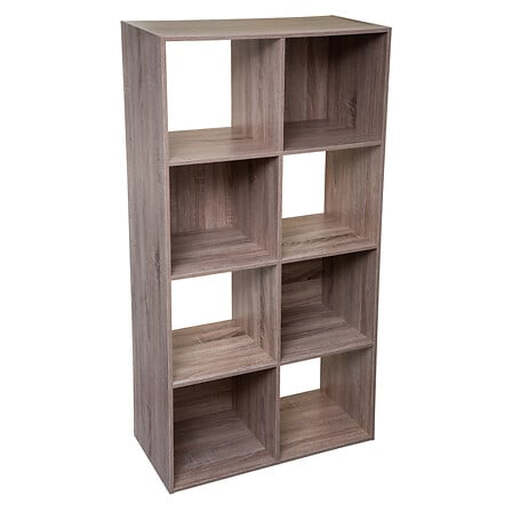
Why this product suits this profile: The eight open compartments provide a clear basic layout for books, photo frames and decorative items in the living room, bedroom or home office.
The number of compartments is clearly specified. This makes it easier to assess in advance whether the layout is suitable for your intended storage needs.
Naturally coordinated wood-effect surfaces and an open design; intended for self-assembly.
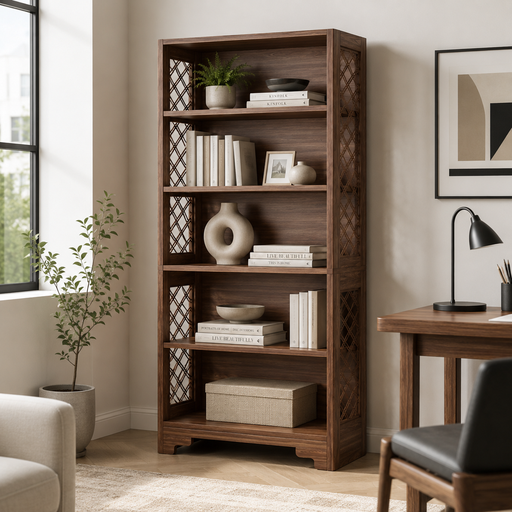
Why this product suits this profile: At 180 cm tall, this bookcase is designed for users who want to store lots of books, files or display items vertically.
The product specifications state six levels, a depth of 30 cm and a load capacity of up to 34 kg per shelf. These figures make it easier to plan how you will use the unit.
MDF construction, X-shaped side elements and six open levels; assembly accessories and instructions are specified.
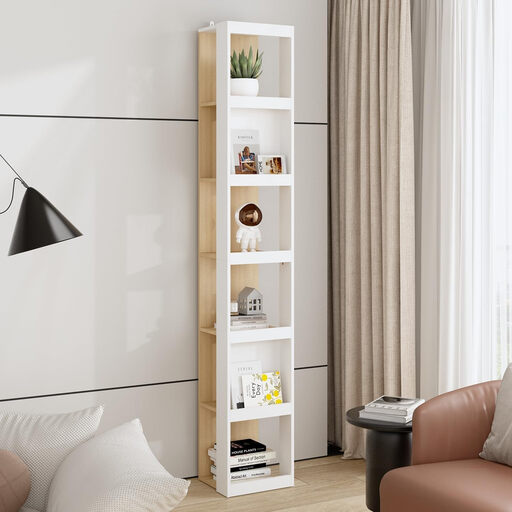
Why this product suits this profile: Standing 200 cm tall with a footprint of 33 × 30 cm, this storage unit makes efficient use of vertical space in the bathroom, kitchen, hallway or living room.
The compact footprint and six levels are clearly specified. Before buying, you should still check the ceiling height and the necessary anti-tip protection.
MDF body, six storage levels and a two-tone white and wood-effect design; described as suitable for several rooms.
We have put together a complete, regularly updated list of products that fully meet these strict selection criteria and the safety regulations applicable in the EU.
First place the shelving unit on a level surface and align it correctly. Then use the wall fixing provided by the manufacturer or a suitable anti-tip system. This is particularly important for narrow, tall models and in households with children or pets.
Its lifespan depends on the material, assembly, load, humidity and care. If the stated maximum load is observed and the shelving unit is protected from standing water, the structure and surface will generally remain functional for longer. Check the screw connections from time to time to make sure they are secure.
The price depends on factors including size, material, number of compartments, construction and features. Do not compare only the purchase price; also consider the assembly effort, any fixing materials required and the permitted load. An inexpensive shelving unit may be sufficient for light decorative items, while books, crockery or files place greater demands on it.