
Lieferung heute & morgen

Qualitätsgarantie

Willkommens-Angebote freischalten: KOSTENLOSE Lieferung | Bis zu 80 % RABATT | Kostenlose 30-Tage-JoyPlus-Testphase
App herunterladen
A shelving unit can quickly create additional storage space – provided its dimensions, load capacity and construction suit its intended use. There are clear differences between a heavy-duty shelving unit for the garage, a metal shelving unit for the workshop and a decorative bookcase for the living room. If you focus only on the price or the number of shelves, you may end up buying a piece of furniture that later feels unstable, does not fit into the available alcove or cannot safely support the items you intended to store.
A specification such as “600 kg load capacity” generally describes the maximum static total load under defined conditions. It does not automatically mean that each shelf can support this weight. The following factors are therefore crucial:
Heavy toolboxes should ideally be placed on the lower shelves. Point loads, such as those created by narrow metal parts or filled containers, can change the actual load situation.
Being able to assemble a shelving unit without tools can make installation easier. However, all connections must still be fully engaged and the shelves inserted correctly. A clip-together or interlocking system does not replace careful assembly. For tall shelving units, securing the unit to the wall with the supplied anti-tip kit is also part of safe use.
A 5-tier shelving unit or a 6-tier shelving unit does not automatically offer more usable space. You should also check the clear height between the shelves, as well as the width and depth. For folders, tool cases or storage boxes, a shelving unit with fewer but more widely spaced shelves may be more practical than a model divided into many closely spaced sections.
Steel constructions are often suitable for cellars, garages, sheds and workshops, as they can be designed to support heavier loads. However, a metal shelving unit with a powder-coated or galvanised steel frame is not automatically suitable for damp rooms. If the shelves are made from MDF or chipboard, avoid direct contact with water and follow the manufacturer’s guidance on the intended area of use.
Look for a clearly stated load capacity. A high-load-capacity shelving unit should also have a sturdy frame, durable connections and the option of being secured to the wall. The load capacity details in the following product recommendations are based on the respective product data and static loading.
Measure the available space, including skirting boards, doors, radiators and walkways. For a freestanding shelving unit, these dimensions are particularly important:
A narrow, tall shelving unit makes use of the room’s height but requires suitable wall fixing. For a garage or workshop, a wider storage shelving unit may be more practical if bulky boxes and equipment need to be stored.
Height-adjustable shelves allow you to adapt the unit to different items. Check the spacing increments at which the shelves can be repositioned and whether the construction can be adjusted without additional tools. A 5 cm spacing grid, for example, offers several positions for boxes, paint tins or tool cases.
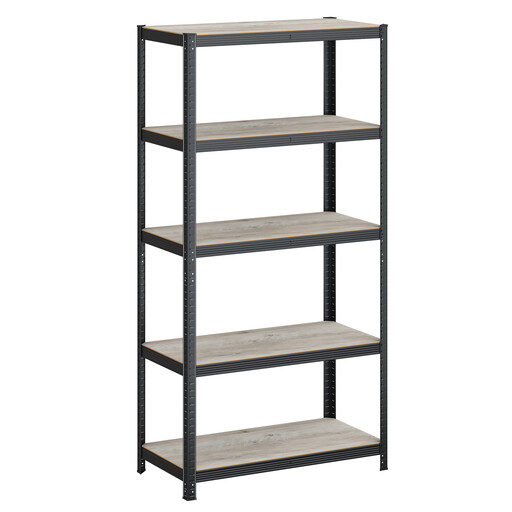
Why this product suits the profile: Measuring 50 × 100 × 200 cm, this metal shelving unit has five shelves and can be used in a cellar, garage or utility room.
The product data states 120 kg per shelf and a static total load capacity of 600 kg. The shelves can be adjusted in 5 cm increments, and an anti-tip kit is included.
Galvanised steel frame, tool-free clip-together system, can be divided into two units, and practical dimensions for larger storage boxes.
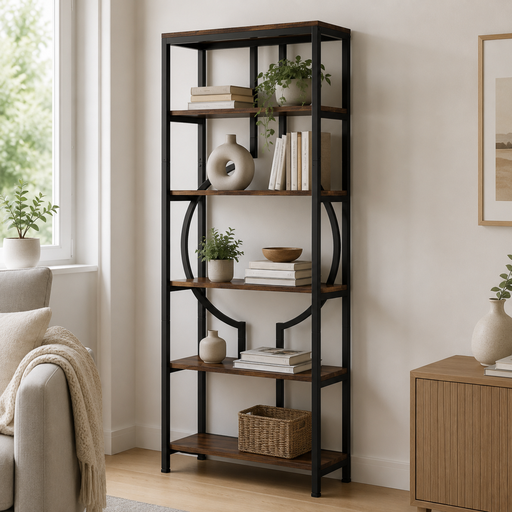
Why this product suits the profile: This bookcase combines six open shelves with a black-and-brown industrial design for the living room, bedroom, office or study.
The stated maximum total load capacity is 100 kg. The manufacturer recommends placing the unit on a level, stable surface and distributing the weight evenly.
Six shelves, 30 × 70 × 180 cm, scratch- and stain-resistant laminate surfaces, and a powder-coated metal frame.
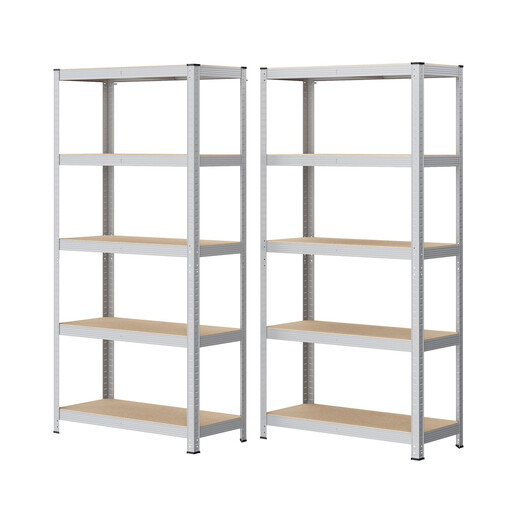
Why this product suits the profile: This two-piece set is suitable for users who need several storage zones, a workshop area or separate shelves for tools and seasonal items.
The product description states a static load capacity of 175 kg per shelf and 875 kg in total. The supplied anti-tip kits support the intended wall fixing.
Two separate units, height-adjustable shelves, steel frames with MDF shelves, and dimensions of 40 × 90 × 180 cm each according to the product details.
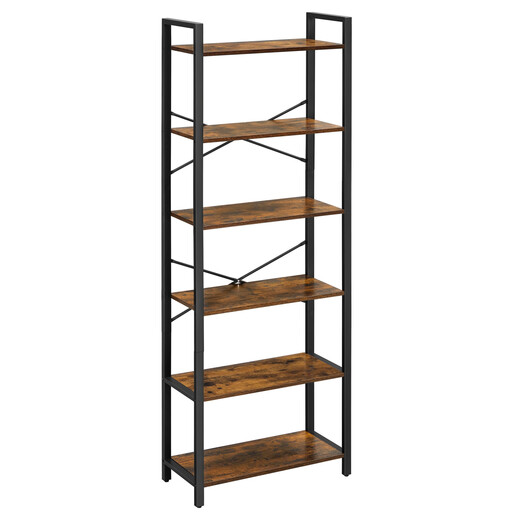
Why this product suits the profile: Measuring 30 × 66 × 186 cm, this slim freestanding shelving unit makes use of the room’s height and is suitable for books, decorations and smaller storage items.
The stated total load capacity is 60 kg. X-bracing, adjustable feet and an anti-tip kit help provide stability on suitable floors.
Six shelves, a steel and chipboard construction, adjustable feet, and assembly with labelled parts and instructions.
We have put together a complete, regularly updated list of products that fully meet these strict selection criteria and the safety regulations applicable in the EU.
A metal storage shelving unit should not be subjected to loads distributed unevenly on one side for extended periods. For a bookcase, it is also advisable to distribute books evenly across several shelves. MDF, laminate and chipboard surfaces should be cleaned dry and protected from standing moisture.
This depends on the construction, shelves, connection system and manufacturer’s specification. The stated maximum load capacity per shelf and static total load capacity are the decisive factors. Neither value must be exceeded. The load must be distributed evenly.
A tall cabinet or freestanding shelving unit should stand on a level surface and be secured to the wall using the supplied anti-tip kit. Use fixings suitable for the wall and floor. If you are unsure about the wall material or the location of cables and pipes, the installation should be checked by a qualified professional.
It is not possible to give a general answer about service life. It is influenced by factors including the load, assembly quality, moisture, corrosion and frequent repositioning. A shelving unit used within its stated load capacity, kept dry and regularly checked for loose connections will generally provide more reliable service conditions than an overloaded or unstable model.