
Lieferung heute & morgen

Qualitätsgarantie

Willkommens-Angebote freischalten: KOSTENLOSE Lieferung | Bis zu 80 % RABATT | Kostenlose 30-Tage-JoyPlus-Testphase
App herunterladen
A shelving unit can help keep things tidy, but the wrong choice can quickly prove impractical. Insufficient load capacity, unsuitable dimensions or an unstable fixing can make a piece of furniture difficult to use day to day. For narrow wall shelves, corner shelves and bathroom shelves in particular, it’s worth checking the technical details rather than relying on the product photo alone.
A shelving unit may look compact in photos but still get in the way of doors, taps or cupboard fronts. Before buying, check the width, height and depth, as well as the space needed for fitting and cleaning. For a corner shelf, it’s also important to make sure there’s enough clear space on both adjoining walls.
Compact models are usually well suited to worktops, washbasins and cupboard compartments. A freestanding shelving unit for the living room, on the other hand, also needs enough floor space and shouldn’t obstruct walkways.
“Multiple tiers” doesn’t automatically mean that every tier can hold heavy items. If you’re choosing a kitchen shelving unit for glasses, food storage containers or pans, check the maximum load per tier. Wherever possible, place heavy items at the bottom to keep the centre of gravity low.
If no maximum load is given, don’t plan to use the shelving unit for heavy food supplies or books. This also applies to wall-mounted shelves: their load capacity depends not only on the shelf itself, but also on the wall material, wall plugs and screws.
Bamboo, acacia, metal, MDF and plastic are suited to different uses. A bamboo shelf may work well in a bathroom, but it still needs regular care and should be kept dry. Avoid letting moisture sit on a wall shelf with an MDF finish. Metal is easy to care for, but in persistently damp areas it may corrode, depending on its coating.
Also check whether an FSC label is actually mentioned in the product details. It isn’t a general guarantee of quality; it relates to the origin of the material covered by the certification.
Start by making a note of what you want to store. Spice jars need only a small gap between tiers, while towels, books and food storage containers need more room. A shelving unit with multiple tiers makes good use of vertical space, but it shouldn’t be so tall that frequently used items are hard to reach.
For small flats or narrow hallways, a space-saving shelving unit with a shallow depth can be a good choice. A decorative shelf, on the other hand, should have enough room for pictures, plants or small accessories without looking cluttered.
Wall shelves need different fixings depending on the surface. Concrete, solid brick, plasterboard, tiles and wood don’t necessarily require the same wall plugs. For adhesive or suction-cup fittings, the surface must be smooth, clean, dry and free from grease. The manufacturer’s details should clearly state whether fixings are included.
Drill-free options may be useful in rented homes, but they aren’t suitable for every load or every wall. For heavy items, a mechanical fixing in a solid surface is generally the more reliable choice.
A kitchen shelf should be easy to wipe clean. In the bathroom, smooth surfaces and good air circulation are an advantage. Avoid leaving water on wood or bamboo. Also check that there’s enough space between tiers for your items and that dust won’t collect in hard-to-reach corners.
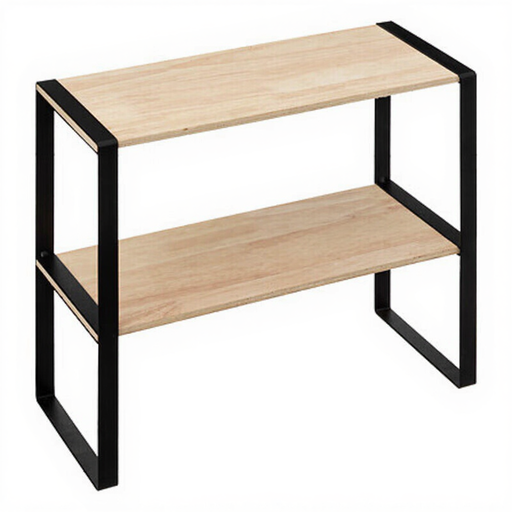
Why this product suits this shopper: This two-tier freestanding shelf is designed for the kitchen, bedroom, living room or home office, and doesn’t need to be mounted on a wall.
The product details specify two tiers, freestanding use and a maximum total load of 10 kg, with 5 kg per tier.
Compact footprint, two shelves and a stated total weight of 1.81 kg.
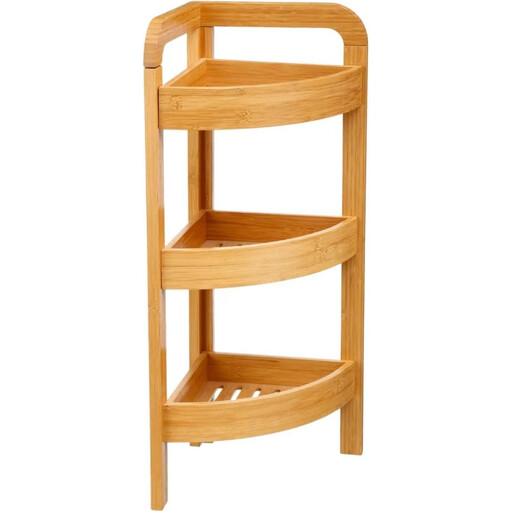
Why this product suits this shopper: This three-tier bamboo corner shelf is designed for bathrooms, showers and other narrow corners.
The product description lists three tiers, dimensions of 23 x 23 x 61 cm and a maximum load of 15 kg.
FSC information for the material, three shelves and self-assembly.
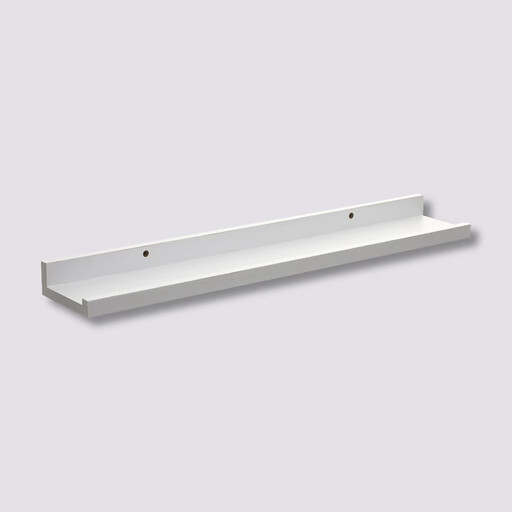
Why this product suits this shopper: This slim wall shelf is suitable for herbs, small kitchen utensils, pictures or decorations above a desk or work surface.
Its shallow depth of 10 cm means it takes up little room; the stated maximum load is 3 kg.
58 cm long, 10 cm deep, with FSC information in the product details.
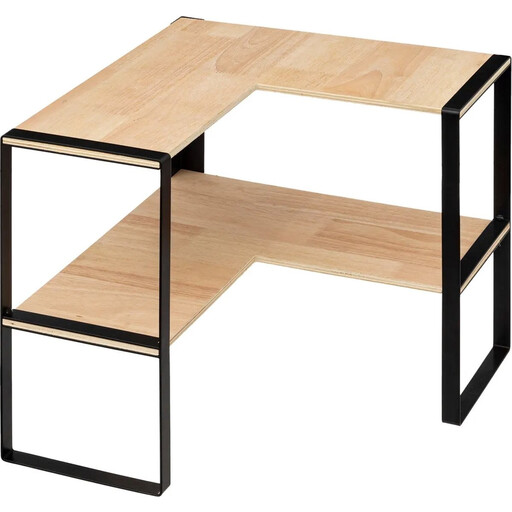
Why this product suits this shopper: This two-tier kitchen shelf makes use of a corner on the worktop, under the sink or inside a cupboard.
The product details list steel and plywood as materials, with two tiers for spices, containers or pans.
Corner design measuring 40 x 40 x 35 cm, versatile use and self-assembly.
We’ve put together a comprehensive, regularly updated list of products that meet these strict selection criteria and the applicable EU safety regulations.
It depends on the model, the tier, the fixing method and the wall surface. The manufacturer’s stated maximum load is the key guide. If no load is specified, avoid storing heavy books, glass containers or ceramic items on it.
Adhesive pads and suction cups may be suitable for lightweight items if the surface is smooth, clean and dry. For heavier loads or uneven walls, a suitable screw fixing is usually a better choice. Check the fittings regularly, even on drill-free products.
A slim bathroom shelf, corner shelf or small rack can make use of otherwise wasted space. Look for a shallow depth, enough clearance from water and materials suited to the intended use. A single tier is often enough for shampoo and soap; a multi-tier shelf may be more practical for households with several people.