
Lieferung heute & morgen

Qualitätsgarantie

Willkommens-Angebote freischalten: KOSTENLOSE Lieferung | Bis zu 80 % RABATT | Kostenlose 30-Tage-JoyPlus-Testphase
App herunterladen
A shelving unit should provide extra storage, stand securely and fit the space available. In practice, however, unsuitable purchases are often caused not by the price, but by unclear product information and an inaccurate assessment of where the unit will be used. For example, a delicate storage shelving unit for books is not automatically suitable for toolboxes. Conversely, a heavy-duty shelving unit can often be impractical in a small kitchen.
A specification such as ‘650 kg load capacity’ initially sounds clear. However, it is important to check whether this figure applies to the shelving unit as a whole or to a single shelf. It often refers to the maximum static load under specific conditions. Evenly distributed loads are not the same as a heavy object placed on a small area.
You should therefore check:
A shelving unit with a depth of 30 cm may fit in a narrow hallway but be too small for large storage boxes. Before buying, check the width, depth and height, as well as the usable internal height between the shelves. With a corner shelving unit, you should also measure the actual floor space available in the corner.
Don’t forget to account for:
A self-assembly shelving unit may use a clip-together system, a screw-fitted construction or a combination of both. Check whether tools are required, how many people the assembly is intended for and whether an anti-tip kit is included. Tall shelving units should be secured to the wall in accordance with the manufacturer’s instructions.
Compact solutions such as a kitchen shelving unit or a two-tier organiser are suitable for storing spices, pans and food containers in the kitchen. A shelving unit with storage boxes is practical in a child’s bedroom, bedroom or home office when you want to protect small items from dust while keeping them easy to access.
In the living room or hallway, a shelving unit with doors can create a tidier, more streamlined look. For cellars, garages and workshops, sturdy constructions with adjustable shelves are more suitable. A metal shelving unit or garage shelving unit can be adapted to accommodate different carton, tool and storage sizes.
The following points are important when choosing the material:
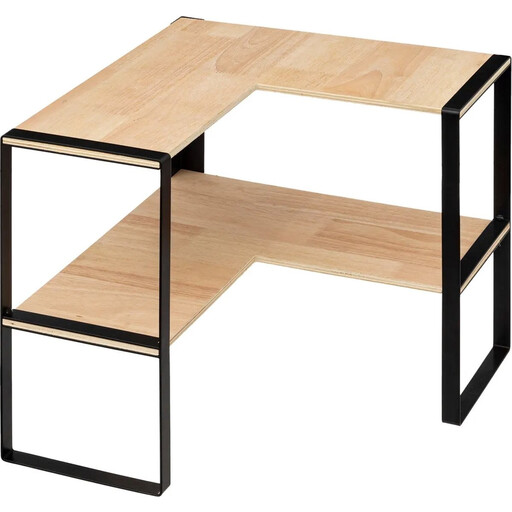
Why this product suits this profile: This compact corner model uses a floor area of 40 x 40 x 35 cm and is suitable for worktops, cupboards or the space beneath the sink.
The clearly stated external dimensions make it easier to check whether you have enough space. The construction is made from steel and plywood, and is intended for smaller kitchen and household items.
Two tiers, a product weight of 2.26 kg and self-assembly; suitable for spice jars, containers or pans.
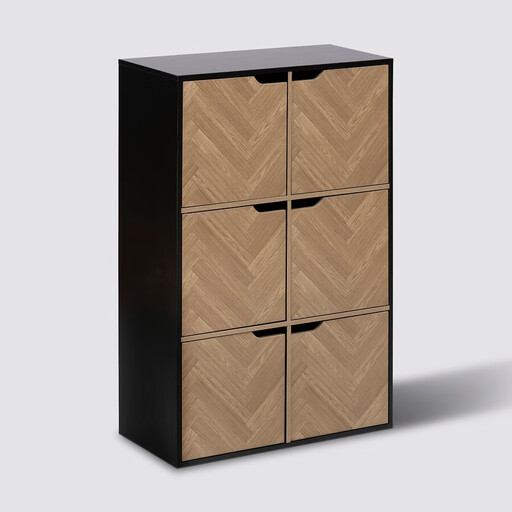
Why this product suits this profile: Six enclosed compartments combine organised storage with a neat furniture front for the living room, hallway, bedroom or home office.
The load capacity is specified as 5 kg per compartment. This helps prevent the enclosed compartments from being overloaded with items that are too heavy or unstable.
Measures 67.5 x 32 x 100.5 cm, has six doors and comes with anti-tip fixings; assembly is intended for two people.
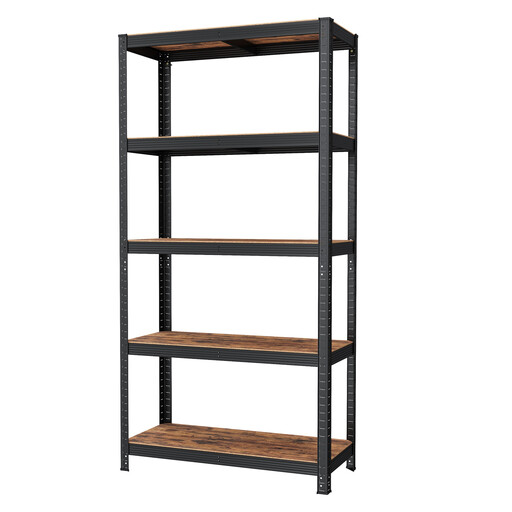
Why this product suits this profile: Five tiers and a stated total load capacity of 650 kg make it suitable for cellars, garages, pantries, storage areas or workshops.
The manufacturer’s specifications state both 130 kg per tier and 650 kg in total. The shelves are height-adjustable; the anti-tip kit should be used.
Steel frame, MDF shelves, 30 x 75 x 150 cm and a construction that can be divided into two units.
We have put together a complete, regularly updated list of products that fully meet these strict selection criteria and the safety regulations applicable in the EU.
Use the anti-tip kit supplied by the manufacturer or suitable wall plugs and screws for the type of wall. Concrete, solid brick, plasterboard and lightweight partition walls require different fixing solutions. The shelving unit should stand on a level surface and must not be used as a step or climbing aid.
Its lifespan depends on the material, load, moisture, assembly and use. A metal shelving unit in a dry indoor environment can remain usable for a long time when loaded correctly. In a garage or cellar, you should regularly check for rust, loose connections, bent shelves and swollen wooden-board panels.
The price depends on factors including size, material, number of compartments, load capacity and assembly system. A small kitchen or corner shelving unit requires considerably less material than a heavy-duty shelving unit for a workshop or storage area. Therefore, compare more than just the total price: also consider the usable floor area, load capacity per tier and what is included in the delivery.