
Lieferung heute & morgen

Qualitätsgarantie

Willkommens-Angebote freischalten: KOSTENLOSE Lieferung | Bis zu 80 % RABATT | Kostenlose 30-Tage-JoyPlus-Testphase
App herunterladen
A shelving unit can hold books, display decorative items or create order in the kitchen and home office. However, product photos and fully furnished room scenes can quickly lead to the wrong purchase. The key factors are not just colour and style, but also dimensions, load capacity, anti-tip protection and material.
A narrow shelving unit saves floor space, but it is not automatically suitable for books, files or larger kitchen containers. Many paperbacks fit within a depth of around 20 to 25 cm, while ring binders usually require more room. Before buying, measure your largest item and allow a little extra clearance.
A tall shelving unit can make excellent use of vertical storage space, but it requires a suitable ceiling height and secure wall anchoring. With a ceiling height of 2.40 m, a model around 1.80 m tall can remain easily accessible. You should also check whether skirting boards, radiators or power sockets restrict the available space.
The specified maximum load often refers to weight distributed evenly across the shelf. Heavy books or crockery should be placed on the lower levels. A freestanding shelving unit must stand on a level floor and, where its height requires it, be secured to the wall using the included anti-tip kit. Children should not climb onto the shelves or pull on the unit.
Start by noting the available floor space:
A shelving unit for the living room can be somewhat wider, while a narrow shelving unit is often more practical for a hallway or beside a desk. For a corner, consider a corner shelf or a vertical bamboo model.
Wood-based materials such as chipboard, MDF or veneered panels offer a wide range of colours and finishes. The surface should suit your intended use and be easy to clean with a dry or slightly damp cloth. In kitchens and bathrooms, protection against prolonged exposure to moisture is particularly important.
A wood-and-metal freestanding shelving unit typically combines a warm wood finish with a steel or iron frame. This works well with industrial, modern and rustic interiors. With an industrial shelving unit, pay attention to the construction of the cross-braces, adjustable feet and wall anchoring.
Compare the maximum load per shelf with the actual weight of the items you intend to store. A bookcase will carry considerably more weight than a display shelf holding lightweight pictures and plants. Also check:
In rented accommodation, check whether the planned wall fixing is permitted before drilling. The supplied wall plugs are not suitable for every type of wall.
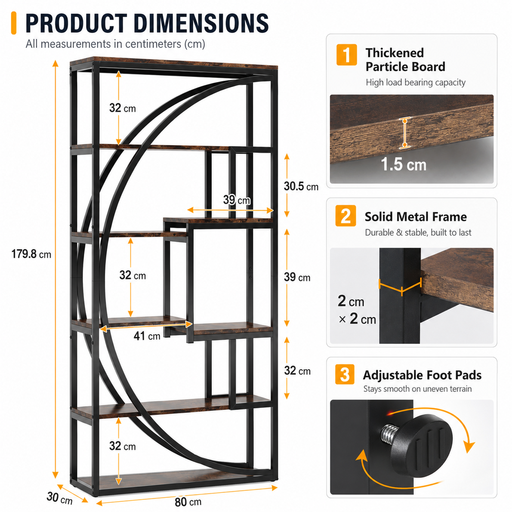
Why it works: Ideal for living rooms, bedrooms or home offices where vertical storage and an industrial look are desired. The unit measures 80 × 179.8 × 30 cm and offers five levels with eight open compartments.
At 30 cm deep, it offers more flexibility than very narrow models. Given its height, check and use the included fixing hardware according to the type of wall.
Chipboard with a vintage brown finish, a black metal frame, five levels and open compartments for books and decorative items.
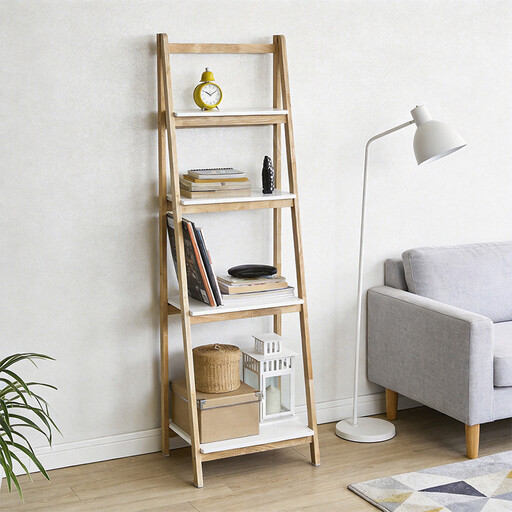
Why it works: This folding freestanding shelf is ideal for anyone looking for a flexible piece of furniture for books, towels, documents or plants. It measures approximately 42 × 140 × 34 cm.
The stated load capacity of up to 15 kg per shelf should not be exceeded. For permanently storing heavy files, a permanently assembled bookcase may be more suitable.
Rubberwood frame, four MDF shelves and a folding design for space-saving storage when not in use.
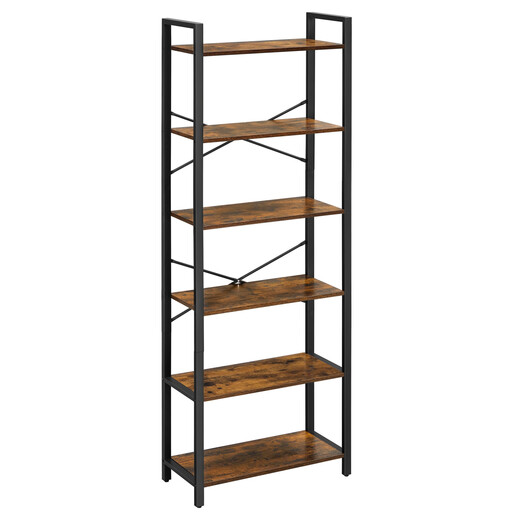
Why it works: Designed for home offices, studies or living rooms with plenty of books, files and decorative items. This tall shelving unit makes use of vertical space while remaining relatively compact at 30 cm deep.
The product specification states a maximum total static load of 60 kg. This is not a recommendation for concentrated overloading; heavy items belong on the lower levels. The anti-tip kit is intended for securing the unit to the wall.
Steel frame, chipboard shelves, six levels, adjustable feet and X-bracing for greater stability on suitable floors.
Discover a current selection of models designed to meet different requirements for dimensions, materials, storage capacity and safe use.
Place the shelving unit on a level, load-bearing floor and secure it to the wall using the designated anti-tip kit. Use wall plugs and screws suitable for the type of wall. Heavy items should be placed on the lower levels.
A depth of around 20 to 25 cm is sufficient for many books. Large coffee-table books and ring binders require more space. Measure your existing books before buying and compare the internal dimensions of the compartments rather than just the unit’s external measurements.
Remove dust with a dry cloth. For heavier soiling, you can use a slightly damp cloth unless the manufacturer specifies otherwise. Prolonged moisture, harsh cleaning products and intense direct sunlight can damage the surfaces.