
Lieferung heute & morgen

Qualitätsgarantie

Willkommens-Angebote freischalten: KOSTENLOSE Lieferung | Bis zu 80 % RABATT | Kostenlose 30-Tage-JoyPlus-Testphase
App herunterladen
A shelving unit should keep things organised, take up little floor space and suit the room. In practice, unclear measurements, missing load limits or unsuitable installation can quickly lead to a purchase you regret. This applies just as much to a tall living room shelving unit as to a bathroom, kitchen or children’s shelving unit.
Before you buy, it’s worth looking out for three common pitfalls:
Measure not only the available wall width, but also the height, depth and clearance in front of the shelving unit. A space-saving unit with a shallow depth suits narrow rooms, but offers less room for ring binders, crockery or larger storage boxes.
For books, the shelf height should suit the size of the books. In the bathroom, compact shelves are handy for towels, toiletries and toilet rolls. A kitchen shelving unit should be deep enough for jars of ingredients or cookbooks. For a living room or bedroom shelving unit, it’s also worth choosing a layout that can accommodate both decorative items and closed storage boxes.
MDF stands for medium-density fibreboard. It has a smooth, even surface and is often used for furniture with a painted or coated finish. When choosing an MDF shelving unit, check the finish on the edges, the quality of the coating and the stated maximum load.
A specific load limit is more useful than general claims such as ‘especially sturdy’. Where possible, place heavier items on lower shelves. Books, ceramics and jars of ingredients can add up to a considerable weight.
A freestanding shelving unit can be placed flexibly around the room, but needs a level surface. Tall models should be secured to the wall if the design allows for it. This is particularly important in homes with children.
A wall-mounted shelving unit saves floor space and can be fitted above a desk, chest of drawers or worktop. Before installation, check:
For a children’s shelving unit, low, easy-to-reach shelves and an anti-tip feature are sensible choices. For wall-mounted models, follow the manufacturer’s installation instructions in full.
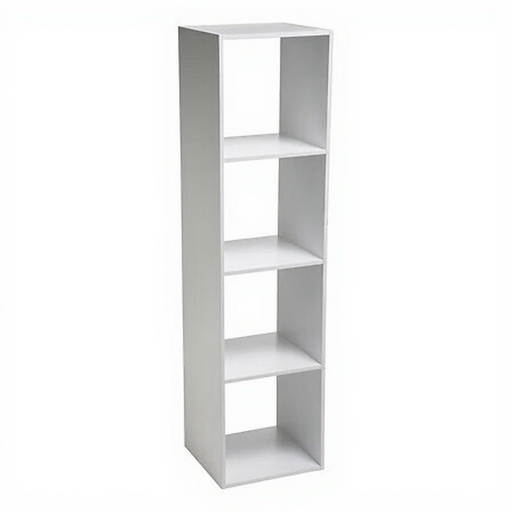
Why this product suits you: With four compartments and dimensions of 134 × 34,5 × 32 cm, this is a straightforward storage solution for a living room, bedroom or home office.
The precise external dimensions make it easier to plan where it will go. It’s designed as a freestanding piece of furniture, so there’s no need to mount it on the wall unless additional securing is required.
Four open compartments, a white finish, easy cleaning with a soft, damp cloth and an installation guide.
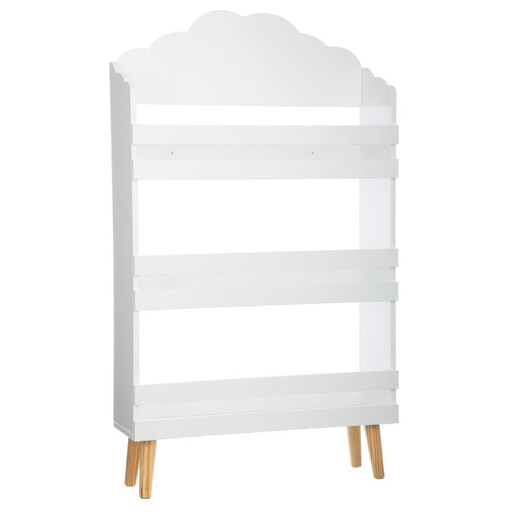
Why this product suits you: At just 100 cm tall, with three compartments, this bookcase is well suited to a child’s bedroom where children should be able to reach their books and games independently.
The stated maximum load of 15 kg, shelf height of 24 cm and raised front edges provide useful, specific guidance rather than purely decorative product details.
Three compartments, MDF components, a maximum load of 15 kg, FSC information and an assembly time of around 60 minutes according to the product details.
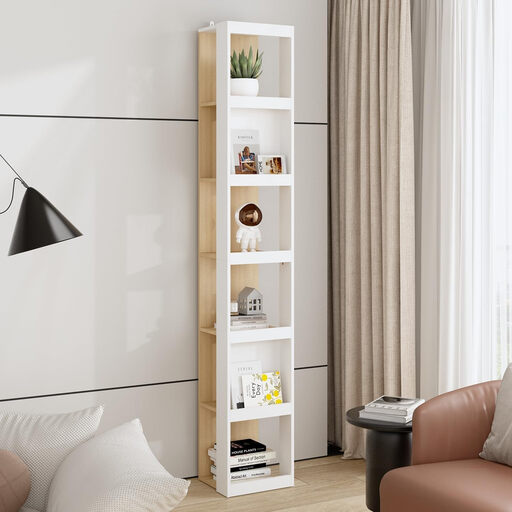
Why this product suits you: Standing 200 cm tall with a footprint of 33 × 30 cm, this tall shelving unit makes use of vertical space in the bathroom, kitchen, living room or bedroom.
The clear dimensions make its narrow footprint easy to assess. Before buying, check the ceiling height, whether it can be secured against tipping and how close it will be to doors.
Six tiers, an MDF construction, a white finish with wood-effect accents and versatile uses.
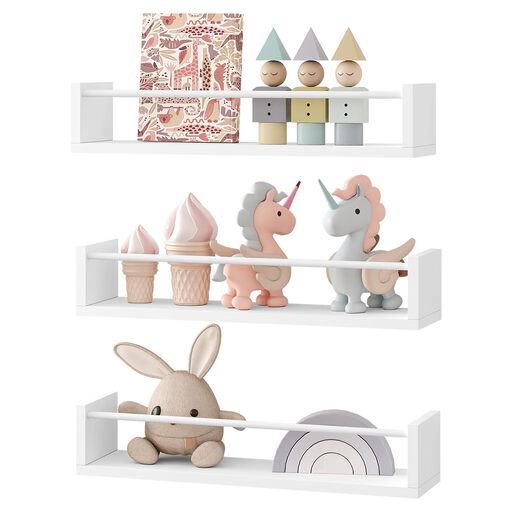
Why this product suits you: The three individual wall shelves, each measuring 40 × 12 × 10 cm, can be arranged horizontally, vertically or in corners.
The product details state a maximum load of 15 kg per shelf. The installation instructions specifically recommend fitting it to a solid, suitable wall.
E1 MDF with steel rods, front retaining rails, flexible arrangement and a compact depth of 12 cm.
For a freestanding shelving unit, all the feet should rest evenly on the floor. After assembly, check whether the unit moves from side to side. For a tall shelving unit, additional wall fixings are a sensible precaution if the manufacturer has provided for them.
Only load a wall-mounted shelving unit once you’ve checked the wall type, wall plug size and screw positions. The stated load capacity usually applies only when the unit is installed correctly. Avoid drilling into pipes or cables, and keep the recommended spacing between shelves.
A soft, slightly damp cloth is usually all you need for cleaning. Avoid leaving standing water on MDF, as moisture can damage its edges and surfaces. A bathroom shelving unit should therefore be kept out of areas exposed to splashes unless it is specifically designed for that purpose.
We’ve put together a complete, regularly updated list of products that meet these strict selection criteria and fully comply with the safety regulations in force in the EU.
A depth of around 20 to 30 cm is enough for many hardback books. Larger coffee-table books, ring binders or decorative items may need more space. The important thing is that the shelving unit doesn’t jut out into walkways or doorways.
A tall shelving unit should only be used in a child’s bedroom if it can be positioned securely and fixed against tipping. For younger children, a low children’s shelving unit with easy-to-reach shelves is usually more practical. Keep heavy items on the lower shelves.
The load capacity depends on the model, material, shelf and installation. Always follow the manufacturer’s guidance. Distribute the weight evenly and don’t exceed the stated limit. For a wall-mounted shelving unit, you’ll also need to take the strength of the wall fixings into account.