
Lieferung heute & morgen

Qualitätsgarantie

Willkommens-Angebote freischalten: KOSTENLOSE Lieferung | Bis zu 80 % RABATT | Kostenlose 30-Tage-JoyPlus-Testphase
App herunterladen
A shelving unit can keep books, kitchen utensils, towels and ornaments neatly organised. But choosing one doesn’t always lead to the right piece of furniture. Buyers often decide based only on colour and price, overlooking dimensions, weight capacity and how much assembly is involved.
This can cause familiar problems, particularly in small flats: a shelving unit that looks narrow may take up too much floor space, a tall model may not fit under the ceiling, or a wall shelf may need fixings that aren’t suitable for the wall. Terms such as “plenty of storage” don’t tell you much either if the shelf height and width aren’t right for the things you want to store.
A narrow shelving unit may take up little floor space, but you’ll still need to allow room for skirting boards, doors and access to sockets. With a tall shelving unit, check whether the ceiling height, sloping ceilings or light fittings will limit where you can place it.
At a minimum, check:
A 5-shelf unit or a unit with 6 shelves doesn’t automatically offer more usable space. Small shelves are suitable for toiletries, spices or ornaments, while books and household storage boxes need more room. So check not only the number of shelves, but also their usable internal dimensions.
MDF, chipboard, solid wood and metal differ in weight, care requirements and assembly. A bathroom shelving unit is regularly exposed to moisture and splashes. In the kitchen, easy-to-clean surfaces may be important. A wall shelf or corner shelving unit also needs suitable wall fixings.
For a freestanding model, the assembly instructions should include guidance on anti-tip fixings. Store heavy items on lower shelves wherever possible. You can only assess the safe load for each shelf reliably if the manufacturer states it clearly.
Measure the space at several points, as walls aren’t always perfectly straight. In small rooms, a vertical piece of furniture can be a good choice: a shelving unit for small rooms makes use of the height without taking up much floor space. A corner model can make use of otherwise empty corners.
For example, the Caldion model has a 33 × 30 cm footprint and is 200 cm high. That makes it worth considering in rooms where vertical storage matters more than wide shelves. Before buying, check the available room height, allowing for the skirting board and clearance from the ceiling.
Choose a material that suits where you plan to use the unit:
A bathroom shelving unit shouldn’t be placed somewhere the shelves will be exposed to constant water. For a kitchen shelving unit, shelf height, ease of cleaning and distance from the hob or sink are especially important.
A freestanding shelving unit needs a level surface. Secure tall furniture against tipping in line with the manufacturer’s instructions, particularly in homes with children or pets. A bookcase loaded with heavy books will be under much more strain than a unit used for lightweight ornaments.
For a home office, an office shelving unit with shelves high enough for ring binders may be a good choice. If you only need to store a few things, you could choose a lower model that can also be used as a display surface or room divider. A living-room cabinet, by contrast, usually has enclosed compartments and protects its contents from dust better than open shelves.
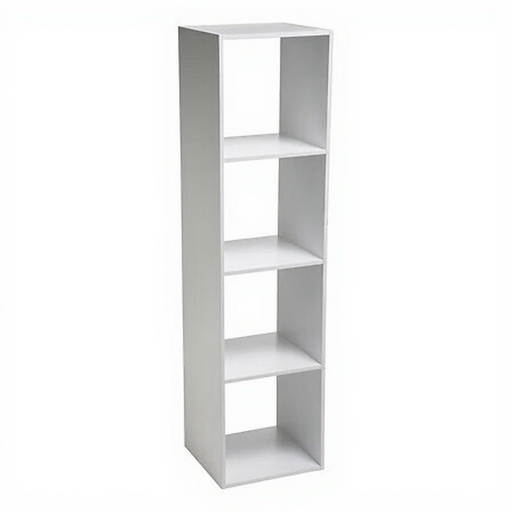
Why it suits this profile: Measuring 134 × 34.5 × 32 cm, with four open shelves, it offers a straightforward storage solution for the living room, bedroom or home office.
The clearly stated overall dimensions make it easier to check how much floor space you’ll need before buying. Its lower height also reduces the risk of the unit not fitting beneath ceilings or sloping ceilings.
Four shelves, a white finish, suitable for living and working spaces, and assembly described as easy in the product information.
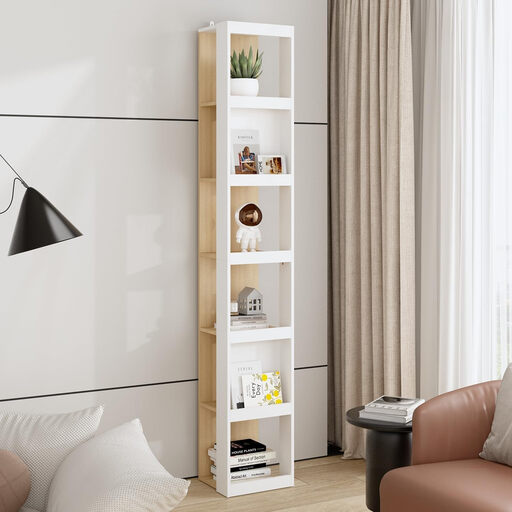
Why it suits this profile: This freestanding MDF model combines a white finish with wood-effect accents, making use of the room’s height with six shelves.
Its precise height of 200 cm and footprint of 33 × 30 cm make it easier to plan where it will go. Before use, check the room height, floor surface and anti-tip fixings.
Six shelves, a vertical design, an MDF construction and the versatility to use it as a bathroom shelving unit, kitchen shelving unit or bookcase.
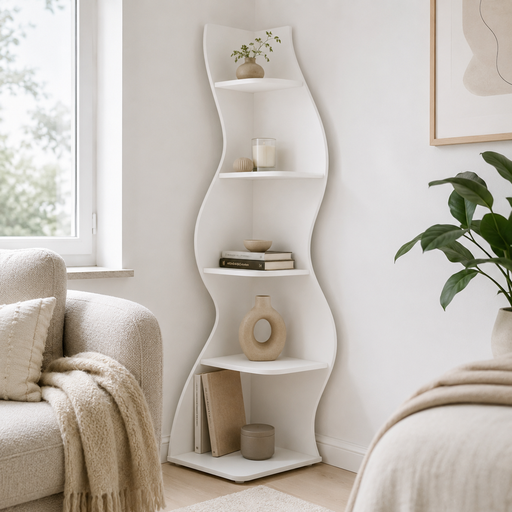
Why it suits this profile: This white corner shelving unit has five shelves and is designed for unused corners in the living room, home office or bedroom.
The corner design makes use of space that often goes unused with standard furniture. Before assembly, check the corner angle, distance from the walls and the recommended fixings.
Five shelves, a white finish, space-saving corner installation and shelves described as adjustable in the product information.
We’ve put together a comprehensive, regularly updated list of products that meet these strict selection criteria and fully comply with the safety regulations in force in the EU.
Before assembly, check all the parts against the instructions. A level floor makes it easier to position the unit correctly. For tall freestanding shelving units, we recommend using anti-tip fixings as specified by the manufacturer. Wall-mounted models need plugs and screws that are suitable for the type of wall. Concrete, brick, plasterboard and stud walls all require different types of fixings.
Place heavy books, crockery or supplies on the lower shelves. Lighter ornaments can go on the upper shelves. In the bathroom, use coasters or wipe away splashes promptly. This helps protect the surface from unnecessary moisture.
For many paperbacks, a depth of around 20 to 25 cm is enough. Larger coffee-table books, ring binders and storage boxes need more space. Choose a depth to suit the items you own, with a little room to spare so books don’t stick out over the front edge.
The unit should stand fully on a level surface and be secured against tipping in line with the manufacturer’s instructions. First, check whether the wall is suitable for the recommended fixings. Store heavy items on the lower shelves wherever possible.
A tall, narrow freestanding shelving unit can make use of the room’s height. A corner shelving unit is a good choice if you have an unused corner. When deciding, consider not only the overall dimensions, but also door openings, skirting boards, radiators and the shelf size you need.