
Lieferung heute & morgen

Qualitätsgarantie

Willkommens-Angebote freischalten: KOSTENLOSE Lieferung | Bis zu 80 % RABATT | Kostenlose 30-Tage-JoyPlus-Testphase
App herunterladen
A shelving unit can neatly store books, decorations, kitchen utensils or office supplies, while making better use of otherwise unused space. However, product images and marketing terms do not always lead to the right buying decision. The most common mistakes are caused by three factors: incorrect measurements, underestimated stability requirements and materials that are unsuitable for the intended room.
A narrow shelving unit can look space-saving in product photos. However, the key measurements at the intended location are width, depth and height. Skirting boards, door openings and sockets can also restrict the usable space. With a corner shelving unit, both walls must have sufficient clearance.
Before buying, measure the available area and allow some room to move around the furniture. The overall dimensions are more important than the number of compartments alone.
A bookcase or freestanding shelving unit with open compartments provides easy access and is suitable for books or decorative items. For toys, documents or smaller everyday items, a shelving unit with storage space and boxes may be more practical. Open surfaces also show dust more quickly, while closed elements keep the contents less visible.
A tall shelving unit has a small footprint and a relatively high centre of gravity. The assembly instructions should therefore be followed carefully. Many items of furniture are designed or required to have wall fixing or an anti-tip device. Heavy items should preferably be placed in the lower compartments. A shelving unit should never be used as a climbing aid.
For the living room, for example, a wide bookcase or modular shelving unit may be suitable. In the hallway or beside a desk, a narrow shelving unit with a shallow depth is often more appropriate. A kitchen shelving unit must not only fit into the available recess, but also have sufficient clearance from moisture and heat sources.
Pay attention to:
Chipboard and other wood-based materials often provide an even surface and comparatively low weight. Metal frames can provide additional stability, while plastic shelving units are lightweight and easy to clean. Suitability depends on the product’s construction and location, not solely on the name of the material.
For kitchens and bathrooms, follow the care instructions and avoid allowing water to stand on the surface. Painted or melamine-coated surfaces are generally cleaned with a soft, slightly damp cloth. Abrasive cleaners can damage the surface.
The stated maximum load must not be exceeded. If no specific load capacity is given, particularly heavy books, lever-arch files or kitchen appliances should only be stored with care and distributed evenly. Also check whether mounting hardware, a back panel, adjustable feet or an anti-tip kit are included.
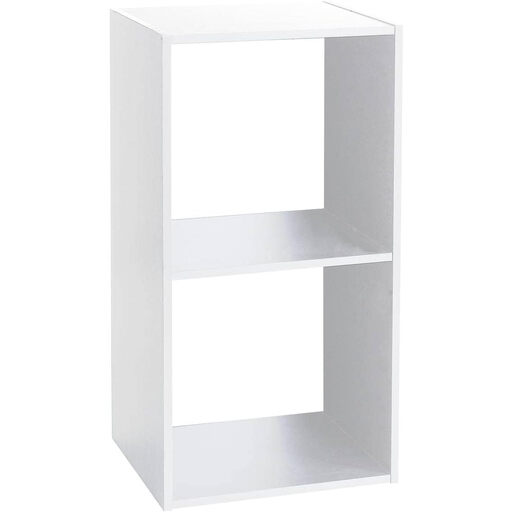
Why this product suits the profile: With a compact design measuring 34.5 cm wide, 32 cm deep and 67.5 cm high, this shelving unit is suitable for smaller spaces, such as beside a desk, in a bedroom or in a hallway. Two open compartments provide space for books and decorations.
The precise overall dimensions make it easier to plan the available space. The manageable number of compartments also reduces the risk of expecting more storage than is actually available.
Chipboard construction, two compartments, white painted finish and self-assembly with the enclosed instructions.
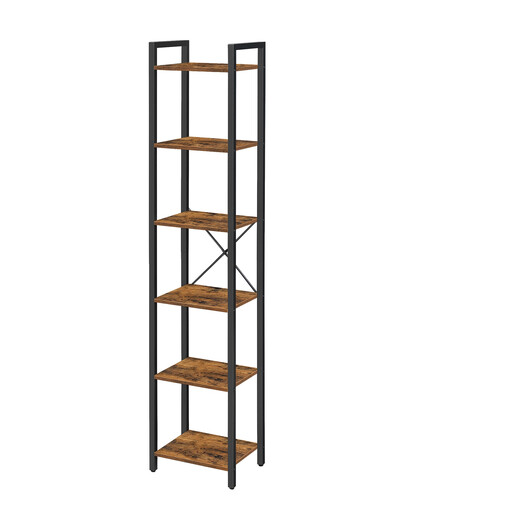
Why this product suits the profile: Standing 187.5 cm high, this bookcase makes use of vertical space and provides six tiers. It is designed for living rooms, studies, bedrooms or narrow passageways.
The depth of 30 cm and width of 40 cm are clearly specified. An anti-tip kit and X-shaped braces address stability; wall fixing should be carried out according to the instructions.
Steel frame, six tiers, adjustable feet and a stated maximum load of 50 kg.
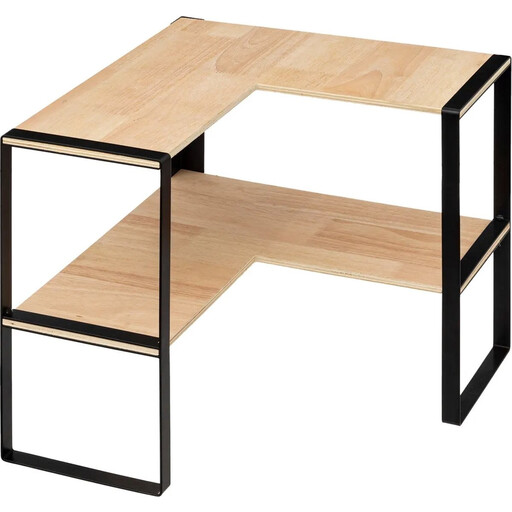
Why this product suits the profile: Measuring 40 × 40 × 35 cm, this corner shelving unit is described as suitable for worktops, cupboards or the area beneath the sink. Two tiers can hold spice jars, food storage containers or frying pans.
The compact footprint is clearly specified for use in limited spaces. As a kitchen shelving unit, it should be protected from moisture and loaded evenly.
Two shelves, a combination of steel and plywood, and versatile use on worktops and inside cupboards.
We have put together a complete, regularly updated list of products that fully meet these strict selection criteria and the safety regulations applicable in the EU.
Place the furniture on a level, load-bearing surface and, where provided, secure it to the wall using the supplied anti-tip kit. Use suitable wall plugs for the type of wall in question and follow the assembly instructions.
Its service life depends on the material, assembly, load and care. Evenly distributing the weight, storing items in a dry environment and observing the maximum load can help preserve its functionality. Damaged connecting elements or swollen wood-based materials should not be subjected to further loads.
The price depends, among other things, on the material, size, number of compartments, doors, drawers and assembly accessories. A compact organiser requires less material than a tall bookcase with a metal frame. Therefore, compare not only the total price, but also the dimensions, storage capacity and required fixings.