
Lieferung heute & morgen

Qualitätsgarantie

Willkommens-Angebote freischalten: KOSTENLOSE Lieferung | Bis zu 80 % RABATT | Kostenlose 30-Tage-JoyPlus-Testphase
App herunterladen
A shelving unit with storage boxes can keep toys, clothes, books, kitchen utensils or office supplies neatly organised. However, not every storage unit automatically creates more order in everyday use. Details such as floor space, material, load capacity and assembly often determine whether a piece of furniture remains practical in the long term.
Before buying, it is therefore worth taking a close look at the product specifications rather than relying on general advertising claims.
Shelving units often look more spacious in product photos than they really are. The key factors are the external dimensions, the size of the individual compartments and the usable depth. A slim freestanding shelving unit may be suitable for books or decorations, but it may not provide enough room for large storage boxes.
For small rooms, measure the following before buying:
A shelving unit made from metal and wood can look sturdy without the maximum load for each level being specified. Load capacity is particularly important for books, crockery or tools. Check whether the manufacturer states a maximum total load or a load per compartment.
If this information is missing, heavy items should not automatically be stored on higher levels. For families with children, it is also important that the shelving unit stands on a level surface and, where provided, is secured against tipping.
An organiser shelf with lots of compartments can be practical if the boxes suit their contents. Containers that are too small can cause items to stick out or make them difficult to remove. Check whether open compartments, removable boxes or a combination of both would best suit your household.
Open compartments are usually easier to access for frequently used items. Less frequently used belongings, on the other hand, can be stored in boxes to keep them protected from dust and create a calmer appearance.
The dimensions should suit not only the room but also the intended use. A shelving unit for the living room and bedroom, for example, can be taller, while a kitchen shelf under a worktop or inside a cupboard needs compact dimensions.
A corner shelf makes use of unused corners and can be placed on a work surface, under the sink or inside a cupboard. For hallways, offices or children's rooms, a vertical storage unit with several compartments is often more space-efficient than several separate pieces of furniture.
The combination of materials affects appearance, weight and cleaning:
A black shelving unit often blends discreetly into modern living rooms, workspaces or entrance areas. However, the colour says nothing about the load capacity or material quality. These details must be checked separately.
Check whether the freestanding shelving unit is designed for self-assembly, how many people are recommended for putting it together and whether wall mounting is possible or required. After assembly, check that all connections are secure and that the shelving unit is standing straight.
If there are young children, keep loose small parts out of their reach during assembly. A shelving unit is not designed for climbing or standing on. The same applies to a multifunctional shelving unit: the maximum load and the instructions in the assembly manual take priority.
The following models differ in format, material and intended use. The classifications are based on the product data provided for each model.
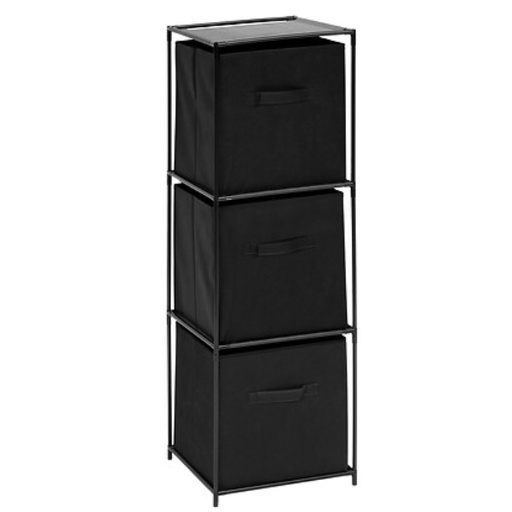
Why this product suits the profile: With dimensions of 34 x 34 cm, this compact black shelving unit requires comparatively little floor space and offers three compartments plus three storage boxes. According to the product description, it is suitable for living rooms, bedrooms, offices and entrance areas.
The external dimensions and number of compartments are clearly stated. This makes it possible to check in advance whether the shelving unit will fit into an alcove or narrow hallway.
Three boxes, three compartments, a black finish, and a combination of polypropylene and steel.
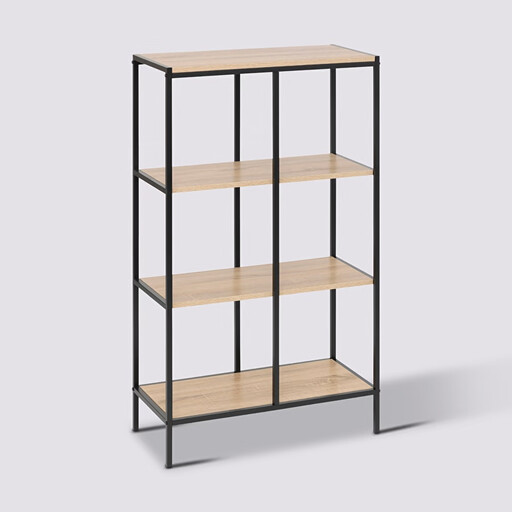
Why this product suits the profile: This storage unit combines a steel structure with particle board shelves and has six boxes. At 116 cm high, it makes good use of wall space, while its depth of 32 cm remains manageable in many living rooms and bedrooms.
The product data specifies a maximum total load of 40 kg and a net weight of 12.1 kg. This makes it easier to plan which items are suitable for storage.
Six boxes, steel used for the vertical structure, an FSC statement for the product, and a stated total load of 40 kg.
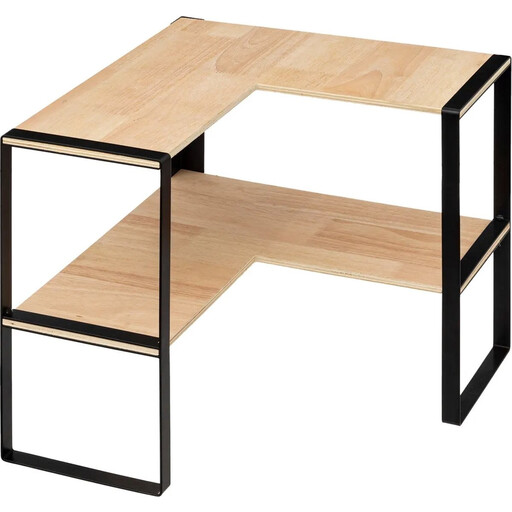
Why this product suits the profile: According to the product description, this two-tier corner shelf was designed for work surfaces, the area under the sink or inside a cupboard. It can hold spice jars, food storage containers or frying pans.
The corner format is clearly specified as 40 x 40 x 35 cm. This allows buyers to check whether the available alcove or work surface offers enough space.
Two tiers, steel and plywood materials, self-assembly, and versatile use in the kitchen or cupboard.
Organise items by how often they are used and by weight. Wherever possible, heavy provisions or books should go at the bottom, while lightweight accessories can be stored in higher compartments. In larger households, label boxes so that toys, documents or textiles can be found again quickly.
Before assembly, check that the delivery is complete. For self-assembly furniture, it is advisable to follow the instructions step by step and initially tighten the screws only lightly. Tighten all connections fully once every part has been aligned.
We have put together a complete, regularly updated list of products that fully meet these strict selection criteria and the safety regulations applicable in the EU.
That depends on where it will be placed and what it will hold. Compact dimensions are ideal for a hallway or small bedroom. Before buying, measure the available floor space and also check whether doors, drawers or boxes can be opened or pulled out fully.
Its service life depends on the material, assembly, moisture and load. A shelving unit should only be used within the stated load limits. Regularly checking the connections and keeping it on a dry, level surface can help ensure safe use.
In general, cleaning with a slightly damp cloth is sufficient unless the manufacturer specifies otherwise. Spilt liquids should be removed promptly. Wood-based materials and particle board in particular should not remain in prolonged contact with water or high levels of moisture.