If you prepare several lunch portions
Plan the dish size, number of oven batches and cooling afterwards together. The German Federal Centre for Nutrition recommends cooling prepared food and keeping it chilled in storage.


The key factors are the outside dimensions of your filled baking dish, the number of portions and the space available. If you don’t have a suitable built-in space, a countertop oven may be enough, provided your dish and handles fit inside the usable cooking space. For larger batches or other oven-baked dishes, a built-in model could also be an option. Compare the cooking functions, countertop or niche dimensions, and cleaning method for the specific model. If you’re preparing lunches for later, remember to plan for prompt cooling, chilled transport and thorough reheating too.
Plan the dish size, number of oven batches and cooling afterwards together. The German Federal Centre for Nutrition recommends cooling prepared food and keeping it chilled in storage.
With a countertop oven, usable interior dimensions matter just as much as the space it takes up, clearance around it and the cooking functions available on the specific model. Measure your baking dish, including its handles.
A built-in oven may be an option if you want to cook other oven-baked dishes as well as casseroles. Check the niche dimensions and connection requirements for the specific model.
A good fit if: you’re cooking smaller portions, don’t have a built-in space to use, and your dish and available countertop space suit the oven.
The trade-off: The interior dimensions limit the size of dish you can use; the capacity in litres alone won’t tell you whether it will fit.
A good fit if: you want to fit a larger dish or more portions in one batch without needing a built-in space.
The trade-off: Compare the usable interior space with your dish; a larger oven also needs more countertop space.
A good fit if: you have a suitable niche and regularly cook larger batches or other oven-baked dishes.
The trade-off: The niche and connection requirements must suit the model; multi-level fan cooking doesn’t prove that several Shepherd’s Pies will brown evenly.
| Buying priority | What to check | Who cares about this most? |
|---|---|---|
| Dish size and number of portions | Compare the dish, including its handles, with the usable width and depth, height and shelf position. | When I’m preparing several portions, I want to know whether my dish will fit and how many batches I’ll need to cook. Around 33% of consumers prioritise dish size and batch capacity. |
| Safe lunch preparation | Plan how to cool the portions promptly after cooking and keep them chilled during storage and transport; consider all parts when reheating. | If the portions won’t be eaten until later, I need to plan for cooling and transport, then reheat them thoroughly. This is a priority for around 27% of consumers. |
| Countertop space or built-in niche | Check the appliance dimensions, the space it needs or the niche dimensions, door clearance, and the model-specific installation and connection instructions. | If kitchen space is limited, I want to know in advance whether a countertop appliance will fit safely or whether there’s a suitable niche. Around 20% of consumers prioritise the space available. |
| Cooking functions and ongoing effort | Compare the cooking functions and cleaning method for the exact model; only compare energy figures if they’re based on the same test method. | If I use the oven regularly, I want to choose cooking functions and cleaning features that suit my routine, and put energy figures into context. This is a priority for around 20% of consumers. |
The capacity in litres doesn’t tell you whether a rectangular dish, handles included, will fit on the shelf.
Measure your dish and handles, then compare the dimensions with the usable interior space of the specific model.
Depending on the fit, you may need a smaller baking dish or an extra oven batch.
Several shelf positions or a manufacturer’s claim about fan cooking on multiple levels don’t prove that several Shepherd’s Pies will cook evenly at the same time.
Check the shelf and dish dimensions, as well as the instructions for the arrangement you have in mind.
Cooking several batches may mean allowing extra preparation time.
Baking doesn’t replace chilled storage and transport, or thorough reheating. The German Federal Institute for Risk Assessment recommends heating food to 70 °C throughout for at least two minutes.
Plan cooling and transport to suit the batch size, and check the temperature inside the food when reheating.
A stated figure for energy use per standard cooking cycle can’t necessarily be applied to a different quantity of food or type of appliance.
Only compare kWh figures when they’re based on the same test method, and consider how many batches your portions will need. The European Commission lists small ovens as being outside the scope of the regulations described for household ovens.
Countertop ovens with a range of cooking capacities, including models for larger baking dishes.
The KB M19 is a compact countertop oven for smaller portions and limited countertop space.
The TO 2068 is a compact countertop oven option with fan-assisted cooking.
The HBA514BS3 is a built-in option for a suitable niche and for cooking other oven-baked dishes too.
The HB510ABR1 is a built-in oven with fan-assisted cooking for a suitable niche.
This selection includes built-in ovens and countertop models for different portion sizes. Before buying, check your dish dimensions and the countertop or built-in space available.
 No image available
A built-in option if you have a suitable niche and want to cook other dishes as well as Shepherd’s Pie.
The product name lists: 60 cm, AirFry, pyrolytic cleaning and 3D Hotair.
 No image available
A countertop appliance to consider if your dish and portions suit its dimensions.
The product name lists a capacity of 32 l, 1600 W, a timer and a temperature range of 100 to 250 °C.
 No image available
A compact countertop appliance for small portions, provided your baking dish fits inside.
The product name lists a capacity of 10 l and a temperature range of 100 to 230 °C.
 No image available
A countertop fan oven for Shepherd’s Pie if your dish and batch size suit the cooking space.
The product name lists a capacity of 28 l and a temperature control with timer.
 No image available
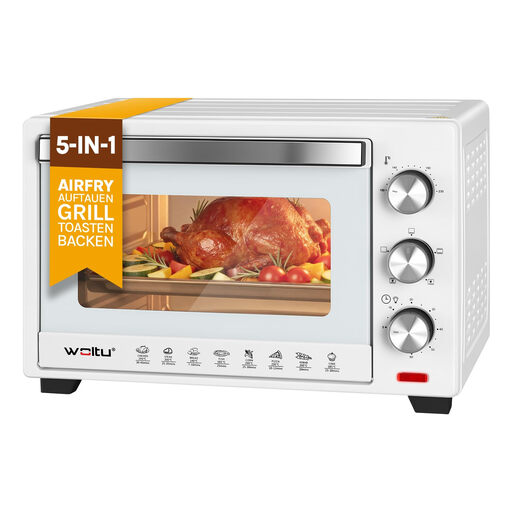
A countertop appliance to consider if your chosen dish fits inside and you’ll make use of the functions listed.
The product name lists a capacity of 30 l, 1800 W, 21 programmes, a rotisserie and a dehydrating function.
Cool prepared portions promptly, keep perishable food chilled during storage and transport, and reheat it thoroughly before eating. The German Federal Institute for Risk Assessment recommends reheating food to at least 70 °C throughout for two minutes; what matters is the temperature inside the food, not just the oven setting.
No. Compare your dish, including its handles, with the usable width, depth and height of the specific model. For the BG 1805/E, Rommelsbacher recommends using a dish slightly smaller than the stated usable interior area of around 34 × 28 cm.
Only compare energy figures if they’re based on the same test method and relate to suitable types of appliance. For household ovens covered by the rules, the EU label includes figures such as kWh per standard cycle using fan-assisted cooking; the European Commission lists small ovens as being outside the scope of the regulations described. So, if a mini oven doesn’t have an equivalent label, that doesn’t prove it uses either more or less energy.
For a countertop oven, check the space it needs and the required clearances against the instructions for the specific model. For a built-in oven, the niche dimensions and connection requirements must be suitable.
No. Your statutory rights apply when goods are faulty, and you should take this up with the seller. A guarantee is an additional voluntary commitment, subject to its own terms and conditions. According to the German consumer advice centre, remedies may initially include a repair or replacement.