Households with different mealtimes
If you don’t all eat at the same time, decide whether to keep later portions hot at a minimum of 60°C throughout or to chill and reheat them later. The BfR recommends this temperature for keeping food hot.


Choose your oven based first on the size of your baking dish, then on whether your kitchen has a suitable space for a built-in model. If the next meal is not far off, keep the finished pie hot and make sure it reaches at least 60°C throughout, as recommended by the Federal Institute for Risk Assessment (BfR). If the next meal is further away, cool portions quickly to below 7°C and reheat them later to at least 70°C throughout for two minutes. A keep-warm function alone does not confirm the temperature of the food.
If you don’t all eat at the same time, decide whether to keep later portions hot at a minimum of 60°C throughout or to chill and reheat them later. The BfR recommends this temperature for keeping food hot.
A small worktop oven may suit smaller baking dishes. Measure the dish and the available worktop space before choosing an appliance.
If you want to cook shepherd’s pie in one large dish in a single batch, the dish needs to fit the usable oven space. For a built-in oven, you’ll also need to check the housing space and connection.
First, consider how long the portions will need to wait before serving. Then choose an oven type and capacity to suit your dish and kitchen.
| Buying priority | What to check when buying | Who is this important for? |
|---|---|---|
| Keeping food hot safely | A dedicated keep-warm function and the ability to measure the temperature inside the pie; what matters is the temperature throughout. | If the next portion will be served soon, I don’t want to rely on the oven setting alone. Around 29% of consumers prioritise keeping food hot safely. |
| Portions for later | Plan for fridge space and suitable portion-sized dishes; use a food thermometer to check the temperature when reheating. | If there’s more time between meals, I need a practical way to chill and reheat food thoroughly. Around 23% of consumers prioritise safe portions for later. |
| The right dish size | Compare the usable internal dimensions and shelf height with the baking dish, including its handles. | If I’m using one large dish for everyone, I want to know in advance whether it will actually fit in the oven. Around 18% of consumers prioritise finding the right size. |
| Oven type and running costs | Check the built-in dimensions or the instructions for freestanding use; don’t assume energy use per standard baking cycle applies to keeping food hot for a long time. | I need to be able to fit the appliance into my kitchen and get a realistic sense of its running costs. Around 18% of consumers prioritise oven type and running costs. |
| Browning and cleaning | Check whether the specific model has a grill or top heat and, where applicable, a cleaning function. | If I want a browned potato topping and cleaning that suits my routine, I’ll look out for these features. Around 12% of consumers put these priorities first. |
The appliance setting doesn’t show what temperature the pie has reached throughout.
When keeping food hot, use a suitable food thermometer to check that the pie is at least 60°C throughout. This is the BfR’s recommendation for hot-held food.
For longer storage, the BfR recommends cooling food quickly and keeping it chilled, rather than simply keeping it warm.
Divide larger quantities into shallow portions, cool them quickly to below 7°C, then reheat them before eating to at least 70°C throughout for two minutes.
The capacity in litres alone doesn’t tell you whether your dish will fit. And the energy use per standard baking cycle, as described by the Verbraucherzentrale, isn’t a measure of the energy used to keep food warm for hours.
Measure your dish and only compare energy figures based on the same testing method.
Built-in ovens for kitchens with a suitable housing space; the HBA514BB3 is a model with a 71-litre capacity, grill and 3D hot air.
Worktop ovens for households without a suitable built-in space; the BGE 1580/E is a 30-litre model with a separate keep-warm setting.
Compact baking and toaster ovens for smaller pies; according to the manufacturer, the TO 2067 has a 20-litre capacity and separately switchable top and bottom heat.
Freestanding cookers for kitchens that also need a hob; according to the manufacturer, the FSM67320DXT has a ceramic glass hob and a 72-litre oven.
Built-in ovens with additional features; for the BP3400B, AEG lists SteamBake, a food sensor and pyrolytic cleaning.
This selection includes built-in ovens for kitchens with a suitable housing space and compact ovens for smaller dishes.
 No image available
For shepherd’s pie in a kitchen with a suitable built-in space.
71 litres; 3D hot air; pyrolytic self-cleaning; 10 AutoPilot programmes; LED touch controls; black.
 No image available
For larger baking dishes in a kitchen with a suitable built-in space.
3kW; Rotating Heat; grill; pizza function; AquaClean steam cleaning; LED display with timer; ECO mode; energy class A.
 No image available
For larger dishes, provided you have a suitable built-in space.
60cm wide; AirFry; 3D hot air; pyrolytic cleaning; steel.
 No image available
For smaller pies if you don’t want to use a built-in space; check the dish dimensions and the instructions for use.
1,600W; timer; crumb tray; temperature range 100 to 250°C; for baking and grilling.
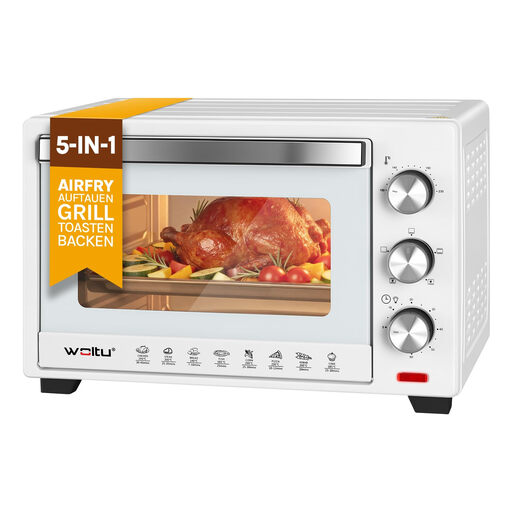 No image available
An option for smaller pies without a built-in space; check that the dish dimensions fit the usable oven space.
28 litres; temperature control; timer; white.
No. The function alone doesn’t confirm the temperature of the food. The BfR recommends keeping food at a minimum of 60°C throughout; check the temperature inside the pie with a suitable food thermometer.
For longer storage, cool the pie quickly to below 7°C and keep it chilled. The BfR recommends dividing larger quantities into shallow portions, then reheating them to at least 70°C throughout for two minutes.
Measure the baking dish, including its handles, and compare it with the usable oven space. For a built-in oven, also check the housing space and connection; for a compact oven, check the worktop space and the safety clearances specified in the instructions.
It shows energy use for standardised baking cycles, not the electricity used during a keep-warm period of any length. The Verbraucherzentrale recommends comparing figures for standardised baking cycles on that basis.
The Bundesnetzagentur lists checks including a correct CE marking, identifiable manufacturer details and German instructions for use with the required warnings. This does not mean that any particular model mentioned here has been individually tested.