
Lieferung heute & morgen

Qualitätsgarantie

Willkommens-Angebote freischalten: KOSTENLOSE Lieferung | Bis zu 80 % RABATT | Kostenlose 30-Tage-JoyPlus-Testphase
App herunterladen
A shoe bench with a seat is a functional addition to any entryway. It creates order by stowing away shoes while also providing a comfortable place to sit when putting them on or taking them off. However, the selection process has some hidden pitfalls that can quickly turn a practical aid into a useless item. Before you make a decision, you should be aware of the most common flaws to find a durable and fitting solution for your hallway.
Many products look appealing at first glance but only reveal their weaknesses in daily use. Pay special attention to these three points to avoid disappointment:
To avoid the problems mentioned above, you should base your choice on objective criteria. The following three parameters are crucial for the functionality and durability of your new hallway bench.
The material significantly determines the stability and appearance. Common materials are MDF (Medium-Density Fibreboard) or other engineered woods, which are often lacquered or veneered. They offer good value for money and are available in many designs, such as a white shoe bench. Pay attention to high-quality finishing on the edges and surfaces.
A crucial, often overlooked value is the maximum load capacity of the seat, specified in kilograms. A value of at least 100 kg is recommended for safe use by an adult. Also, check the load capacity of the compartments or baskets to ensure they can support the weight of several pairs of shoes.
A shoe bench with storage should adapt to your needs, not the other way around. Compare the different systems:
Models with adjustable shelves are particularly advantageous. They allow you to flexibly adjust the height of the compartments to suit different types of shoes—from flat sandals to high winter boots.
Measure the available space in your hallway or for your entryway bench precisely before making a decision. Consider not only the width and height but also the depth. A bench that is too deep can block the walkway, while one that is too narrow may not offer enough storage or could seem unstable. Standard depths are often between 30 and 40 cm, which is sufficient for most shoe sizes and does not protrude too far into the room.
Here is a selection of models tailored to different needs and living situations.
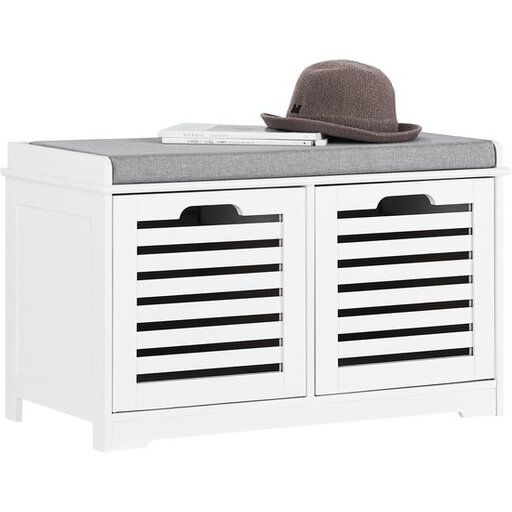
Why This Fits Their Persona: Ideal for a first flat or smaller hallways. This model combines comfortable seating with flexible storage via baskets, without requiring a large budget. The compact dimensions fit well in limited spaces.
The specified load capacity of 120 kg for the seat addresses the problem of instability. The removable baskets are easy to clean and bypass the trap of impractical, fixed compartments.
Combination of a seat cushion and two baskets for flexible organisation of shoes and accessories. The white finish blends neutrally into many interior styles.
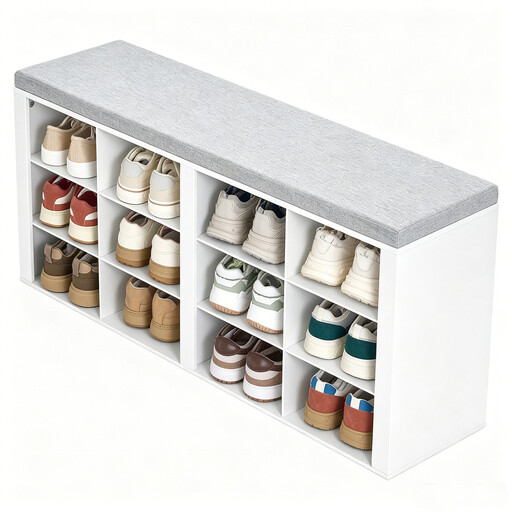
Why This Fits Their Persona: Perfect for families or individuals with many shoes who are looking for a structured and tidy solution. The high number of compartments allows for systematic organisation of the entire shoe collection.
The adjustable shelves solve the problem of impractical storage, as they can be adapted to fit boots, high heels, or trainers. The specified load capacity of 150 kg ensures high stability.
Maximum flexibility thanks to height-adjustable shelves in the 12 compartments. The seat cushion is removable, which makes cleaning easier.
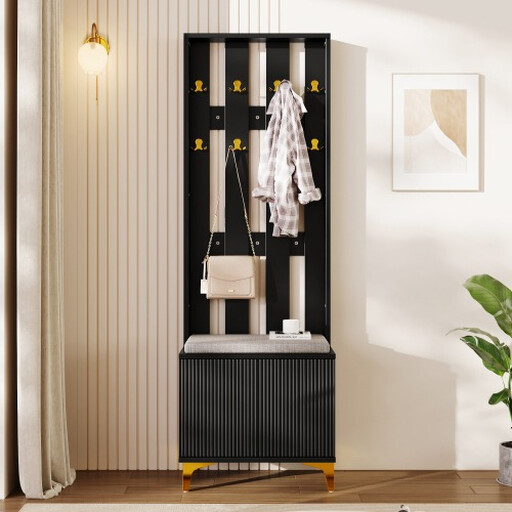
Why This Fits Their Persona: For anyone looking for a uniform and multifunctional solution for the entire entryway. This set combines a `shoe cabinet with a bench` with a wardrobe panel and hooks for jackets and coats.
As a complete set, the construction is designed for stability. Features like soft-close hinges and a push-to-open mechanism indicate a higher quality of workmanship, which helps avoid delicate surfaces.
All-in-one solution that combines shoe storage, a seating area, and a coat rack. This ensures a harmonious and tidy overall look in the entryway.
We have compiled a complete, real-time list of products that fully satisfy these strict selection criteria and UK safety regulations.
The load capacity varies greatly depending on the model and material. Simple models made of engineered wood often have a specified maximum load capacity of 100 kg to 120 kg. More robust versions, especially those made of solid wood or with a reinforced construction, can support 150 kg or more. Always check the manufacturer's product description for exact details to ensure safe use.
Surfaces made of MDF are generally easy to care for. A soft, slightly damp cloth is usually sufficient for cleaning. Avoid aggressive cleaning agents or soaking wet cloths, as moisture can penetrate the edges and cause the material to swell. Wet shoes should be allowed to dry briefly before being stored to ensure the longevity of the surfaces.
On many models, the cover of the seat cushion is removable and washable. This is a practical feature for easily removing stains or dust. Whether the cover is removable and how it can be cleaned (e.g., hand wash or machine wash) is specified in the manufacturer's product information. For permanently attached cushions, a surface cleaning with an upholstery cleaner may be necessary.