
Lieferung heute & morgen

Qualitätsgarantie

Willkommens-Angebote freischalten: KOSTENLOSE Lieferung | Bis zu 80 % RABATT | Kostenlose 30-Tage-JoyPlus-Testphase
App herunterladen
A shoe cabinet with 10 compartments can bring order to your entrance hall, but it needs to suit the available floor space and the actual size of your shoes. Many products advertise high capacity, modular use or easy assembly. In practice, however, specific dimensions, construction materials and ventilation determine whether your shoe storage works well day to day.
This buying guide from Joybuy Product Recommendation Officer explains what households, families and people with large shoe collections should look out for. The focus is on clear product data rather than broad advertising claims.
Capacity figures often refer to flat shoes, slippers or slim trainers. Boots, wide sports shoes and shoes with thick soles need more room. With a shoe cabinet with 10 compartments, you should therefore consider not only the total number of compartments, but also the internal height and width of each one.
As a general guide, around two pairs of flat shoes per compartment is practical. With larger shoes, the actual capacity may be lower. Removable dividers or height-adjustable shelves provide greater flexibility.
A shoe cabinet with doors protects shoes from dust and keeps the contents out of sight. However, if damp shoes are put away immediately after wearing, restricted air circulation can be a disadvantage. For everyday shoes that are worn regularly, an open shoe rack with space between the shelves may be more practical.
A closed shoe organiser is better suited to dry shoes or areas where protection from dust is particularly important. Ventilation openings and a well-designed layout are also important details.
A modular shoe rack can often be configured vertically, horizontally or as several separate units. At the same time, there are more connections, plug-in components or plastic connectors that need to be assembled correctly. Before buying, check the construction method, included accessories and permitted load capacity.
A level surface is also important for tall racks. Depending on the room and household situation, additional anti-tip protection may be advisable. Children should not climb on the rack or pull on it.
The description shoe cabinet with 10 compartments only covers part of the storage arrangement. You should also check:
If you are looking for shoe storage for 20 to 40 pairs, compare the stated capacity with your own shoe collection. A compact model may be sufficient for a family with mostly flat shoes. For boots and large sports shoes, more space per compartment is more important than a high nominal number of compartments.
A shoe cabinet for the hallway must not obstruct walkways, doors or radiators. Before buying, measure:
For a small flat, a slim, tall shoe rack for small spaces may be a good choice. A wider configuration offers easier access and can be positioned under a staircase or along a longer wall.
Metal frames can create a clean, open structure and can be wiped down with a damp cloth. PP or ABS plastic panels are lightweight and resistant to normal levels of moisture; the connections should nevertheless be properly secured. Claims such as “waterproof” should not be interpreted as complete watertight sealing.
Look out for:
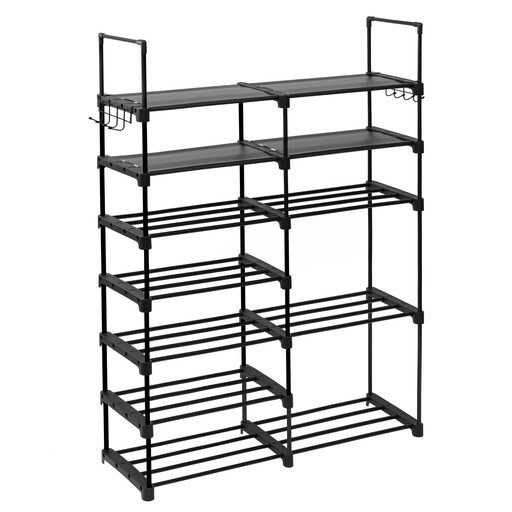
Why this product suits this profile: The open rack offers a clear storage solution for hallways or bedrooms and, according to the product details, holds around 20 to 25 pairs of shoes.
The open design improves ventilation. Seven height-adjustable levels and four removable protective covers allow it to accommodate different shoe shapes.
Metal and plastic construction, 10 hooks, dimensions of 86 × 125 × 30 cm and a stated total load capacity of 35 kg.
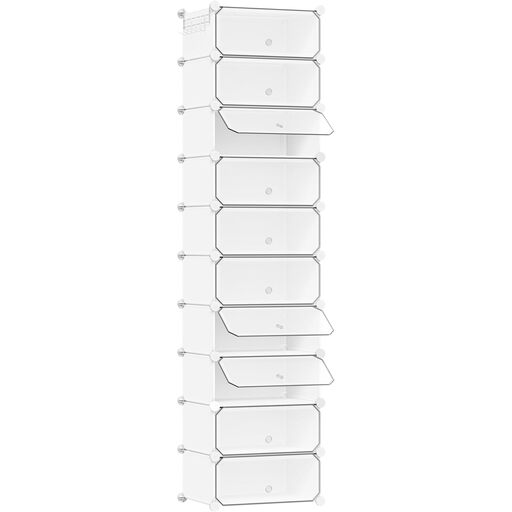
Why this product suits this profile: This model is aimed at users who prefer closed, modular shoe storage with a clearly defined compartment layout.
The ten doors reduce visible dust build-up. The individual compartments, measuring 40 × 30 × 17 cm, are clearly sized and can be used for different types of footwear.
PP plastic panels, a metal frame and ABS connectors; overall dimensions of 40 × 30 × 170 cm, plus assembly accessories including a hammer and instructions.
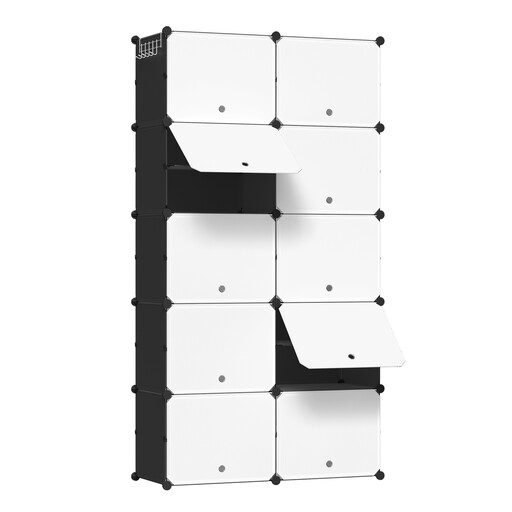
Why this product suits this profile: The modular construction is suitable for households with up to 40 pairs of shoes and can also be used as a shelving unit or for additional storage.
The removable dividers create larger sections for bulky shoes. The configuration can be arranged vertically, horizontally or as several smaller units.
Ten storage sections with 20 levels in total, overall dimensions of 94 × 180 × 36,5 cm, a metal frame, PP panels and additional hooks for bags or keys.
We have put together a complete, regularly updated list of products that fully meet these strict selection criteria and the safety regulations applicable in the EU.
Before assembly, check that all connectors, shelves and hooks are included. The rack must stand on a level surface. For a tall configuration, we recommend following the manufacturer's guidance on securing it to the wall.
Simple measures can help extend its service life:
This depends on the internal dimensions and the shape of the shoes. With flat shoes, around 20 pairs is often realistic. Models with additional levels or smaller storage areas can hold up to 40 pairs, according to the product details. Boots and wide sports shoes reduce the actual capacity.
Stability depends on the materials, connectors, height of the configuration and distribution of the load. A metal frame can provide a supporting structure, but it does not replace correct assembly. The rack should not be climbed on and must stand on a level surface.
An open shoe rack provides quick access and better air circulation. A shoe cabinet with doors offers greater protection from dust and creates a more enclosed appearance. With damp everyday shoes, allowing them to dry properly before putting them away is important with either option.