
Lieferung heute & morgen

Qualitätsgarantie

Willkommens-Angebote freischalten: KOSTENLOSE Lieferung | Bis zu 80 % RABATT | Kostenlose 30-Tage-JoyPlus-Testphase
App herunterladen
A shoe cabinet should keep your shoes organised, free up space in the hallway and fit the area you have available. In practice, unclear size information, overestimated capacity and missing safety details often lead to disappointing purchases. Households with several people in particular need a solution that holds plenty of pairs while remaining easy to access and stable for everyday use.
Claims such as ‘holds 20 or 25 pairs of shoes’ often refer to flat trainers or shoes with slim soles. Boots, high-top trainers and heeled shoes need more height. Check whether the shelf height is adjustable and how many pairs you can realistically store for everyday use.
When choosing a narrow shoe cabinet, depth isn’t the only thing to consider. Doors, drawers and tilt-out compartments also need room to open. Before buying, measure the available wall width and height, as well as the space in front of the furniture. In narrow passageways, a model with front-opening flaps may be impractical.
Moisture-resistant materials can make cleaning easier, but they don’t remove the need to position the furniture appropriately. Tall furniture should stand on a level floor and, where specified, be secured to the wall. If you’re considering a tall shoe rack, also check the anti-tip protection, weight limits and assembly instructions.
For a hallway with limited floor space, shallow models around 23 to 31 cm deep are a good choice. A shoe cabinet with doors also protects the contents from dust. Open shelves, on the other hand, make shoes quicker to reach and can work well in a walk-in wardrobe, for example.
As a guide:
The actual capacity depends on shoe size and shape, as well as the layout of the compartments. So, as well as checking the overall dimensions, make sure you look at the internal measurements.
MDF and coated wood-based materials give furniture a solid, finished look. Smooth surfaces can usually be cleaned with a slightly damp cloth. PP plastic is relatively lightweight and, depending on the design, may be moisture-resistant. Metal frames can provide extra stability for tall, open shoe racks.
For fabric shelves, check the weight limit for each tier. These compartments are handy for lightweight everyday shoes, but aren’t necessarily suitable for heavy boots or full storage boxes.
A shoe cabinet with doors should open fully without blocking a passageway. Wall fixings are particularly important for tall models. Children shouldn’t climb on furniture or hang from doors and flaps. A storage bench with shoe compartments should also be designed to support the stated maximum weight and placed on a stable, level surface.
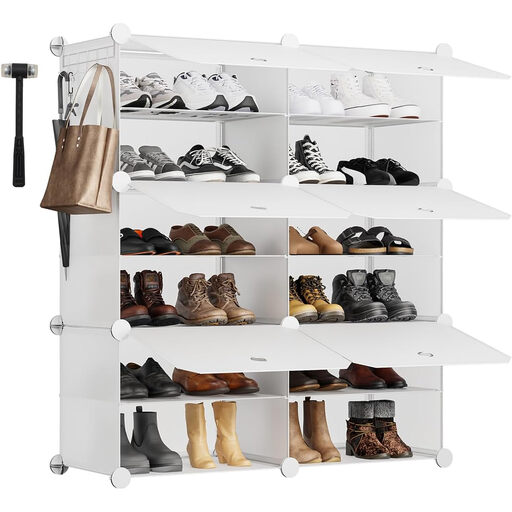
Why this product suits your needs: Measuring 84 × 31 × 92 cm, with stated storage for up to 24 pairs of shoes, it’s a good fit for families and larger shoe collections.
The product information gives a load capacity of 5 kg per compartment and lists several anti-tip devices. The compartments are ventilated and the PP panels can be wiped clean.
PP panels, metal connectors, wipe-clean surface and assembly hammer, according to the product description.
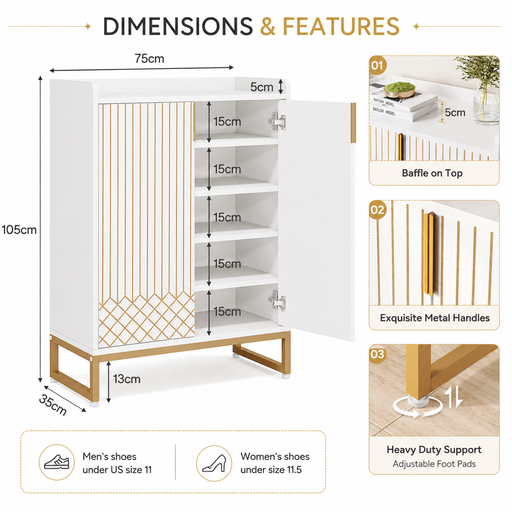
Why this product suits your needs: Its enclosed design works well in hallways, bedrooms and living spaces where you want to keep shoes neatly out of sight.
The doors keep shoes out of sight and can help reduce dust. The stated capacity is around 22 to 25 pairs.
Five tiers, enclosed front, open bottom compartment and top shelf, according to the product description.
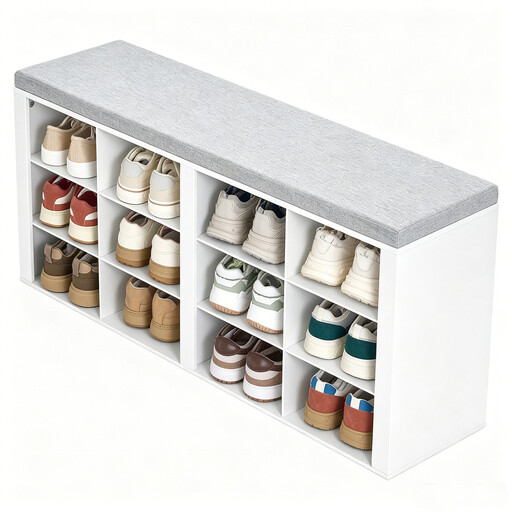
Why this product suits your needs: Combining a seat with shoe storage makes it easier for families to put shoes on and take them off in the entrance hall every day.
The height-adjustable shelves can be adapted to different types of shoes. The removable seat cover makes cleaning easier.
Measures 104,5 × 30,5 × 49,5 cm and has a stated load capacity of 150 kg.
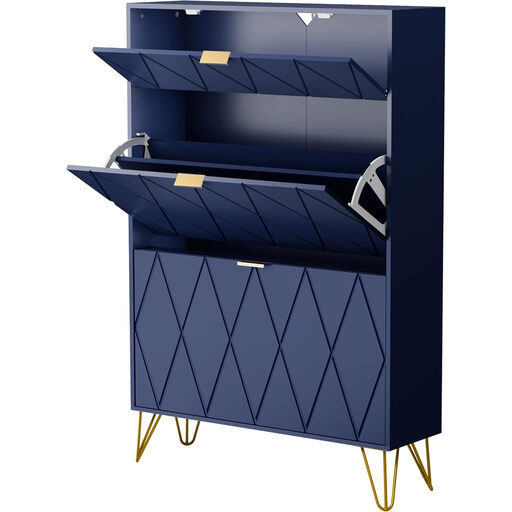
Why this product suits your needs: At 24 cm deep, this model makes use of vertical storage space and is designed for narrow hallways, entrances and corridors.
The overall dimensions of 80 × 24 × 120 cm are clearly stated. The anti-tip device should be attached to the wall as instructed.
Two flaps, one drawer, a top shelf, plus MDF panels and metal legs, according to the product information.
We’ve put together a comprehensive, regularly updated list of products that meet these strict selection criteria and fully comply with the safety regulations in force in the EU.
A depth of around 23 to 31 cm works well in many hallways. The key is to make sure that doors or flaps can open fully and that the passageway remains clear. If you have larger shoe sizes, check the internal width and compartment layout too.
It depends on the shape of the shoes and how they’re arranged. A model advertised as holding ‘up to 25 pairs of shoes’ may fit that many if you’re storing flat shoes. Boots, high-top trainers and heeled shoes reduce the usable storage space. Adjustable compartments give you more flexibility.
For tall or narrow furniture, use the anti-tip device supplied, following the assembly instructions. The unit should stand on a level surface. Don’t exceed the weight limits, and don’t let children climb on the shoe cabinet.