
Lieferung heute & morgen

Qualitätsgarantie

Willkommens-Angebote freischalten: KOSTENLOSE Lieferung | Bis zu 80 % RABATT | Kostenlose 30-Tage-JoyPlus-Testphase
App herunterladen
A shoe cabinet should keep shoes tidy, take up little floor space and suit your home. In practice, however, a few common mistakes can lead to unnecessary expense. A cabinet may look spacious in product photos but only have room for slim trainers. Or a tall tilt-out shoe cabinet may be less stable if it isn’t secured to the wall. An attractive finish also tells you little about whether the shelves are adjustable, the doors are easy to open or the stated dimensions will work in your hallway.
This guide explains what households in the UK should consider when buying. It will help you choose the right shoe storage for your entrance hall, bedroom, living room or utility room.
A shoe cabinet doesn’t need to take up a lot of floor space to offer plenty of storage. What matters is how the interior is laid out. Tilt-out shoe cabinets with several compartments make good use of height, but may not accommodate tall shoes, walking boots or ankle boots. If you’re choosing a shoe rack with fixed shelves, check the height of each compartment.
Depth also matters in a hallway. A slim shoe cabinet around 23 to 31 cm deep can help keep the walkway clear. Before buying, also check that there’s enough room for the handles, doors or flaps to open fully.
Manufacturers’ claims such as ‘holds 20 or 32 pairs’ often refer to specific shoe styles and sizes. Wide sports shoes, high-top trainers and shoes with chunky soles need more space. When choosing a shoe cabinet for your hallway, it’s worth sorting your shoe collection into:
Tall furniture should stand on a level surface and be secured against tipping in line with the manufacturer’s instructions. This is especially important in homes with children. Load limits usually apply to the top, individual compartments or the seat, and shouldn’t be treated as interchangeable.
For a shoe cabinet with a bench, check the stated maximum load for the seat. Decorative surfaces, drawers and open shelves may have different load limits. Follow the assembly instructions in full before using the furniture.
Measure the width, depth and height of the space. Allow for skirting boards, radiators, doors and the room you’ll need to move around in front of the furniture. Slim hallways are often better suited to shallow tilt-out shoe cabinets or compact shoe racks. If you can make use of the full room height, a tall cabinet can provide more vertical storage, but remember to plan for wall fixings.
MDF, chipboard and melamine-coated boards vary in finish, weight and care requirements. Plastic or PP components are generally easy to wipe clean and may suit a cellar, dressing room or utility room. Whatever the material, avoid leaving it in standing water. Let wet shoes dry before putting them away, so the furniture isn’t exposed to moisture for long periods.
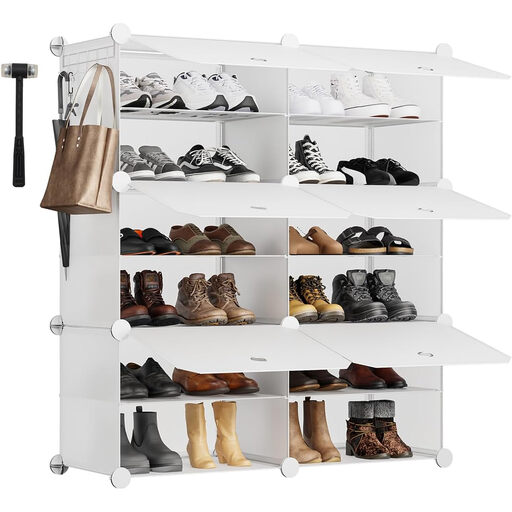
Why this product suits this type of buyer: According to the product description, it holds up to 24 pairs of shoes and can be used in a hallway, dressing room or utility room. The PP components and metal connectors are wipe-clean, and the unit is designed for easy self-assembly.
The product details specify a load capacity of 5 kg per compartment and several anti-tip devices. This makes it easy to check important assembly and load information before you buy.
84 × 31 × 92 cm; six compartments; wipe-clean PP surface; assembly hammer and illustrated instructions included.
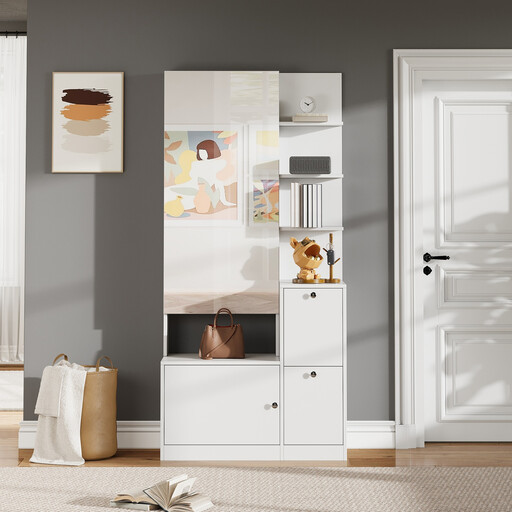
Why this product suits this type of buyer: This model combines tilt-out shoe storage, concealed storage, five open shelves and an integrated mirror. At 40 cm deep, it makes good use of height without projecting too far into the hallway.
The dimensions, two pull-out shoe compartments and five open shelves are all clearly specified. The product information also notes that it arrives in two packages and requires assembly.
Integrated mirror; two doors; five open compartments; stated top load capacity of 50 kg.
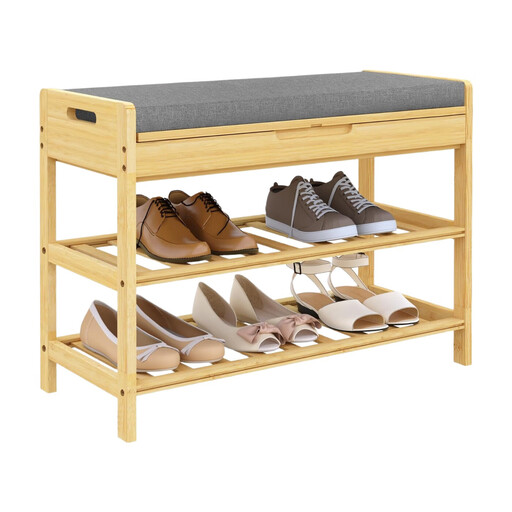
Why this product suits this type of buyer: Two open shoe shelves, a closed compartment and a padded seat combine shoe storage with a bench. Its dimensions of 68 × 50 × 30 cm make it a good fit for compact entrance halls.
The seat has a stated maximum load of 150 kg. The open shelves and closed compartment are also described clearly, rather than being covered by a general storage-capacity claim.
Bamboo construction; two open compartments; concealed compartment beneath the seat; removable seat cover according to the product description.
We’ve put together a complete, regularly updated list of products that meet these strict selection criteria and fully comply with the safety regulations in force in the EU.
Models around 23 to 31 cm deep are often easier to fit into narrow hallways. Before buying, though, check your shoe sizes, the design of the compartments and the space needed to open the doors or flaps. For taller shoes, a slightly deeper model with adjustable shelves may be more practical.
It depends on the shape and size of your shoes, as well as the layout of the compartments. A stated capacity of 20 pairs may be lower if you have wide sports shoes. Sort through your shoes and compare their height and width with the internal dimensions of the cabinet you’re considering.
For tall or narrow furniture, use the anti-tip fittings as directed in the assembly instructions. The cabinet should stand on a level surface. Children shouldn’t climb on the shelves, doors or top. Securing the cabinet to the wall improves stability, but doesn’t replace the need to observe the stated load limits.