
Lieferung heute & morgen

Qualitätsgarantie

Willkommens-Angebote freischalten: KOSTENLOSE Lieferung | Bis zu 80 % RABATT | Kostenlose 30-Tage-JoyPlus-Testphase
App herunterladen
A shoe cabinet should keep your shoes tidy, take up as little space as possible and suit your home. In practice, though, a few common buying decisions can lead to disappointment: a narrow cabinet may not have enough internal height, an open shoe rack won’t protect shoes from dust, and a modular system can become unstable if assembled incorrectly.
This guide explains what households, families and people with larger shoe collections should look for when buying. We focus on details you can check, such as dimensions, materials, load capacity, assembly and ventilation.
A compact, narrow shoe cabinet may look like a space-saving choice for your hallway. But what matters is the usable height inside each compartment. High-top trainers, ankle boots and heeled shoes won’t fit in every drop-down compartment. So, as well as checking the width and depth, look at the internal dimensions and whether the shelves can be removed or adjusted.
A claim such as ‘holds 20 pairs of shoes’ often assumes flat everyday shoes arranged to save space. Boots, walking boots and larger trainers need more room. If you’re considering stackable shoe boxes, check the internal dimensions against your shoe size too.
Tall furniture and modular shoe racks need a level surface to stand on. Wall fixings are especially important for narrow, tall designs. Small children should not climb on a shoe cabinet. With interlocking systems, make sure every connection is fully engaged, and don’t exceed the maximum load for each compartment.
First, measure the available space in your hallway, bedroom, dressing room or entrance. As well as the footprint, allow for the space needed to open doors and flaps.
A shoe rack with doors keeps shoes out of sight and helps reduce direct exposure to dust. Open compartments, on the other hand, make shoes easier to reach and allow more air to circulate.
PP plastic is resistant to moisture and can usually be wiped clean with a damp cloth. A PP shoe cabinet is therefore a good choice for entrance areas where wet outdoor shoes may be left. For interlocking models, check the quality of the connections, the metal frame and the load capacity of each compartment.
MDF and coated wood-based panels can give a furniture-style finish. Follow the care instructions and avoid leaving water to collect around the edges and feet. Fabric shelves need different care from smooth plastic surfaces, and it’s particularly important not to exceed their stated load limit.
Easy assembly doesn’t mean you can skip the safety checks. Once assembled, check the following:
Ventilated storage can be a good choice for delicate shoes. However, it’s no substitute for drying wet shoes before putting them away. Don’t overfill closed compartments either.
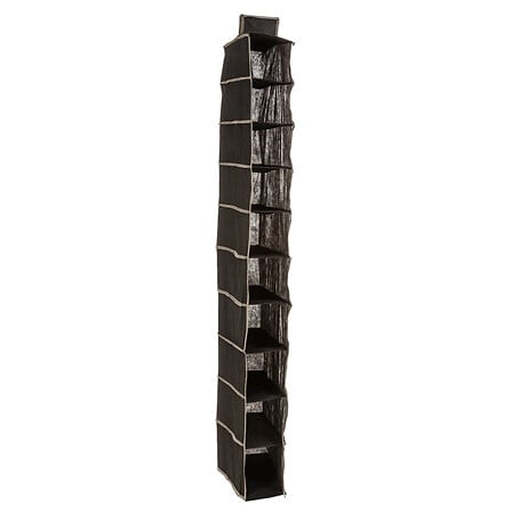
Why it suits this need: Designed for bedrooms, wardrobes and narrow entrance areas, this vertical unit holds up to 10 pairs of shoes.
Its dimensions of 33 x 33 x 173 cm and compartment layout make it easy to assess how much space it needs. The design isn’t intended for heavy boots.
Vertical design, metal frame, non-woven fabric shelves and wipe-clean surfaces.
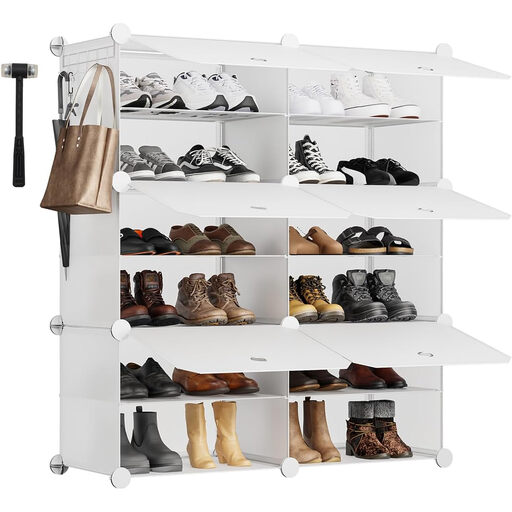
Why it suits this need: With six compartments, a stated capacity of up to 24 pairs and dimensions of 84 x 31 x 92 cm, it gives families with several pairs of shoes plenty of storage to work with.
The PP panels are moisture-resistant and wipe-clean. The stated load capacity of 5 kg per compartment and several anti-tip restraints give you specific points to check.
Moisture-resistant PP, assembly hammer, illustrated instructions and ventilation openings.
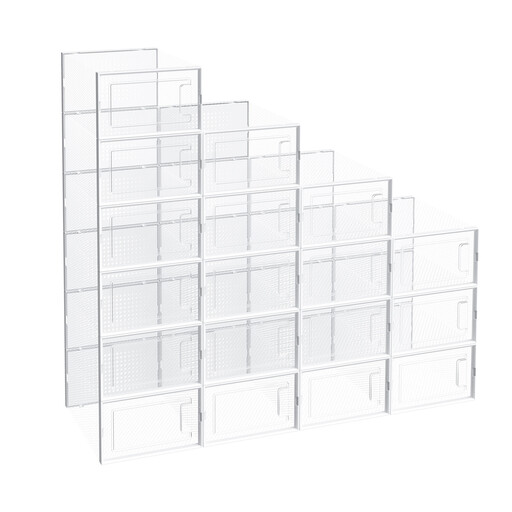
Why it suits this need: The 18 individual boxes with front doors are ideal for collections you want to keep dust-free and neatly displayed.
The transparent fronts mean you don’t need to open each box to see what’s inside. Before buying, compare your shoe size with the box dimensions of 35 x 25,2 x 19 cm.
Stackable PP boxes, transparent doors and ventilation openings.
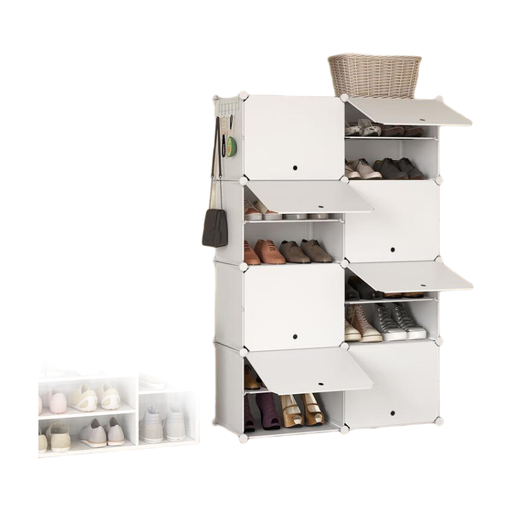
Why it suits this need: According to the product details, this modular shoe rack can be arranged in different ways and used to store bags, toys or books too.
The construction is clearly described: PP panels, a metal frame and ABS connectors. Follow the instructions carefully when assembling it.
Eight compartments, stated storage for up to 32 pairs of shoes and flexible ways to use it.
We’ve put together a complete, regularly updated list of products that meet these strict selection criteria and the applicable EU safety regulations.
It depends on the shape of the shoes, the height of the compartments and how they’re arranged. A shallow shoe cabinet with drop-down compartments usually makes use of the width, while a vertical shoe rack uses the height. Allow extra room for larger trainers or boots. The internal dimensions matter more than the advertised pair capacity.
Let wet shoes dry completely before putting them in closed compartments. Ventilation openings or open shelves help air circulate. Plastic surfaces such as PP can be wiped down regularly with a damp cloth. However, shoe storage is no substitute for cleaning and drying your footwear.
There’s no reliable way to give a single lifespan. It depends on the materials, assembly, load, moisture and how often the unit is rearranged. Stick to the stated load capacity, distribute heavier shoes evenly and check the connections regularly. This helps you spot any signs of instability or excessive wear early.