
Lieferung heute & morgen

Qualitätsgarantie
App herunterladen
Kategorien
Organised shoe storage is the foundation of an uncluttered entryway. Shoes left in disarray in a hallway not only look messy but can also become a tripping hazard and shorten the lifespan of your footwear through exposure to dust and pressure marks. Selecting the right piece of furniture—be it a classic shoe cabinet, an open shoe rack, or a multifunctional shoe bench—depends on objective criteria like available space, the number of shoes to store, and material properties. This article analyses the technical specifications of various models to help you make an informed decision.
The decision for a specific model should be based on an analysis of your personal needs and the spatial constraints of your home. The following aspects are of key importance.
The most common designs differ primarily in their functionality and space requirements.
The choice of material affects the furniture's longevity, maintenance, and aesthetic appeal.
Before purchasing, measure the intended space precisely (width, height, depth). Also, consider the clearance required for opening doors or drawers. Capacity is typically stated in pairs of shoes. This figure is an estimate and depends on the shoe size and type (boots require more space than flat shoes). Models with adjustable shelves offer more flexibility in this regard.
Based on an analysis of specifications and functional design, we present three distinct models that cater to different needs.
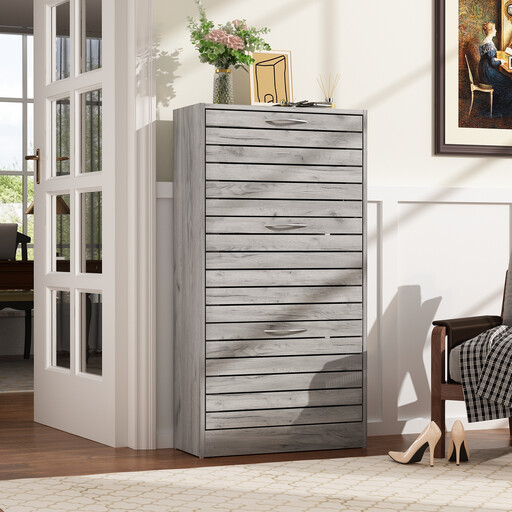
Why we recommend this product: This model is a classic tip-out shoe cabinet that stands out for its extremely slim profile of just 24 cm. This makes it an ideal solution for narrow entryways and hallways. The three flaps, each with two compartments, offer high storage density within a small footprint. The design, featuring horizontal grooves, adds a modern texture to the otherwise minimalist frame.
Pros:
Who it's for: Individuals living in homes with narrow hallways who are looking for a closed, stylish, and space-saving shoe storage solution.
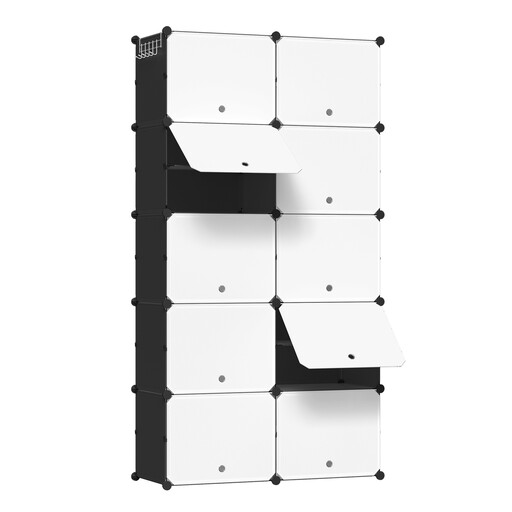
Why we recommend this product: The strength of this product lies in its exceptional flexibility. As a modular shoe organiser, it can be assembled in various configurations—as a tall tower, a wide rack, or even as several smaller units. Its capacity of up to 40 pairs of shoes is impressive. The polypropylene panels are waterproof and easy to clean.
Pros:
Who it's for: Families or collectors with a large number of shoes who need an adaptable and expandable storage solution. Also suitable for alcoves, spaces under sloped ceilings, or under the stairs.
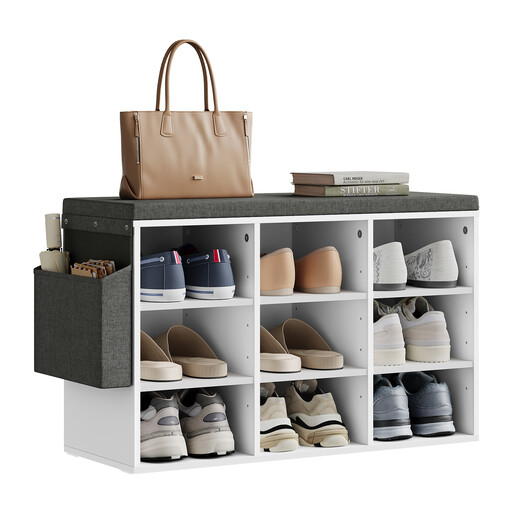
Why we recommend this product: This model combines two essential functions for an entryway: shoe storage and a place to sit. The padded seat enhances comfort when putting on shoes. The compartment structure, with adjustable side panels, allows for storing shoes of different heights, including ankle boots.
Pros:
Who it's for: Households looking for a practical and compact all-in-one solution for their hallway shoe cabinet and who value having a comfortable place to sit.
The models presented cover common requirement profiles. However, the market offers a multitude of other specialised solutions. For specific design preferences or to discover other functional furniture pieces, exploring broader categories can reveal additional options. For example, under Duck Shoes, you can find other related product groups that complement the range.
1. How deep should a shoe cabinet be? Depth is a critical dimension, especially for narrow hallways. Standard shoe cabinets often have a depth of 30-40 cm. Tip-out shoe cabinets, with a depth of 17-25 cm, are significantly more space-efficient and therefore often the better choice for tight spaces. Measure your available space and account for the swing clearance of any doors.
2. What is better: an open shoe rack or a closed shoe cabinet? Both systems have specific pros and cons. An open shoe rack provides good ventilation, which is particularly beneficial for damp shoes, and allows for quick access. A closed shoe cabinet protects footwear from dust and UV light and creates a calmer, more organised look in the room. The choice depends on your priorities: ventilation and quick access versus protection and aesthetics.