
Lieferung heute & morgen

Qualitätsgarantie

Willkommens-Angebote freischalten: KOSTENLOSE Lieferung | Bis zu 80 % RABATT | Kostenlose 30-Tage-JoyPlus-Testphase
App herunterladen
A shoe cabinet should keep your shoes tidy, take up as little space as possible and suit your home’s style. In practice, unclear measurements, unsuitable compartments or complicated assembly can all lead to the wrong purchase. This is why, especially in small homes and narrow hallways, it’s important to consider the overall design, not just the stated shoe capacity.
Claims such as ‘holds 20 to 32 pairs of shoes’ often refer to flat everyday shoes. Trainers with thick soles, ankle boots and high heels need more internal height. So check:
A shoe cabinet with adjustable compartments is more flexible than one with fixed shelves.
A slim shoe cabinet with an external depth of around 24 to 30 cm may suit many hallways. However, the usable internal depth is reduced by the back panel, doors or tilt-out compartments. Before buying, measure the available space, including the area needed to open the doors. Skirting boards, radiators and light switches can also affect where you can place it.
A tall shoe cabinet has a relatively small footprint. Secure assembly is especially important for models with several tiers, doors or tilt-out compartments. Look for:
Children should not climb on or play with a shoe cabinet. Always follow the manufacturer’s instructions on weight limits and fixing.
For a hallway shoe cabinet, width, depth and height are all equally important. A tall, narrow model makes good use of wall space, while a wider shoe rack is often easier to access. A shoe cabinet that holds 20 to 32 pairs may be a good choice for a family or a large collection. A smaller model with fewer compartments may be enough for a two-person household.
Look beyond the external dimensions and check how the compartments are arranged. A model with ten compartments may hold a large number of pairs if each one can fit two pairs side by side. Larger shoes and boots will reduce the usable capacity.
MDF or chipboard models often have the look of traditional furniture and work well in hallways, bedrooms or living rooms. Plastic panels with a metal frame are usually lighter and can be wiped clean with a damp cloth. For damp entrance areas, check the care instructions and how resistant the material is to moisture.
Closed shoe storage keeps dust out and creates a neater look. Ventilation holes in the doors or small openings around the handles can be useful for enclosed compartments. You’ll still need to clean the cabinet regularly and make sure wet shoes are completely dry before storing them.
A shoe cabinet with doors needs extra clearance in front of it. Tilt-out compartments usually open forwards, so bear this in mind if your hallway is very narrow. A shoe cabinet with tilt-out compartments can make shoes easier to reach, while hinged doors often give the cabinet a more traditional furniture look.
Modular systems can be adapted to suit different spaces. However, the connectors and frame need to be assembled correctly. Before buying, check whether tools, connectors and illustrated instructions are included.
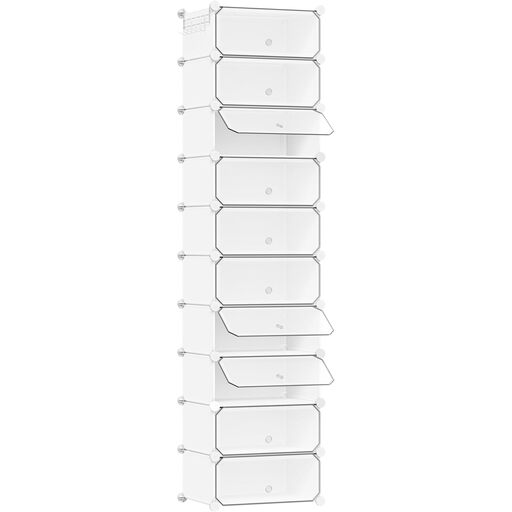
Why this product suits your needs: This modular system has ten compartments and can be used in the hallway, bedroom or utility area. Its stated capacity is up to 20 pairs of shoes.
Individual compartments and doors keep everything neatly organised. The modular design can be adapted to the space available.
PP plastic panels, a metal frame and ABS connectors; ten compartments with doors and stated dimensions of 40 × 30 × 170 cm.
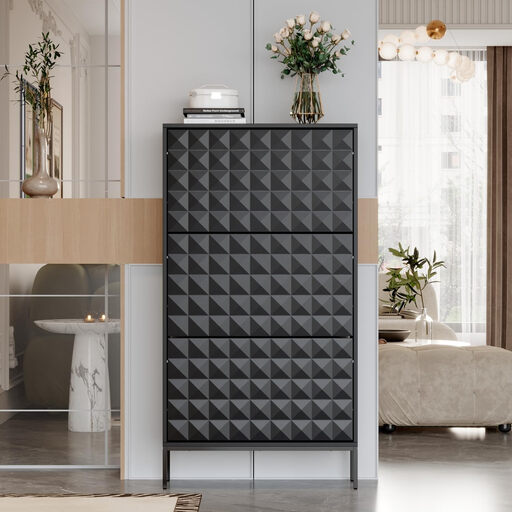
Why this product suits your needs: This cabinet combines a slim depth of around 24 cm with three doors and a modern black MDF finish. It’s a good fit for households looking for enclosed shoe storage with the look of a piece of furniture.
Three adjustable or removable shelves make it easier to accommodate trainers, heels and shorter boots.
Manufacturer-stated capacity of up to 24 pairs of shoes, 15 cm-high legs and provision for anti-tip fixing; dimensions according to the product description are approximately 131.5 × 70 × 24 cm.
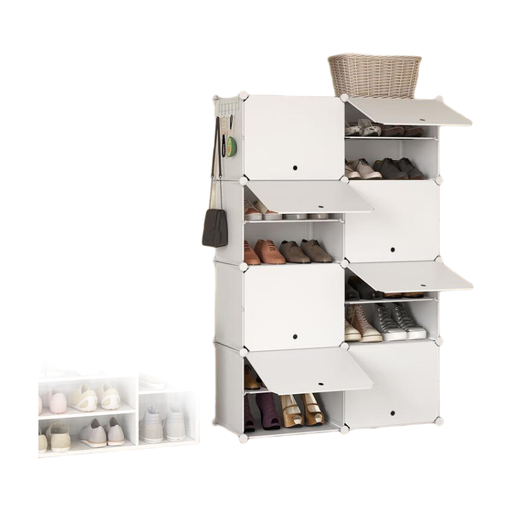
Why this product suits your needs: This system is designed for families and shoe lovers who need space for up to 32 pairs and want the flexibility to change the layout.
Depending on how you assemble it, the compartments can be arranged vertically, horizontally or as several smaller units. Dividers can be removed to make room for larger items.
Eight compartments, side hooks and modular PP panels with a metal frame; the product description states that it can hold up to 32 pairs of shoes.
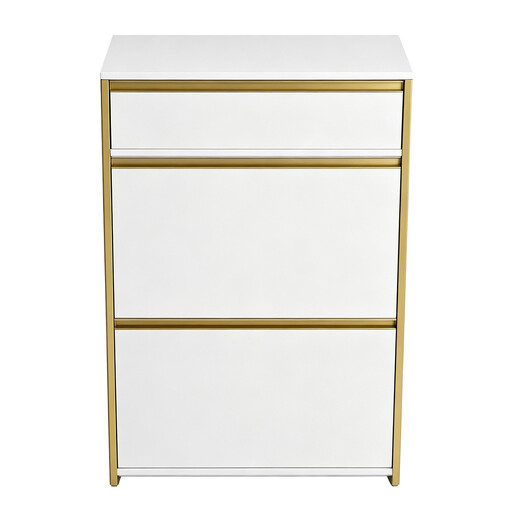
Why this product suits your needs: Measuring 60 × 24 × 104.5 cm, this cabinet can store small items, books or decorations as well as shoes, making it suitable for the hallway, living room or bedroom.
Adjustable and removable shelves give you more flexibility than a fixed layout. An anti-tip kit is provided for wall fixing.
Four adjustable shelves, a drawer and a top surface; the product description states that it can hold up to 12 pairs of shoes.
We’ve put together a complete, regularly updated list of products that meet these strict selection criteria and fully comply with the safety regulations in force in the EU.
Allow enough time for assembly and sort the screws, connectors and shelves before you begin. For tall or modular systems, fit the anti-tip kit as instructed. Distribute weight evenly across the compartments and don’t exceed the stated maximum load.
To help your shoe cabinet last longer:
A depth of around 24 to 30 cm may suit a narrow hallway. What matters, though, is the usable internal depth. Also measure the skirting boards, the space needed to open the door and the distance from other furniture.
It depends on your shoe size, the type of shoes and how the compartments are arranged. Flat shoes need less room than trainers, boots or heels. Figures such as 20, 24 or 32 pairs are therefore a guide and should be checked against the internal measurements.
An open shoe rack gives you quick access and doesn’t need extra space for doors or tilt-out compartments. A closed shoe cabinet keeps shoes out of sight and helps keep dust off them. The best option for your hallway depends mainly on the size of the space, how much cleaning you’re prepared to do and the look you want.