
Lieferung heute & morgen

Qualitätsgarantie

Willkommens-Angebote freischalten: KOSTENLOSE Lieferung | Bis zu 80 % RABATT | Kostenlose 30-Tage-JoyPlus-Testphase
App herunterladen
A shoe cabinet should keep your shoes neatly stored, avoid making the hallway feel unnecessarily narrow and remain easy to access every day. That is why your choice should be based on more than just colour and design. The interior dimensions, stability, ventilation and actual storage capacity are what really matter.
Manufacturer claims such as “for 20 or 30 pairs” often refer to flat shoes or slim trainers. Boots, hiking shoes and footwear with a high shaft require more height. When choosing a shoe cabinet with flap compartments or doors, you should therefore check the compartment height and width, rather than relying solely on the advertised pair capacity.
A slim shoe cabinet is suitable for narrow hallways, but it usually needs to be taller to provide sufficient storage space. Before buying, check:
A space-saving shoe cabinet can be practical if its depth is around 23 to 30 cm, for example. However, an anti-tip device is particularly important for very tall furniture.
Doors and flaps protect shoes from dust. However, shoes may still be damp after being worn. A closed shoe storage unit should therefore not be used to store wet footwear. Allow shoes to dry first and look for air circulation, removable shelves or small openings, if these are mentioned in the product description.
Measure the largest shoes in your household and compare these measurements with the interior dimensions. A shoe rack with several compartments is flexible if its shelves can be removed or adjusted in height. A model with lots of individual compartments can be useful for families, while singles or smaller households may be perfectly well served by a compact shoe cabinet with flap compartments.
Also bear in mind that the external dimensions do not correspond to the usable interior space. Doors, frames and back panels reduce the actual storage area.
Easy-care surfaces are useful in the hallway. PP plastic panels can generally be wiped clean with a damp cloth and are less sensitive to occasional moisture than untreated wood. MDF and chipboard furniture often offers a homely appearance, but should be protected from standing water.
Look for specific information about:
The E1 classification for wood-based materials describes a formaldehyde emissions class. However, it does not replace an assessment of the product’s overall quality and says nothing about its load capacity or whether it will accommodate your shoes.
Tall or narrow furniture should be secured against tipping, especially in households with children. If an anti-tip device is provided, it should be attached to the wall according to the instructions. Before assembly, check that the wall plugs and screws are suitable for the wall material.
Modular systems often use push-fit connectors, metal frames and plastic panels. This construction can allow for flexible configurations, but requires careful assembly. Once assembled, check that all connectors are fully engaged and that the furniture is standing on a level surface.
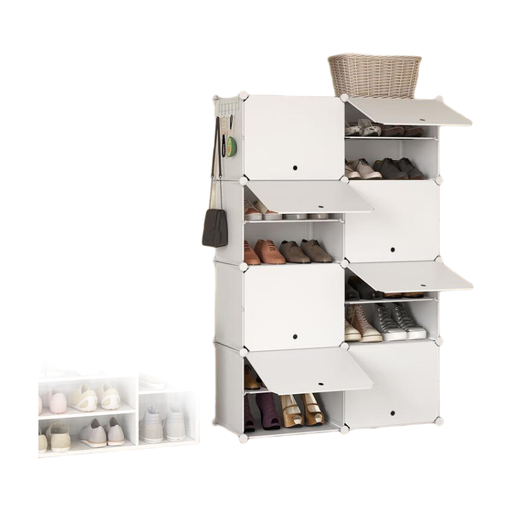
Why this product suits this profile: According to the product details, the modular system provides eight compartments and can be assembled as a vertical shoe rack or in another configuration. It is suitable for households that want to adapt their shoe storage flexibly.
According to the manufacturer, the compartments can be altered by removing the dividers. This makes it possible to adapt the layout to different shoe sizes.
White PP panels, a metal frame, eight compartments and a small hammer supplied for assembly.
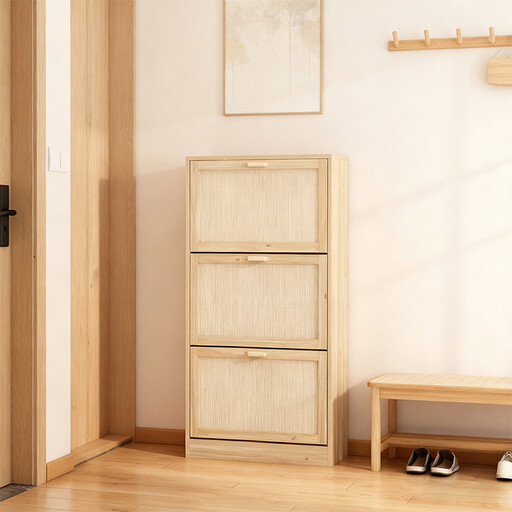
Why this product suits this profile: The wood-effect finish, three flap compartments and adjustable shelves are well suited to a permanent hallway installation where depth is limited.
The interior layout is not completely fixed: the shelves can be removed or adjusted. An anti-tip device is provided.
External dimensions of approximately 60 × 118 × 24 cm, capacity for up to twelve pairs according to the product details, and a sturdy top panel supporting up to 10 kg.
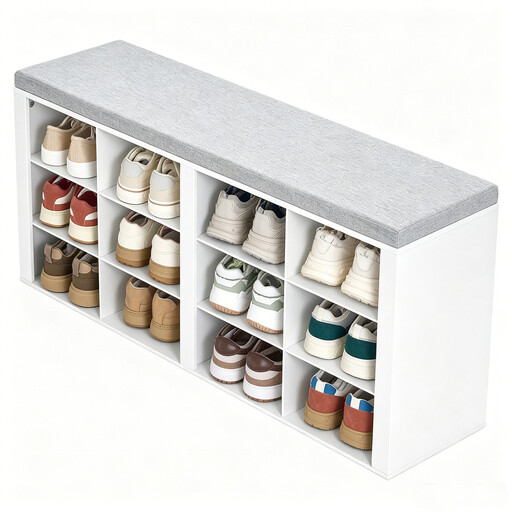
Why this product suits this profile: The bench makes it easier to put on and take off shoes in the entrance area. Height-adjustable shelves allow you to accommodate trainers, heeled shoes and taller footwear.
The variable compartment height reduces the risk of individual shoes not fitting in the designated spaces. The removable seat cover can be cleaned separately.
Dimensions of approximately 104.5 × 30.5 × 49.5 cm and a load capacity of up to 150 kg according to the product details.
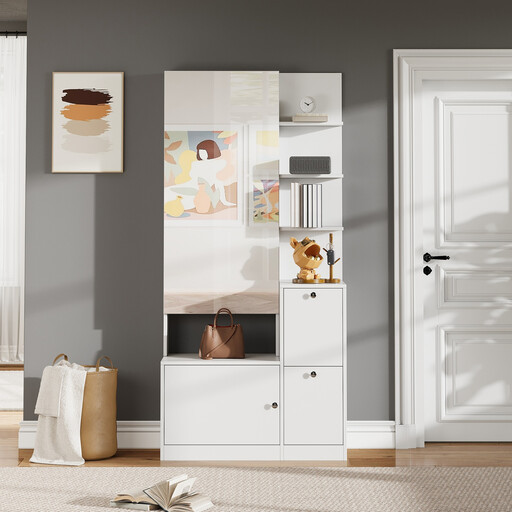
Why this product suits this profile: This piece of furniture makes use of the hallway’s height and combines shoe compartments, enclosed storage, open shelves and an integrated mirror.
The product description states a depth of 40 cm and two pull-out shoe cabinets. Before buying, check that this depth is suitable for your walkway.
85 × 40 × 180 cm, five open shelves, an integrated mirror and two pull-out shoe storage sections.
We have put together a complete, regularly updated list of products that fully meet these strict selection criteria and the safety regulations applicable in the EU.
A depth of around 23 to 30 cm may be sufficient for narrow hallways if you mainly store flat shoes. For larger shoe sizes or bulkier footwear, the interior dimensions are crucial. Measure your longest shoe and allow a little extra space.
A shoe cabinet with flap compartments needs sufficient space in front of the unit to open, but can be particularly slim in design. A shoe cabinet with doors is often easy to organise and protects the contents from dust. The right option depends on the available floor space, shoe height and how frequently you want to access your footwear.
Sort shoes by season or frequency of use, and use adjustable compartments for different heights. Wet footwear should be allowed to dry outside the closed cabinet first. Regularly cleaning the shelves and correctly fitting the anti-tip device will help ensure safe, well-maintained use.