
Lieferung heute & morgen

Qualitätsgarantie

Willkommens-Angebote freischalten: KOSTENLOSE Lieferung | Bis zu 80 % RABATT | Kostenlose 30-Tage-JoyPlus-Testphase
App herunterladen
By a Joybuy Product Recommendation Officer
A cluttered entryway with shoes blocking the path is a common problem in many homes. The right shoe storage not only creates order but also protects your shoes from dust and damage. However, the selection is vast, ranging from simple shoe chests to modular systems. This guide is designed to help you find a functional and aesthetically pleasing solution for your needs. We will introduce various concepts and highlight their specific features so you can make an informed decision.
Before you decide on a model, several fundamental criteria should be considered. These will help you narrow down the selection to products that truly fit your home and your habits.
The first step is to precisely measure the intended location. Especially in a narrow hallway, every inch counts. Pay attention not only to the Width and Height but also to the Depth of the furniture. A cabinet that is too deep can obstruct the walkway, while a model that is too shallow may not be suitable for larger shoe sizes (e.g., size 11 and up) or boots. Check that doors or flaps have enough room to open without blocking other furniture or doorways.
Consider how many pairs of shoes you need to store and what types of shoes you own.
The material affects not only the durability but also the style of the furniture. A modern shoe cabinet made of engineered wood with clean lines fits well into minimalist interiors. Plastic models are often lightweight, flexible, and easy to clean. Metal frames have an industrial feel and are typically very sturdy. Choose a design that harmonises with your existing furniture to create a cohesive overall look.
Here, we present three different products that meet various shoe storage requirements. The selection is based on product features and their everyday functionality.
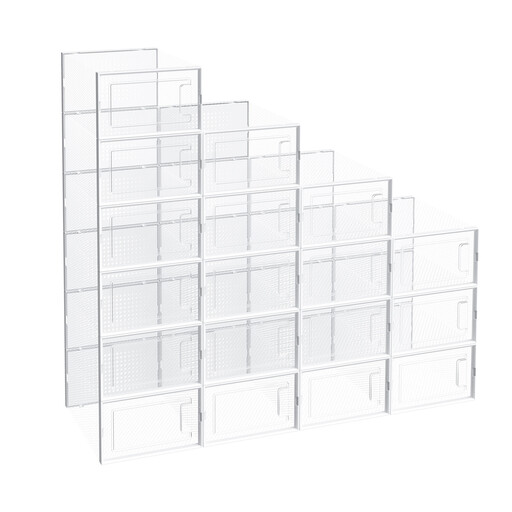
Why it stands out: This system consists of 18 individual, stackable boxes, offering the highest degree of flexibility. The transparent front door allows you to see the contents at a glance without having to open the box. The modular design allows the boxes to be arranged individually—side by side, on top of each other, or even in different locations around the home.
Advantages:
Who it's for: For individuals looking for a flexible and expandable solution who like to keep their shoe collection in view. Especially practical for sneaker enthusiasts or households where the number of shoes changes frequently.
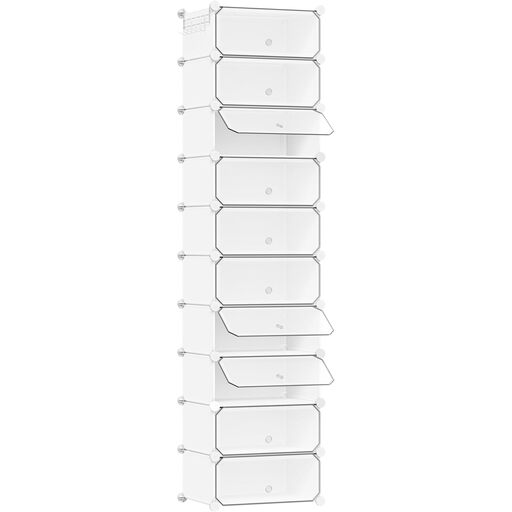
Why it stands out: This shoe cabinet from WOLTU is a modular interlocking shelving system made of plastic panels and a metal frame. With ten compartments, each holding up to two pairs of shoes, it offers high capacity in a small footprint. The shape of the rack can be adapted to the available space during assembly.
Advantages:
Who it's for: For families or shared living spaces that need a cost-effective and customisable solution with plenty of storage. Its versatility also allows it to be used as an organiser for other items in different rooms.

Why it stands out: This cabinet from Tribesigns presents itself as a fully-fledged piece of furniture in the style of a shoe chest. Made from E0-grade engineered wood and metal elements, it combines closed storage with an open compartment at the bottom. The adjustable shelves inside allow for storing different types of shoes, from flat slippers to ankle boots.
Advantages:
Who it's for: For anyone looking for a durable and visually appealing furniture solution for the hallway or living room. Ideal for users who value a tidy appearance and prefer a fixed structure over a flexible system.
The products featured cover a broad spectrum, but the world of shoe storage is even more diverse. If you are looking for individual solutions for particularly valuable shoes or for transparent organisers for your wardrobe, you will find more specialised products in our shoe boxes category.
1. What is better, an open shoe rack or a closed shoe cabinet? Both options have their merits. An open rack ensures good ventilation for the shoes and quick access. It is particularly suitable for shoes that are in daily use. A closed shoe cabinet protects shoes from dust and UV light and creates a very neat appearance in the room. The decision depends on personal priorities: quick access and ventilation versus protection and a clean look.
2. How can I store shoes to save space? To save space, vertical solutions are ideal. Tall, narrow shoe cabinets or stackable boxes make optimal use of the room's height. Tilt-out shoe cabinets are also very space-saving due to their shallow depth. For shoes not in seasonal use (e.g., winter boots in summer), it is recommended to store them in boxes in the attic or basement to free up space in the hallway for current footwear.
3. How many shoes fit in an average shoe cabinet? The capacity varies greatly depending on the model. Compact tilt-out cabinets for narrow hallways often hold 8 to 12 pairs. Larger shoe chests can accommodate 20 to 30 pairs. Modular systems are flexible in their capacity and can hold dozens of pairs depending on the number of elements. Always check the product description for specific details on capacity and the internal dimensions of the compartments.