
Lieferung heute & morgen

Qualitätsgarantie

Willkommens-Angebote freischalten: KOSTENLOSE Lieferung | Bis zu 80 % RABATT | Kostenlose 30-Tage-JoyPlus-Testphase
App herunterladen
A cluttered entryway with shoes scattered about is a common frustration in many homes. The right shoe cabinet promises a quick fix, but the selection is vast, and not every model delivers on its promise. As your Joybuy Product Recommendation Officer, I'll help you identify common purchasing pitfalls and make an informed decision that perfectly suits your needs and living space.
Many buyers are drawn in by appealing product photos or seemingly low prices, only to find that the furniture is impractical or already broken after just a few months. Pay special attention to these three points:
To avoid buyer's remorse, focus on objective criteria that determine practical, everyday usability.
The stability of a cabinet is directly linked to the materials used.
Measure your available space precisely before making a decision. Every inch counts, especially in a narrow hallway. A space-saving tilt-out shoe cabinet with a shallow depth can be an excellent solution here. In contrast, a modular shelf or interlocking system offers maximum flexibility. You can adjust its height and width to fit into alcoves or the space under a staircase. Models with doors create a clean, uncluttered look and protect your shoes from dust.
Here are some recommendations tailored to different living situations and needs.
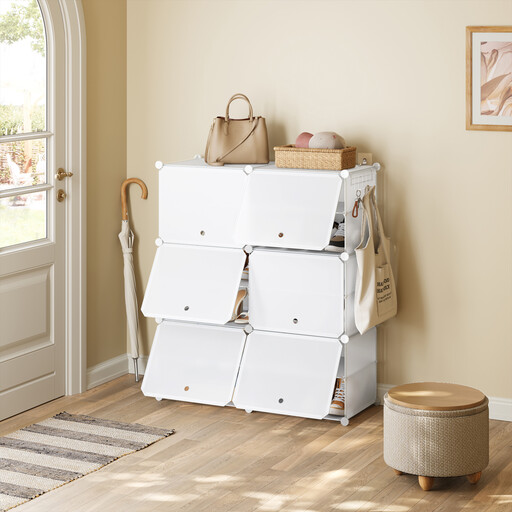
Why it's a great fit: Ideal for anyone looking for an adaptable solution. The interlocking system can be assembled in 2 or 3 rows depending on the available space, allowing it to flexibly adapt to a hallway, bedroom, or the area under the stairs.
The construction of PP panels with a metal frame and ABS connectors ensures a stable structure, avoiding the problem of wobbly, cheap shelves. The compartments can be adjusted for boots, which makes the capacity claim more realistic.
High adaptability due to its modular design; water-resistant and easy-to-clean panels; includes extra hooks for accessories.
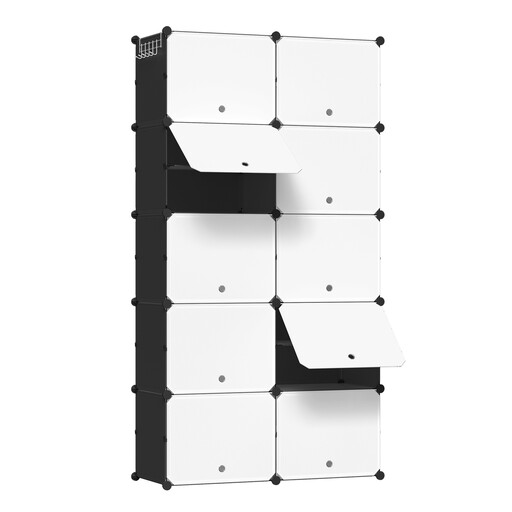
Why it's a great fit: With a capacity for up to 40 pairs of shoes, this shelving system is the answer to shoe chaos in larger households. It makes optimal use of vertical space.
This model sidesteps the misleading capacity trap through its sheer volume. The dividers are removable, so even boots or large bags can fit, providing true flexibility.
Very high storage capacity; removable dividers for bulky items; can also be used as a bookshelf or multi-purpose cabinet.
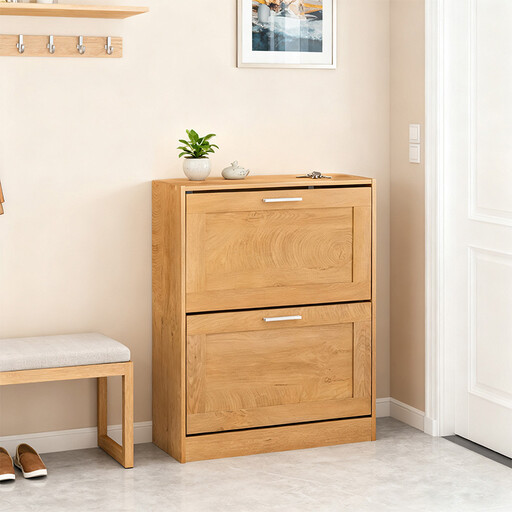
Why it's a great fit: With a depth of only 23 cm, this tilt-out shoe cabinet is extremely space-saving and blends discreetly into the hallway thanks to its classic design. Shoes disappear completely behind the flaps.
The unit is made of solid MDF and PB panels, giving it a stable and high-quality feel—unlike flimsy plastic shelves. Its construction is specifically designed for space-saving storage.
Very shallow depth, ideal for narrow hallways; closed design for a tidy appearance; adjustable compartments for different shoe heights.
We've compiled a complete, up-to-date list of products that fully meet these strict selection criteria and rigorous safety standards.
For a narrow hallway, tilt-out shoe cabinets with a depth of 20 to 25 cm are a great choice. Standard shoe cabinets or shelves where shoes stand straight require a depth of at least 35 cm to easily accommodate larger shoe sizes. Always measure your available space before buying and also account for the swing clearance of any doors or flaps.
The main advantage is flexibility. You can adapt a modular shelf to your exact spatial needs—whether in height, width, or shape. It can also be easily disassembled and reassembled if you move. Many systems allow you to remove dividers to create compartments for boots or other bulky items, making them a true multi-purpose cabinet.
Yes, but only if the material is suitable. A bathroom cabinet must be moisture-resistant. Models made of lacquered MDF, plastic (like PP panels), or powder-coated metal are the right choice here. Untreated wood or basic particleboard would quickly swell in the damp environment. Check the product description to see if the cabinet is explicitly rated for use in damp rooms.