
Lieferung heute & morgen

Qualitätsgarantie

Willkommens-Angebote freischalten: KOSTENLOSE Lieferung | Bis zu 80 % RABATT | Kostenlose 30-Tage-JoyPlus-Testphase
App herunterladen
A shoe cabinet with doors keeps shoes out of sight in the hallway, bedroom or living room, and can make cleaning easier. However, not every design suits every household. It’s easy to choose furniture based on its appearance or stated capacity, while overlooking depth, internal layout and tip-over safety.
That’s why the Joybuy Product Recommendation Officer’s selection focuses on clear, practical criteria: footprint, usable compartments, materials, assembly and suitability for everyday use.
The manufacturer’s stated capacity, such as “for 20 or 30 pairs”, is only a guide. High-top trainers, ankle boots and heeled shoes need more height than flat slippers. With a tilt-out shoe cabinet, wider styles or shoe boxes can also reduce the usable space.
Before buying, check:
For a narrow hallway, a depth of 24 to 30 cm is often more practical than a deeper piece of furniture. However, it’s important to check that the doors, flaps or drawers can open fully. You’ll also need to allow for skirting boards, radiators and door frames.
So, when planning for a shoe cabinet in a small room, use the overall dimensions, including handles, doors and feet. It’s also worth leaving space to open it and clean around it.
Don’t judge a tall or modular shoe cabinet on its footprint alone. The taller and lighter the construction, the more important it is to have suitable anti-tip protection. Many designs come with a wall-fixing device, which must be fitted in a way that’s suitable for your wall type.
If you have children or pets, the furniture should be securely anchored. A shoe cabinet isn’t designed for climbing or sitting on unless this is explicitly stated as a feature.
Start by measuring the space available. For a hallway shoe cabinet, width, depth and height are all equally important. A design with adjustable shelves can accommodate different types of shoes more easily than a fixed layout.
A shoe rack with doors is a good choice if you want to keep visible clutter to a minimum. The doors also protect the contents from dust, but they don’t replace regular cleaning and ventilation. If your shoes are damp, let them dry thoroughly before putting them away.
MDF and coated wood-based materials provide a smooth, furniture-style finish. PP panels are lightweight, wipe-clean and, in some modular systems, can be combined in different ways. Metal frames and connectors can help to stabilise the structure, provided they’re assembled correctly.
Look for:
A shoe bench with storage can make it easier to put your shoes on, but it needs a seat with an adequate weight capacity and a comfortable seat height. A drawer is handy for keys or shoe-care accessories, but it isn’t a substitute for a separate organiser. If you’re choosing a white shoe cabinet, make sure the finish, handles and visible edges suit the rest of your furniture.
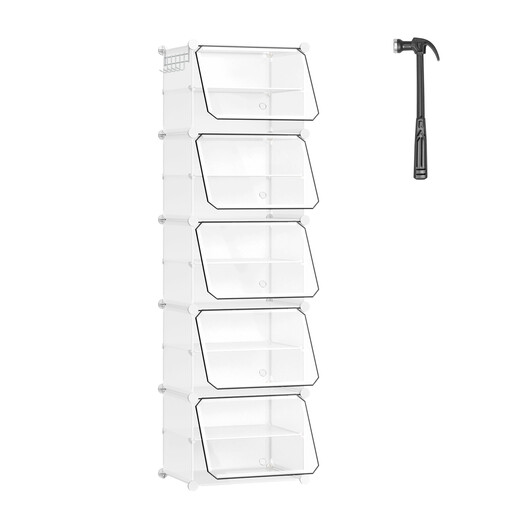
Why this product suits this profile: With ten compartments, doors and side hooks, this modular system is well suited to smaller households and anyone looking to tailor the layout to fit a particular alcove.
The compartments and doors are clearly specified, and the modular design makes the internal layout easy to understand. The hooks provide extra space for keys or bags.
The PP panels are wipe-clean, and the system comes with a rubber mallet and assembly accessories.
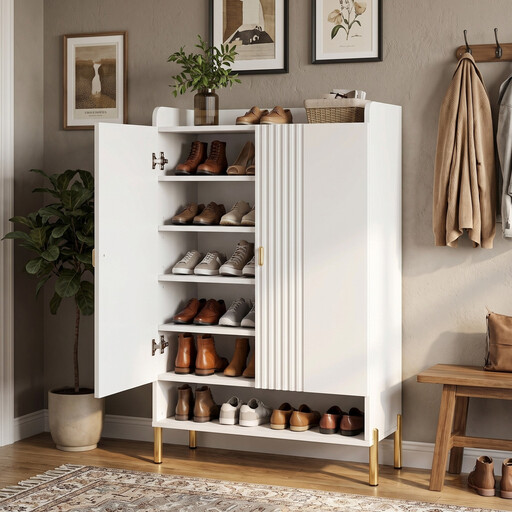
Why this product suits this profile: This freestanding piece combines concealed storage with a sturdy wooden construction, metal feet and a flexible internal layout.
The shelves can be adjusted in height or removed. This means the stated capacity isn’t limited to shoes of just one height.
Measures 75 × 36,5 × 111 cm, with six tiers and a top surface that can be used for storage.
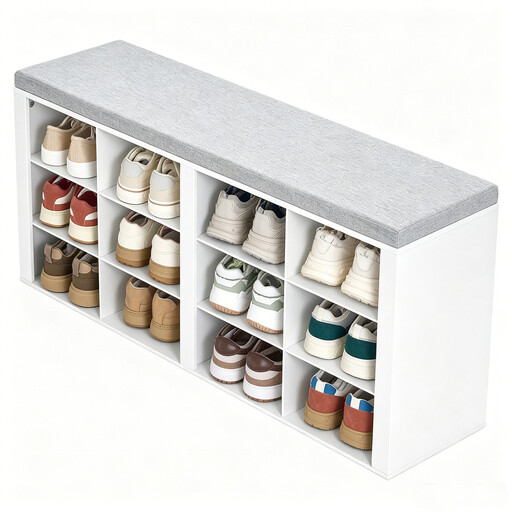
Why this product suits this profile: Combining a bench with shoe storage makes this a good choice for family hallways where shoes are put on and taken off regularly.
The height-adjustable shelves can be adapted for trainers, boots or heeled shoes. The removable seat cover makes it easier to keep clean.
Measures 104,5 × 30,5 × 49,5 cm, with twelve compartments and a stated load capacity of 150 kg.
We’ve put together a complete, regularly updated list of products that meet these strict selection criteria and fully comply with the safety regulations in force in the EU.
It depends on the shape of your shoes and the cabinet’s design. For narrow hallways, models around 24 to 30 cm deep may be a good option. Before buying, check that your shoes will fit inside fully and that the doors or flaps can open.
Its lifespan depends on the materials, load, assembly and care. Distributing weight evenly, storing dry shoes and fitting anti-tip protection correctly can help preserve the structure during everyday use. Check damaged connectors or loose screws promptly.
A tilt-out shoe cabinet often takes up little depth, making it suitable for narrow entranceways. A shoe rack with doors, on the other hand, usually offers a more flexible internal layout. For households with different types of shoes, adjustable shelves are often more practical than fixed tilt-out compartments.