
Lieferung heute & morgen

Qualitätsgarantie

Willkommens-Angebote freischalten: KOSTENLOSE Lieferung | Bis zu 80 % RABATT | Kostenlose 30-Tage-JoyPlus-Testphase
App herunterladen
By Joybuy's Product Recommendation Officer
A cluttered entryway with shoes blocking the path is a daily nuisance in many homes. It not only detracts from your hallway's appearance but can also become a tripping hazard. The right shoe storage creates order, protects your footwear, and enhances your entryway both functionally and aesthetically.
This article serves as a practical guide. We will introduce various types of shoe cabinets and analyse their features to help you make an informed decision that perfectly matches your available space, shoe collection, and interior design style.
Before you decide on a model, a few considerations can help narrow down your options and ensure you find a solution that you'll be happy with for years to come.
The type of storage significantly impacts both functionality and appearance.
Precisely measure the available space in your hallway (width, height, depth). Remember to account for the swing clearance of any doors or flaps. Consider how many pairs of shoes you currently own and whether you might need more space in the future. For shoe lovers or families, a high-capacity shoe cabinet is essential, while a compact model is often sufficient for singles or couples in smaller flats.
The material determines not only the durability but also the style of the furniture.
Here, we present three different models that cater to various needs and spatial situations.
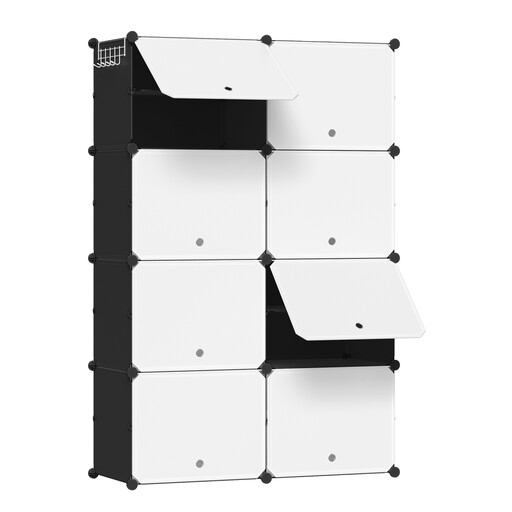
What makes this model stand out The strength of this system lies in its exceptional modularity. It consists of individual PP panels and connectors that can be assembled in any configuration you desire. Whether as a tall tower, a wide sideboard, or several small boxes – its shape adapts to your space, not the other way around.
Advantages:
Who is it for? For families, collectors, or people in shared living spaces who need customisable shoe storage with maximum capacity. It's also a practical option for use in a basement or attic.
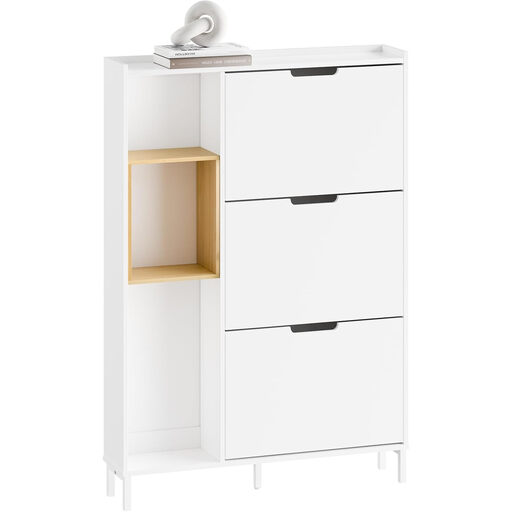
What makes this model stand out With a depth of just 19 cm, this tip-out shoe cabinet is specifically designed for very narrow entryways. The combination of a white body and bamboo accents gives it a modern, Scandinavian-inspired aesthetic that visually enhances the hallway.
Advantages:
Who is it for? For residents of apartments or small homes looking for a space-saving yet stylish solution for their hallway. Ideal for singles and couples with a manageable number of shoes.
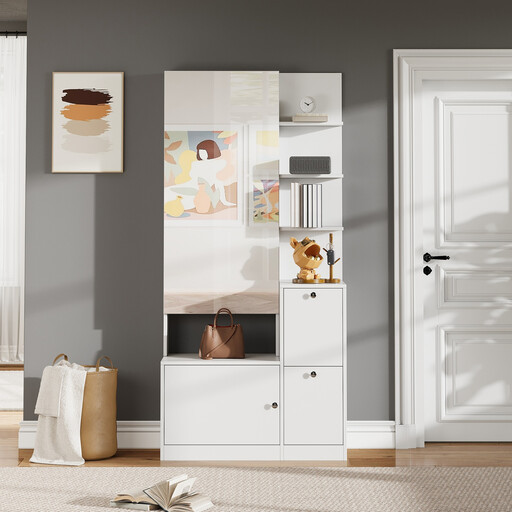
What makes this model stand out This hall tree with shoe storage is a complete solution for the entryway. It makes optimal use of vertical space and combines multiple functions in one piece of furniture: a cabinet section for jackets, pull-out shoe compartments, open shelves, and an integrated mirror.
Advantages:
Who is it for? For anyone seeking a comprehensive and cohesive solution for their hallway who doesn't want to combine multiple individual pieces of furniture. Especially practical for homes where the entryway is the only cloakroom.
If the models presented don't exactly match your vision or if you're interested in other designs and sizes, there are numerous other possibilities. A well-organised hallway can be achieved with a variety of furniture pieces.
Discover a wider selection of chests and cabinets in our Hallway Cabinets category to find the perfect addition to your entryway.
1. How deep should a shoe cabinet be for a narrow hallway? For narrow hallways, models with a depth between 17 cm and 25 cm are ideal. Tip-out shoe cabinets are often the best choice here, as their design is particularly space-saving. Standard shoe cabinets typically have a depth of 30 cm to 40 cm, which can obstruct the walkway in tight corridors.
2. What is the advantage of a closed shoe cabinet over an open shoe rack? A closed shoe cabinet protects shoes from dust, dirt, and fading from sunlight. It also ensures a calm and tidy appearance in the hallway. An open shoe rack, on the other hand, allows for better ventilation of the shoes and very quick access. The choice depends on whether a flawless look or maximum functionality is the priority.