
Lieferung heute & morgen

Qualitätsgarantie

Willkommens-Angebote freischalten: KOSTENLOSE Lieferung | Bis zu 80 % RABATT | Kostenlose 30-Tage-JoyPlus-Testphase
App herunterladen
A shoe cabinet for the hallway should keep shoes neatly organised, leave the walkway clear and complement your existing hallway furniture. In homes with narrow entranceways, however, unclear dimensions, inflexible compartments or complicated assembly can quickly lead to the wrong purchase.
A piece of furniture may look slim in product photos but still stick out a long way into the hallway. Before buying, measure the available wall width and depth, as well as the distance from doors. For narrow entranceways, models around 23 to 24 cm deep are often easier to fit in than traditional cabinets measuring 35 cm or more.
You should also check whether doors, drawers or flaps can open fully. A tilt-out shoe cabinet needs room in front of it, while a shoe cabinet with flaps may project into the room differently, depending on its design.
Claims such as ‘holds twelve pairs of shoes’ depend on shoe size, boot height and style. Trainers usually take up less space than boots or wide sports shoes. With a shoe cabinet with adjustable shelves, you can adapt the shelves to different types of footwear. Fixed shelves, on the other hand, make the storage space less flexible.
So measure not only the overall dimensions but also the internal height of the compartments. Boots may be better stored separately. You’ll find a useful overview in the boot storage cabinet category.
Many hallway furniture items are delivered flat-packed. Clear instructions, labelled parts and the necessary fixings make assembly easier. Wall fixing is also important for a tall shoe cabinet or a model with several open compartments. The cabinet should stand on a level surface and, where provided for, be secured to the wall. Children should not climb on doors, drawers or open shelves.
Width and depth are particularly important in a small hallway. A slim shoe cabinet with a shallow depth can help free up space in the entranceway, but it often offers less room for larger shoes. A tall cabinet makes use of the wall space, but should be securely fixed.
Here’s a practical way to measure:
A shoe cabinet with a drawer also provides space for keys, shoe-care products or small everyday items. A shoe cabinet with flaps keeps shoes mostly out of sight. Open compartments, meanwhile, are handy for bags, decorative items or frequently worn shoes.
If you’d also like to store scarves, hats or household items alongside your shoes, look for a cabinet with several separate sections. Adjustable shelves offer more flexibility, provided they can actually be removed or fitted at different heights.
MDF and particleboard are common materials for wood-based furniture. What matters is a sturdy construction, doors that close neatly and a load capacity suited to how you’ll use the cabinet. The stated load capacity for the top should not be confused with the maximum load for individual shelves.
A white shoe cabinet reflects light and can make small hallways feel more open. However, dust and dirt tend to show up more easily on light-coloured surfaces. A soft, slightly damp cloth is usually all you need for cleaning; follow the care instructions provided by the manufacturer.
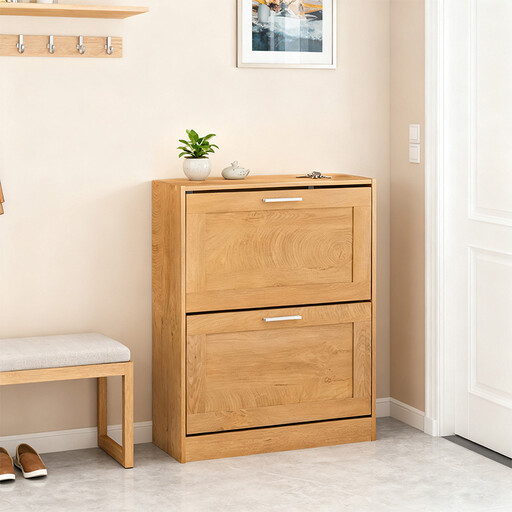
Why this product suits this need: At around 60 × 79 × 23 cm, this model is well suited to narrow hallways. It has two flaps and height-adjustable shelves.
Its shallow depth helps prevent the cabinet from taking up unnecessary space in the walkway. Removable shelves can be adjusted to accommodate shoes of different heights.
Two flaps, height-adjustable compartments, foot pads and a stated load capacity of up to 20 kg.
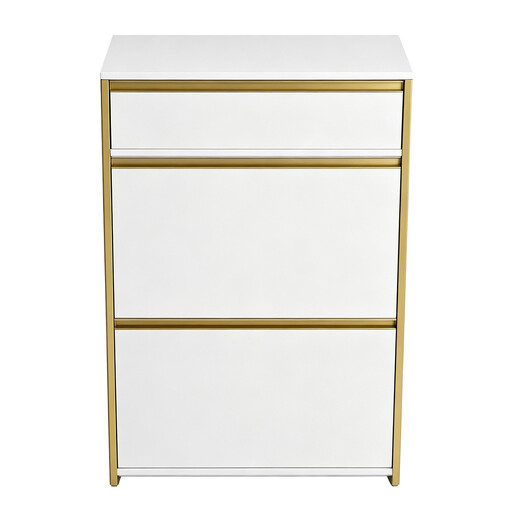
Why this product suits this need: This model combines shoe storage with a drawer, a top surface and adjustable shelves, measuring around 60 × 24 × 104.5 cm.
The flexible interior helps avoid the limitations of a fixed layout. When correctly secured to the wall, the anti-tip device can reduce the risk of the cabinet tipping over.
Four adjustable compartments, a drawer, metal handles and a construction made from high-density particleboard, according to the product description.
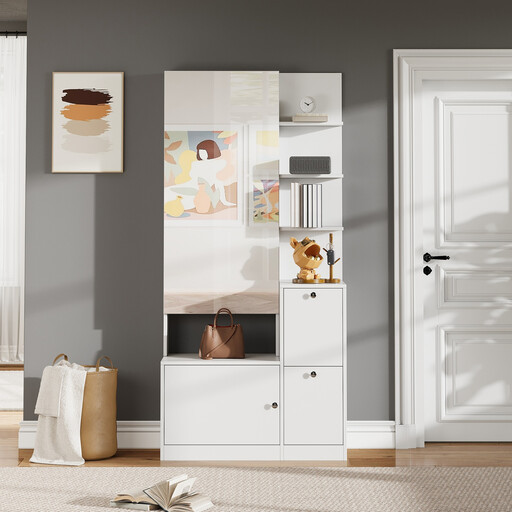
Why this product suits this need: This tall cabinet combines two pull-out shoe compartments, five open shelves, three internal sections and an integrated mirror.
The dimensions are clearly stated, and the separate sections make it easier to keep things organised. Before buying, check that a depth of 40 cm and a height of 180 cm will fit in your hallway.
Integrated mirror, two shoe cabinets with two levels each, five open shelves and a stated top load capacity of 50 kg.
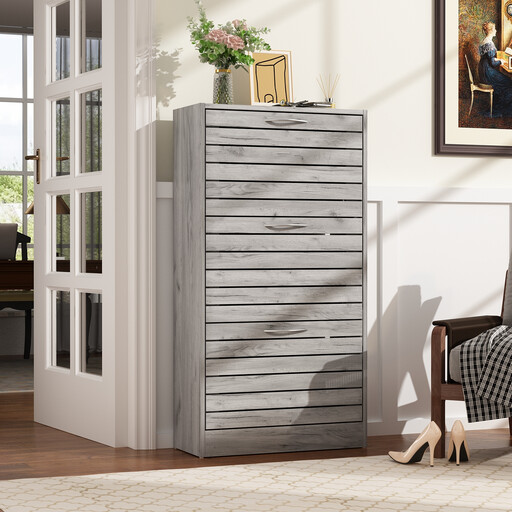
Why this product suits this need: At around 54 × 24 × 107 cm according to the product name, this model makes good use of vertical space while remaining relatively shallow.
The six separate storage spaces make it easier to sort your shoes. Before ordering, compare the stated capacity with your own shoe sizes.
Three flaps, six storage levels, a depth of around 24 cm and illustrated step-by-step assembly instructions, according to the product description.
We’ve put together a complete, regularly updated list of products that meet these strict selection criteria and fully comply with the safety regulations in force in the EU.
It depends on the walkway and the shoes you need to store. Models around 23 to 24 cm deep are often space-saving. However, larger shoes, boots or high-top trainers may need more internal space. Measure the available floor space and your shoes before buying.
The actual capacity depends on shoe size, sole width and compartment height. A manufacturer’s claim that it holds twelve pairs should therefore be treated as a guide. If you’re considering a tilt-out shoe cabinet with several levels, check that the flaps will close easily with your shoes inside.
An anti-tip device is a sensible precaution for tall or narrow furniture. Follow the assembly instructions and use the recommended fixings. The cabinet should also stand level and should not be used as a climbing aid.