
Lieferung heute & morgen

Qualitätsgarantie

Willkommens-Angebote freischalten: KOSTENLOSE Lieferung | Bis zu 80 % RABATT | Kostenlose 30-Tage-JoyPlus-Testphase
App herunterladen
A shoe rack should keep shoes organised, clear the hallway and fit the available space. In practice, however, unclear measurements, overstated capacities and unsuitable installation methods often lead to disappointing purchases. Especially in small flats or busy entrance areas, it is worth checking a few specific product details before buying.
Manufacturers often specify a maximum number of pairs. However, this depends on whether you are storing flat shoes, trainers, boots or high-heeled shoes. A shoe rack for 18 pairs may offer considerably less space when used for bulky footwear. For realistic planning, you should allow at least 10 to 15 per cent spare capacity.
Although a slim shoe rack takes up little floor space, it may be relatively tall. A model measuring 140 cm in height will not automatically fit beneath a coat rack or in an area with a low wall shelf. Before buying, measure the width, depth and height, including skirting boards and doors.
A wall-mounted shoe rack is only secure when the wall type, wall plugs and screws are compatible. Wall plugs supplied for plasterboard are not automatically suitable for concrete, brick or lightweight partition walls. With a freestanding shoe rack, on the other hand, a level surface and, where necessary, anti-tip protection are crucial.
For a hallway with limited depth, a shoe rack measuring around 19 to 30 cm deep is suitable. You should also check whether the cupboard or front door can be opened fully. A shoe rack with several tiers makes better use of vertical space, but it needs sufficient room above it.
For wall-mounted models, you must take the distance between the shoes and the walkway into account. This prevents shoes from protruding into the passage. For bedrooms, walk-in wardrobes or utility rooms, door organisers and particularly slim models may also be useful.
The load capacity should be stated for each tier and for the item of furniture as a whole. The stated load capacity of the three-tier WOLTU model is up to 5 kg per shelf. The eSituro shoe rack has a stated total load capacity of 35 kg. These limits must not be exceeded.
If you want to store boots, high-top trainers or boxes, look for removable or height-adjustable shelves. A fixed shoe shelf can quickly become impractical when used for different types of footwear.
Coated metal tubes are easy to clean with a damp cloth. Shelves made from laminated non-woven fabric can reduce the overall weight, but should be loaded evenly. Metal frames with plastic connectors need to be assembled carefully to prevent the tiers from wobbling.
An open rack provides easy access and good ventilation. A shoe cabinet offers greater protection from view and dust, but requires more depth and adequate ventilation. For wall-mounted models, secure anchoring to a suitable wall is a non-negotiable safety requirement.
The following selection categorises specific models by space requirements, capacity and installation method. The stated product data is the deciding factor, rather than general advertising claims.
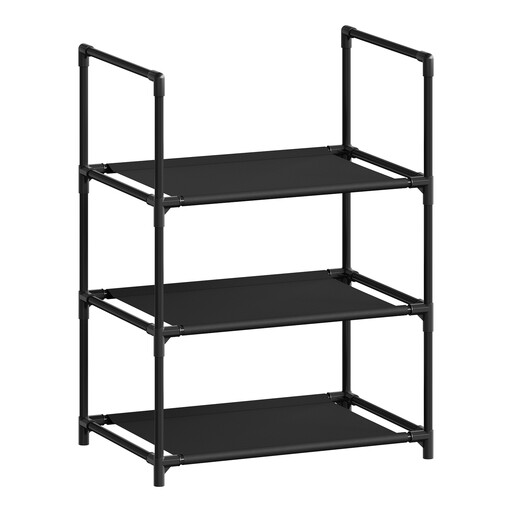
Why this product suits this profile: Measuring 41 × 28 × 55 cm and holding up to six pairs, this compact freestanding model is ideal for smaller hallways, rented flats or limited entrance areas.
The external dimensions and stated load capacity of up to 5 kg per tier make realistic planning easier. One shelf can be removed to accommodate tall boots or boxes.
Three tiers, a metal frame with non-woven fabric shelves and a tool-free slot-together system.
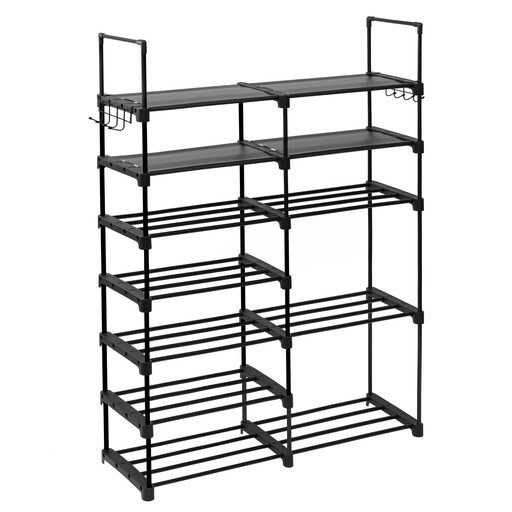
Why this product suits this profile: This open rack offers seven height-adjustable tiers, ten hooks and a stated capacity of 20 to 25 pairs. That makes it suitable for families and households with a varied shoe collection.
Height-adjustable tiers and removable protective covers accommodate different types of footwear, including high heels and boots.
35 kg total load capacity, seven tiers and additional hooks for coats, bags or scarves.
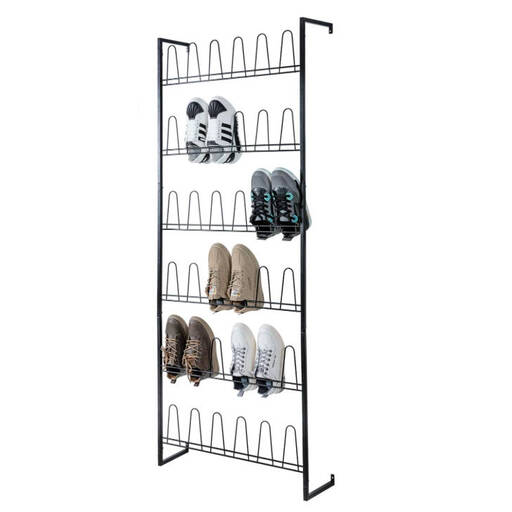
Why this product suits this profile: This wall-mounted shoe rack with 36 hooks is suitable for anyone who wants to keep the floor clear in the hallway, garage, utility room or walk-in wardrobe.
The capacity of up to 18 pairs and the need for wall mounting are clearly stated. Suitable fixings must be selected for other wall types.
Vertical storage, a metal construction and 36 hooks for different types of footwear.
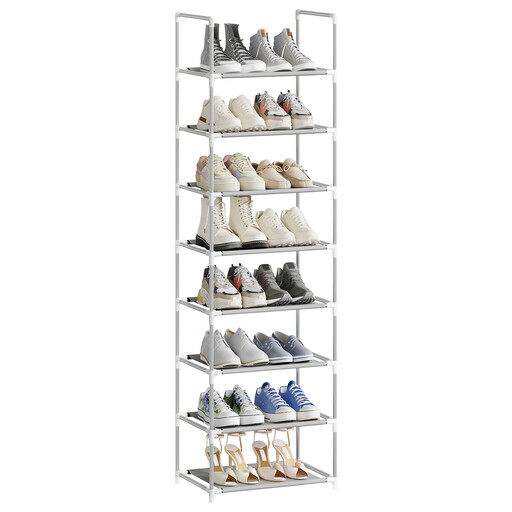
Why this product suits this profile: Measuring 41 × 28 × 140 cm, this tall rack makes use of wall space and, according to the product description, holds up to 16 pairs of shoes. It can be divided into two smaller units.
The removable tiers create space for boots or boxes. Anti-tip protection is provided; nevertheless, the rack should stand on a level floor.
Eight tiers, a divisible design, tool-free assembly and up to 5 kg per tier.
We have put together a complete, regularly updated list of products that fully meet these strict selection criteria and the safety regulations applicable in the EU.
For many hallways, a depth of around 19 to 30 cm is practical. The key consideration is that doors, passageways and skirting boards are not obstructed. You should also take the actual shoe size into account.
First, identify the type of wall. Different wall plugs and screws are required for plasterboard, brick and concrete. The rack must be installed at the specified mounting points and checked for stability after being loaded.
Its lifespan depends on the material, installation, load and frequency of use. Distributing the weight evenly, observing the stated load capacity and cleaning with a damp cloth can help extend its service life. Damaged connectors or bent parts should not be used any further.