
Lieferung heute & morgen

Qualitätsgarantie

Willkommens-Angebote freischalten: KOSTENLOSE Lieferung | Bis zu 80 % RABATT | Kostenlose 30-Tage-JoyPlus-Testphase
App herunterladen
A cluttered entryway, strewn with shoes, is a common annoyance in many households. The right shoe rack promises a quick fix, but the selection is vast, and not every model delivers on its promise. Before you make a decision, it's important to understand the typical weaknesses that can quickly turn a supposed organizational aid into a source of frustration.
This guide will help you identify the crucial features to find a functional and durable solution for your shoe storage needs.
The 3 most common problems when choosing a shoe rack:
To avoid these pitfalls, you should base your selection on three objective criteria. These will help you find a product that perfectly matches your available space, your shoe collection, and your expectations for durability.
The material is a key determinant of your shoe storage's stability and lifespan.
The design affects both the look and the everyday functionality.
Measure the available space precisely: Width, Height, and Depth are crucial. Then, count the number of shoe pairs you own, taking different types of shoes into account. A pair of winter boots requires significantly more room than a pair of sandals. Ideally, plan for a buffer for future purchases. Don't blindly trust the manufacturer's stated pair count; instead, check the internal dimensions of the compartments.
Instead of making a one-size-fits-all recommendation, we have selected models that cater to specific requirements and living situations.
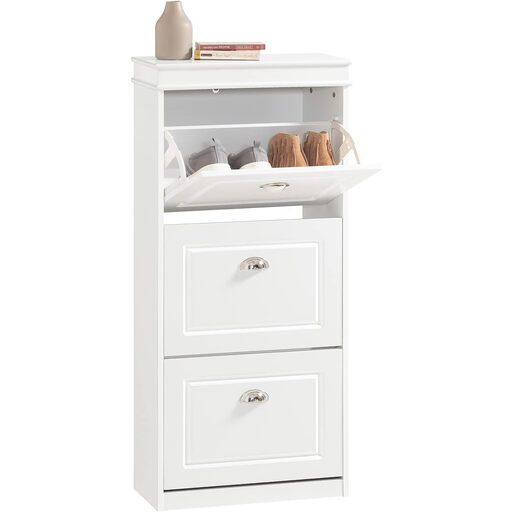
Why it's a great fit: With a depth of just 24 cm, this tip-out cabinet is specifically designed for the narrow hallways common in many urban apartments. The closed design makes the entryway look instantly tidy and organized.
Solves the issue of incorrect dimensions with its intentionally slim profile. The sturdy MDF construction, combined with the included anti-tip hardware for wall mounting, prevents instability.
Shallow 24 cm depth. Closed design protects shoes from dust. Includes anti-tip hardware for secure wall attachment.
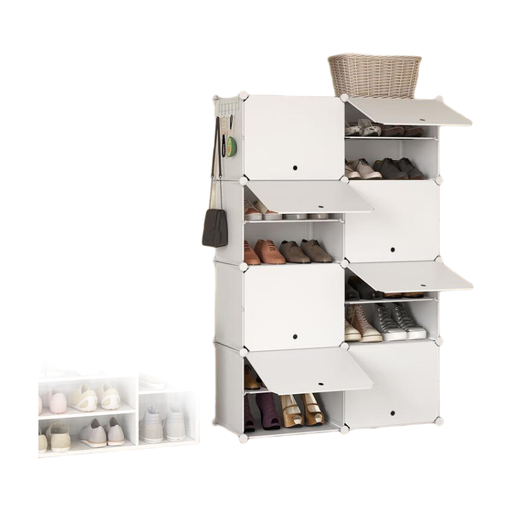
Why it's a great fit: This modular system offers a high capacity for up to 32 pairs of shoes and can be flexibly adapted to the available space and needs. The closed compartments hide the shoe chaos of an entire family.
Tackles the capacity problem with its large and flexible storage space. The snap-together system with ABS connectors and a metal frame is significantly more robust than simple plastic racks, thus counteracting instability.
Modular system for flexible arrangement. High capacity for up to 32 pairs of shoes. Partitions can be removed for larger items.
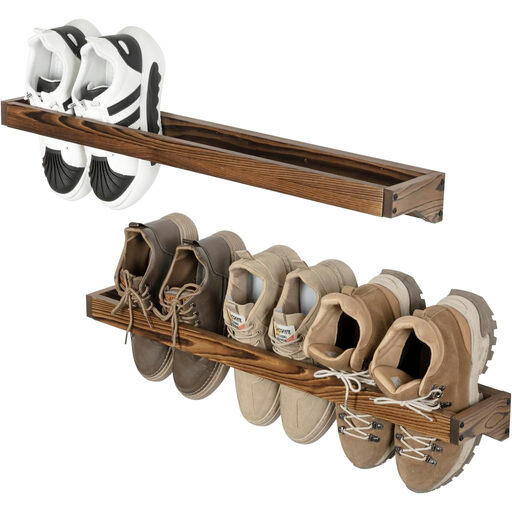
Why it's a great fit: Crafted from solid wood with a rustic, torched finish, this rack is more than just storage—it's a decorative element. The wall-mounted design creates a floating look and keeps the floor completely clear.
Sidesteps the problem of unsuitable materials by using durable solid wood. When correctly mounted to the wall, it is absolutely stable and avoids the wobbling of freestanding racks.
Made from solid wood. Space-saving wall-mounted design. Slatted shelves provide good ventilation for shoes.
We've compiled a complete, up-to-date list of products that fully meet these strict selection criteria and safety standards.
Measure the available width, height, and depth in the intended location. Plan for a few centimetres of clearance all around for air circulation and easy cleaning. For a shoe cabinet with hinged doors, you must also account for the radius of the opening door. A standard shoe depth is about 30–35 cm; a narrow rack or a tip-out cabinet should therefore have a depth of less than 25 cm.
A metal or plastic shoe rack is easiest to clean by wiping it with a damp cloth. Avoid aggressive or abrasive cleaning agents. For a wooden shoe rack, regular dusting is sufficient. For cleaning, a slightly damp cloth or a special wood cleaner can be used. With models made of MDF or particle board, it is particularly important to avoid standing moisture.
Generally, no. The compartments of a tip-out cabinet are designed for the dimensions of low-top shoes, sneakers, or sandals. Tall footwear like boots or ankle boots usually won't fit. For storing boots, open racks where a shelf can be omitted or shoe cabinets with adjustable shelves are more suitable.