
Lieferung heute & morgen

Qualitätsgarantie

Willkommens-Angebote freischalten: KOSTENLOSE Lieferung | Bis zu 80 % RABATT | Kostenlose 30-Tage-JoyPlus-Testphase
App herunterladen
A shoe rack should bring order without making your hallway feel even narrower. In small flats, tight entrance areas or shared wardrobes, it’s not just the number of shelves that matters. Dimensions, weight capacity, assembly method and how easily you can reach your shoes every day are equally important.
If you only focus on a high pair count or an attractive product photo, you often miss crucial details. Three typical buying mistakes crop up particularly often:
First, measure the available area including skirting boards, doors and the width of the walkway. A shoe rack for the hallway shouldn’t block the path. For tight alcoves, a narrow shoe rack around 20 to 30 cm deep could be suitable. What really matters, though, is the usable shelf width.
A model with an external depth of 23 cm may be enough for many flat everyday shoes. Tall boots or particularly large shoe sizes, on the other hand, need more room. With a shoe cabinet that has flaps, you should also check whether the doors can open fully.
An open shoe stand allows quick access and is ideal for shoes you wear every day. A closed shoe shelf or a shoe rack with doors keeps the entrance area looking tidier and offers better protection from visible dust.
Look out for:
With a stackable shoe rack or a modular design, the connections between individual elements must click fully into place. Racks simply placed on top of each other can lose their stability.
A metal shoe rack is often made from metal tubes with plastic connectors. This construction can be lightweight and easy to assemble. With fabric shelves, you should pay attention to the maximum load per level.
MDF, particle board or PP plastic differ in weight, care and assembly. For every type, the rule is: stick to the maximum weight capacity and place the rack on a level floor. For tall furniture, a wall fixing is recommended if the manufacturer provides one. Small children should not climb on or hang from racks.
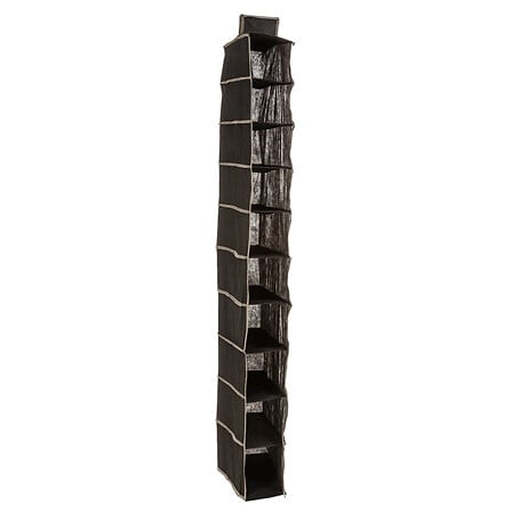
Why this product fits the profile: The vertical storage is designed for singles or small households with limited floor space. This model holds up to 10 pairs and can be hung or placed in a narrow alcove.
The capacity is clearly stated as 10 pairs. The note advising not to overload with heavy boots makes the usage limit transparent.
Lightweight PP pockets, reinforced cardboard structure, grey colouring and wipe-clean surfaces.
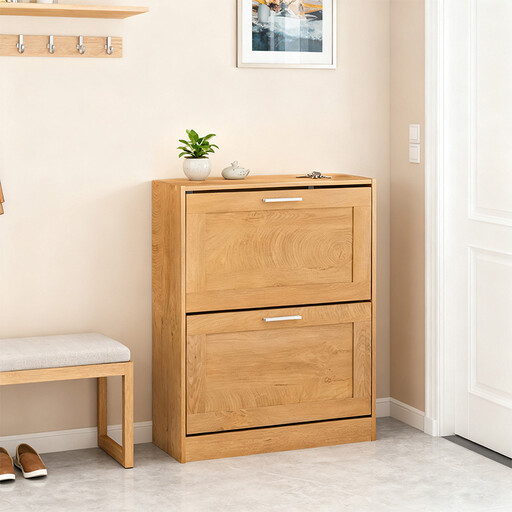
Why this product fits the profile: This closed piece of furniture, measuring roughly 60 × 79 × 23 cm, combines a compact footprint with a tidy appearance in the hallway.
The removable shelves can be adjusted to different shoe heights. Adjustable feet improve stability and protect the floor from scratches.
MDF and particle board construction, up to 20 kg load capacity, plus assembly accessories and instructions.
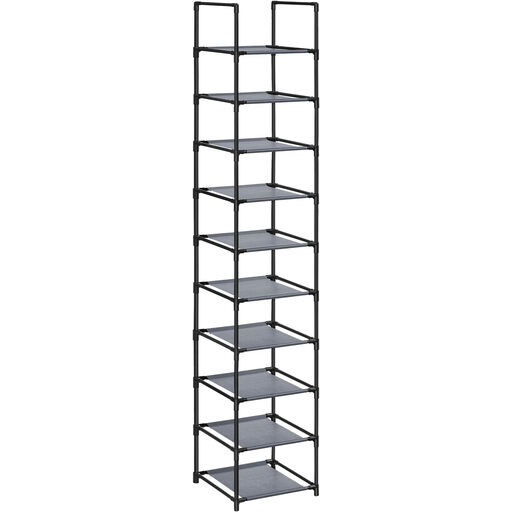
Why this product fits the profile: With a footprint of 33 × 33 × 173 cm, this tall shoe rack makes use of vertical space and is designed for families or extensive shoe collections in hallways, bedrooms and wardrobes.
The construction states ten tiers and a capacity of up to 30 pairs. The fabric covering should still not be overloaded and should only be cleaned with a damp cloth.
Metal frame, ten tiers, non-woven fabric shelves and a compact footprint of 33 × 33 cm.
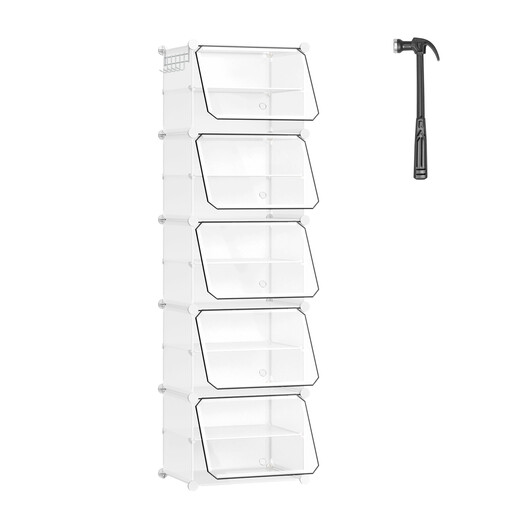
Why this product fits the profile: The modular cube system is ideal for households that want to adapt their shoe storage in the hallway or wardrobe to the available space.
The ten separate compartments prevent messy stacking. After assembly, all clips should be clicked into place; climbing on or hanging from the rack should be avoided.
Ten compartments for up to 10 pairs, wipe-clean PP panels, doors and side hooks for keys or bags.
We’ve put together a full, regularly updated list of products that fully meet these strict selection criteria and the safety regulations in force in the EU.
Along with the width, the depth matters. A slim model around 20 to 30 cm deep can work for many hallways. Also measure the distance to doors and check whether flaps or cabinet doors can open fully.
The actual capacity depends on shoe size, sole width and compartment height. For flat shoes, ten compartments might hold up to 10 pairs, for example. With a model that has ten tiers and a stated capacity of up to 30 pairs, this figure should be taken as a guide. Boots and large trainers usually need more room.
An open shoe stand offers quick access and makes airing easier. A shoe cabinet with doors looks neater in the entrance area and offers better protection from visible dust. If you change several pairs every day, you can combine open shelves with closed compartments.