
Lieferung heute & morgen

Qualitätsgarantie

Willkommens-Angebote freischalten: KOSTENLOSE Lieferung | Bis zu 80 % RABATT | Kostenlose 30-Tage-JoyPlus-Testphase
App herunterladen
As a Joybuy Product Recommendation Officer, I see the challenge many people face every day: a cluttered entryway where shoes block the path. This can quickly become a nuisance, especially in apartments with narrow hallways. The goal of this article is to give you a clear overview of different types of entryway shoe storage. We'll introduce you to various concepts—from open shelves to closed cabinets—so you can make an informed decision for your home.
Before you decide on a model, the following three points will help you define the requirements for your new shoe storage solution.
The available space is the most critical factor. Carefully measure the designated spot in your hallway, bedroom, or closet (width, height, depth). For particularly tight spaces, a slim shoe cabinet or a space-saving tip-out shoe cabinet, which requires very little depth, is ideal. Also, consider that doors or flaps need enough room to open. Open shelves often create a more airy feel, while closed cabinets provide a calmer, more streamlined appearance.
The choice of material affects not only the look but also the stability and maintenance required.
Consider how many pairs of shoes you need to store now and whether your collection might grow in the future. Some racks are stackable or modularly expandable. Adjustable shelves are practical for storing everything from flat sneakers to taller boots or ankle boots. If you want to organize your shoes effectively, a system that can adapt to different shoe sizes and types is a wise investment.
Here, we present three different models that cater to various needs and spaces.
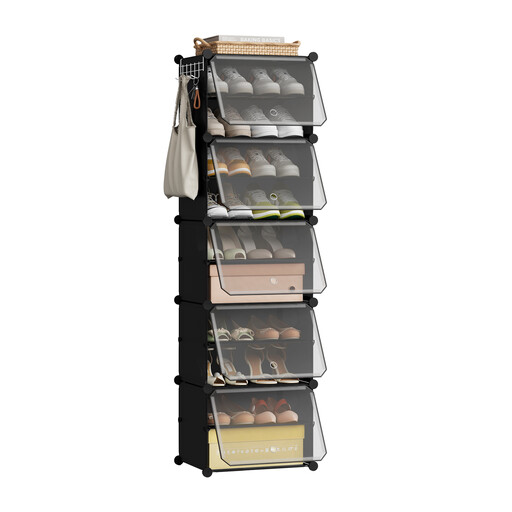
eSituro 10-Cube Modular Organizer, Black
Why It Stands Out: This modular cube organizer from eSituro is the definition of flexibility. It consists of individual PP panels and connectors that you can assemble as you wish—tall, wide, or split into several smaller units. The 10 compartments with doors protect shoes from dust, while the five side hooks offer extra space for keys or umbrellas.
Advantages:
Who It's For: For those looking for a customizable and expandable solution. Ideal for rooms with sloped ceilings, alcoves, or for anyone who likes to reconfigure their storage as their needs change.
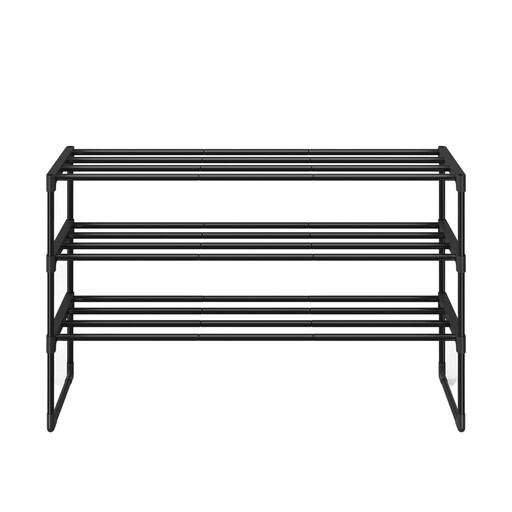
Ochama 3-Tier Metal Shoe Rack, Slim & Stackable, Black
Why It Stands Out: This rack from Ochama focuses on the essentials: sturdy, open, and space-saving shoe storage. With a width of 92 cm, it offers space for 16 to 20 pairs of shoes on three tiers. The construction of metal tubes and plastic connectors is designed for durability and can be assembled without any tools.
Advantages:
Who It's For: For anyone who prefers a straightforward, sturdy, and open solution where shoes are quickly accessible. Perfect for the basement, closet, or an industrial-style hallway.
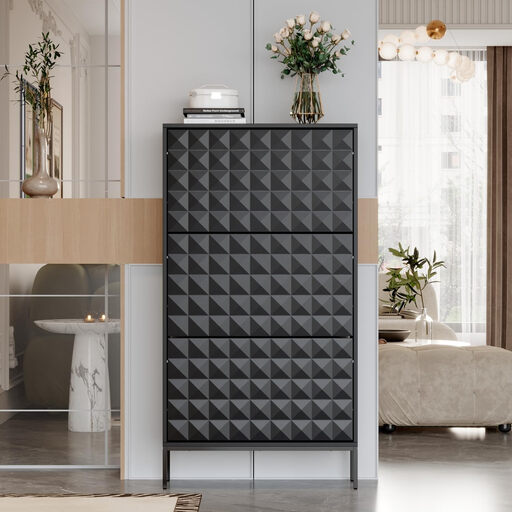
Caldion Slim Shoe Cabinet with 3 Flaps, Black
Why It Stands Out: The Caldion shoe cabinet is a classic space-saving tip-out cabinet with a modern design. With a depth of just 24 cm, it fits even in very narrow hallways. Behind the three flaps are compartments with adjustable dividers, offering space for up to 24 pairs of shoes. The closed front and the black 3D-textured finish create an elegant and tidy look.
Advantages:
Who It's For: For families or shoe enthusiasts who want to store a large number of shoes neatly and out of sight in a narrow hallway. Ideal for anyone who values a tidy and modern atmosphere.
Didn't find the perfect model for you among these suggestions? The world of shoe storage is diverse, offering the right solution for every style and need. Models in neutral colors that blend seamlessly into existing decor are particularly popular.
Discover our selection of black shoe racks and find more functional designs for your home.
1. What is better, an open shoe rack or a closed shoe cabinet? That depends on your priorities. An open rack provides good ventilation for shoes and quick access. A closed cabinet or tip-out cabinet protects shoes from dust and creates a very tidy, calm look in the room. For hallways that also serve as a formal entryway, a closed solution is often the better choice.
2. How can I organize my shoes to save space? To organize shoes in a space-saving way, utilize the room's vertical space. Vertical racks, stackable boxes, or a space-saving tip-out cabinet are ideal for this. A modular cube organizer can also be perfectly adapted to fit into alcoves or unused corners. Also, sort your shoes by season to store rarely worn pairs separately.
3. How much depth does a shoe rack need? A standard shoe rack, where shoes stand straight, needs a depth of about 30-35 cm. A slim shoe cabinet of the tip-out variety, where shoes are stored at an angle, often manages with a depth of just 17-25 cm, making it an excellent solution for very narrow hallways.