
Lieferung heute & morgen

Qualitätsgarantie

Willkommens-Angebote freischalten: KOSTENLOSE Lieferung | Bis zu 80 % RABATT | Kostenlose 30-Tage-JoyPlus-Testphase
App herunterladen
By the Joybuy Product Recommendation Officer
A shoe rack should keep your shoes tidy, take up as little space as possible and remain easy to access every day. However, hallways, rented homes and small bedrooms in the UK quickly reveal whether a model really fits the space available. Poor purchases are often not caused by the price, but by unsuitable dimensions, unclear load limits or a design that does not take everyday use into account.
“Suitable for lots of shoes” does not tell you much. What matters is whether the compartments are high and deep enough for trainers, boots, high-top shoes or slippers. A shoe stand with several tiers may hold many pairs, but with larger shoe sizes or bulky soles, the usable width per tier may not be sufficient.
Look out for specific details such as the number of compartments, tiers, hooks and maximum number of pairs. With open racks, you should also bear in mind that the actual capacity depends on the shape of the shoes.
A slim shoe rack for the hallway may initially seem practical. However, with a tall, narrow design, the footprint can be crucial. Uneven floors, unevenly distributed loads or frequently pulling shoes out can affect stability.
Check whether the model has non-slip feet, a sturdy frame or the option to attach it to the wall. With a shoe cabinet with doors, it is also important to check whether it stands securely on the floor and whether it can be secured against tipping if necessary.
A shoe rack with hooks can combine storage for shoes, bags, scarves and jackets. This is useful in a small entrance area, but it requires sufficient depth and height. Hooks should not merely be included; they should also be suitable for the intended load.
You should therefore compare the maximum load of the clothes rail, the hooks and each shelf separately. A high overall load capacity does not replace even weight distribution.
Measure the available space in three places: width, depth and height. There should be enough room to move around the shoe rack in the hallway. For narrow alcoves, a vertical or hanging shoe rack may be a sensible choice. Behind a door, you should also check that the door panel, frame and fittings leave enough clearance.
The following options are suitable for small spaces:
Metal frames are often easy to maintain and suitable for everyday use. Plastic or PP panels can usually be cleaned with a damp cloth and can be arranged flexibly in modular systems. Wood-effect panels offer a closed, furniture-style appearance, but should not be exposed to moisture for prolonged periods.
Open shelves are easy to clean, while a shoe cabinet with doors can partly protect shoes from dust. Look for easy-to-reach gaps and do not use abrasive cleaning products if the manufacturer advises against them.
Load ratings must relate to the relevant component. According to the product information, the JOYFURNOS model has a maximum clothes-rail load of 40 kg, while each hook is rated for up to 4 kg. The eSituro shoe rack with seven tiers is listed as having a total load capacity of 35 kg.
With wall-mounted models, choosing the right fixings is particularly important. Wall plugs and screws must be suitable for the wall material. Plasterboard, concrete and brick each present different requirements. Always follow the supplied instructions and only load the rack after checking all the connections.
The following models meet a range of requirements, from a simple shoe stand to a combined hallway storage solution. The details are based on the respective product descriptions and technical data.
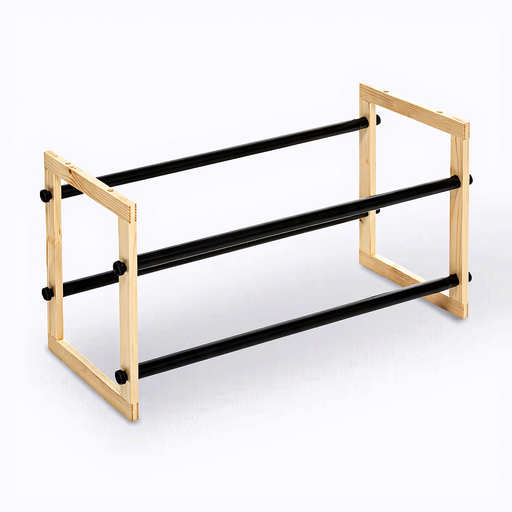
Why this product suits this profile: Measuring a compact 60 × 20 × 30 cm, this extendable model can be adjusted to fit the available space. According to the product information, two tiers provide room for up to twelve pairs of shoes.
The extendable design reduces the risk of buying a rigid rack with an unsuitable width. Its capacity is clearly specified.
Steel shelves, a pinewood frame, two tiers and FSC certification according to the product data.
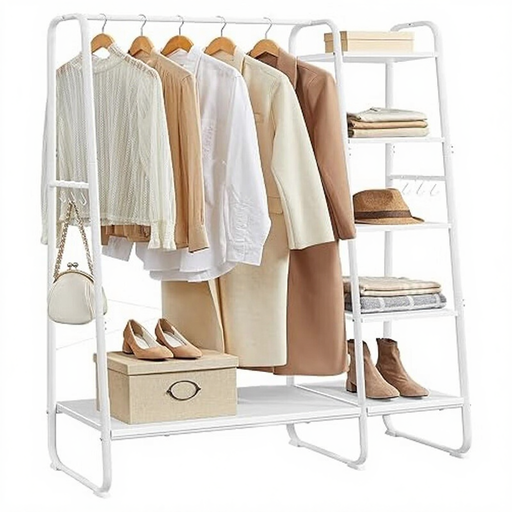
Why this product suits this profile: The combination of a clothes rail, five shelves and six hooks is suitable for bedrooms, dressing rooms or entrance areas where you want to organise shoes and clothing together.
The product data specifies separate load limits: up to 40 kg for the clothes rail and up to 4 kg per hook. This makes it easier to plan how to use it.
45 × 120 × 160 cm, steel frame, wood-effect panels and non-slip feet according to the product description.
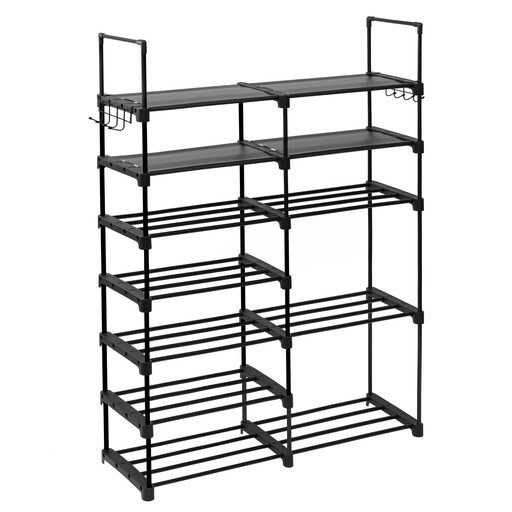
Why this product suits this profile: Families and households with lots of shoes get seven height-adjustable tiers and ten hooks for jackets, bags, scarves or hats. The product information states that it holds 20 to 25 pairs of shoes.
The height-adjustable tiers can be adapted for different types of shoes. The total load capacity of 35 kg is stated as a specific limit.
86 × 125 × 30 cm, seven tiers, ten hooks, a metal and plastic construction, plus open ventilation according to the product data.
We have put together a complete, regularly updated list of products that fully meet these strict selection criteria and the safety regulations applicable in the EU.
Place the rack on a level, stable surface. Where possible, put heavier shoes on the lower tiers. With a shoe rack with hooks, bags and jackets should be distributed evenly. Wall-mounted models must be installed using fixings suitable for the wall.
After assembly, check all connections and tighten any loose screws. With modular plastic systems, all clips must be fully engaged. A shoe rack is not a seat or climbing frame and should not be used as a step.
A depth of around 30 cm is practical for many everyday shoes, although the required size depends on the shape and size of the shoes. For boots or particularly large shoes, check the internal dimensions of the relevant compartment. A very slim model is better suited to flat shoes or hanging shoe storage.
An open shoe rack provides quick access and supports air circulation. A shoe cabinet with doors has a more enclosed appearance and can protect shoes from visible dust. Dry, well-ventilated storage is important for damp shoes. The right choice therefore depends on the space, cleaning requirements and the look you want.
Load the tiers evenly, do not exceed the stated load limits and place the furniture on a level floor. Tall or wall-mounted models should be secured according to the instructions. Regularly checking the screws, clips and frame connections helps you identify loose components at an early stage.