
Lieferung heute & morgen

Qualitätsgarantie

Willkommens-Angebote freischalten: KOSTENLOSE Lieferung | Bis zu 80 % RABATT | Kostenlose 30-Tage-JoyPlus-Testphase
App herunterladen
Storing shoes in the hallway, wardrobe or under the bed sounds straightforward. In practice, however, typical weak points soon emerge: boxes don't fit your shoe size, doors are hard to open when stacked, or ventilation isn't as effective as you'd hoped. Shoe storage boxes shouldn't be chosen on colour and quantity alone.
This guide explains what households, sneaker collectors and fashion-conscious shoppers should look for when buying. Afterwards, you'll find a curated selection for different usage scenarios.
Manufacturers often quote the external dimensions. However, wall thickness, door frames and closures reduce the available space. This can be particularly tight for high-top sneakers, shoes with thick soles or models with a larger shaft.
Before buying, therefore, check:
For example, the JOYFURNOS boxes measuring 35 × 25.2 × 19 cm are stated to fit sneakers up to UK size 11. Even so, you should measure your own shoes, as the shape varies depending on the model.
Transparent shoe boxes make selection easier because the contents are quickly visible. However, they don't replace regular care. Dust protection depends on whether the lid and front flap close properly. What's more, residual moisture can collect inside after wearing.
A box with ventilation holes supports air circulation but doesn't automatically dry wet shoes. Shoes should be completely dry before storage. Placing a damp pair directly into a closed plastic shoebox can affect material care.
"Stackable" initially only describes the shape. For actual use, the connecting elements, base area and load capacity are what matter. A tall stack in the hallway shouldn't wobble or make it difficult to access the lower boxes.
Look out for:
For classic low shoes, lower boxes are often sufficient. Running shoes, high-top sneakers and walking boots need more height. If you want to store different types of shoes, don't plan solely around your smallest pair.
The specifications of each product serve as a practical guide:
The measurements aren't directly comparable between different brands. What matters is the actual internal space.
Many shoe organisers for the wardrobe use PP plastic (polypropylene). This material is lightweight and is often used for the body of transparent or coloured boxes. Front doors can be made of PS plastic, while frames are sometimes made of ABS.
Material specifications shouldn't be confused with a blanket statement about durability. Also check the finish of the edges, hinges and plug-in connections. For foldable fabric boxes, the lid, seams and shape stability of the frame are important.
A shoe box with a front flap is usually quicker to access in daily use than a model that has to be completely removed from the stack. For the entrance area, the door opening shouldn't be blocked by a wall, piece of furniture or narrow alcove.
For space-saving shoe storage in the wardrobe, stackable models make sense, provided the width and height fit the shelf. In the hallway, a low shoe rack organiser may be more suitable if shoes are changed frequently.
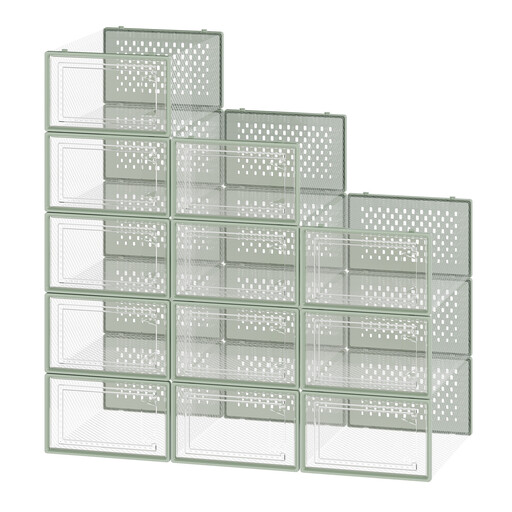
Why this product suits the profile: The 12-pack is ideal for buyers who want to organise several everyday shoes or sneakers uniformly. The stated dimensions per box are 33.3 × 23.2 × 14.3 cm.
The transparent panels and front doors reduce the need to open several boxes repeatedly. However, you should still check the shoe height before buying.
12 boxes, transparent front and integrated ventilation openings; assembly is done via a click-together system.
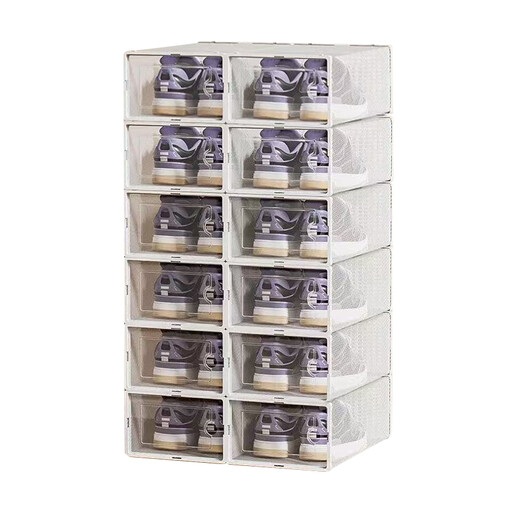
Why this product suits the profile: The extra-large design is aimed at users with larger or bulkier sneakers. The self-closing magnetic door is designed for frequent access.
The larger size addresses the problem of standard boxes being too small. You should check the specific placement dimensions before mounting against a wall.
Extra-large format, transparent plastic construction and magnetic door with self-closing function.
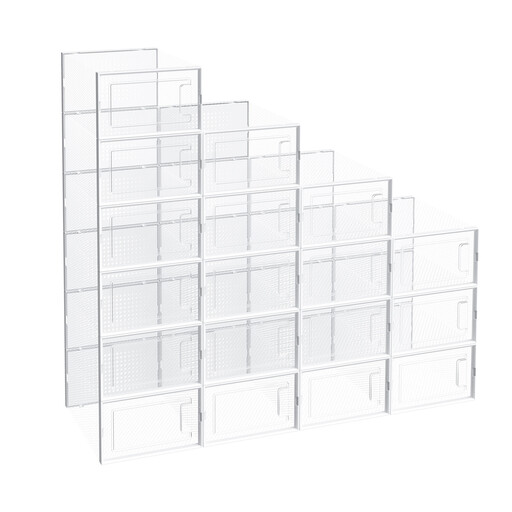
Why this product suits the profile: The 18-pack is aimed at households or collectors with many pairs and limited shelf space in the wardrobe or entrance area.
The clear front makes it easier to identify many pairs. However, the ventilation holes are no substitute for ensuring shoes are completely dry before putting them away.
18 individual boxes, front doors, ventilation openings and stated dimensions of 35 × 25.2 × 19 cm per box.
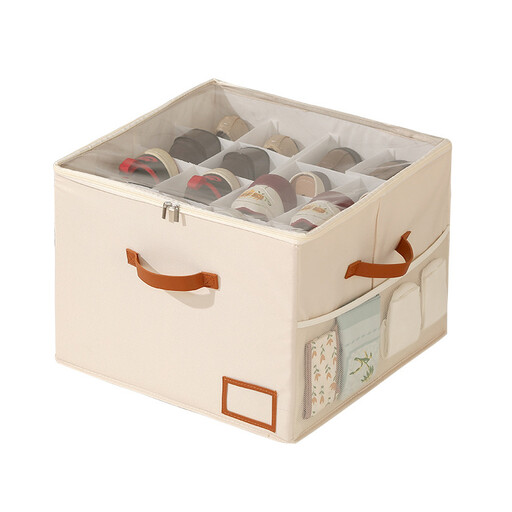
Why this product suits the profile: The foldable design is ideal for buyers who want to store seasonal shoes flexibly or save space when not in use.
The foldable concept avoids permanently unused rigid boxes. For frequently worn shoes, you should check the accessibility of the lid at the planned location.
Foldable fabric design, lid, stackable design and dust-repellent product description.
We've put together a complete, regularly updated list of products that fully meet these strict selection criteria and the safety regulations in force in the EU.
Plan the location before you order. In the wardrobe, the boxes must not only fit in but also be able to be pulled out or opened. In the entrance area, there should be enough clearance from doors and walkways.
For a longer service life, we recommend:
For delicate leather shoes, damp sports shoes or heavily worn sneakers, you should also consider whether open intermediate storage is sensible. A shoe storage box protects against dust, but doesn't replace proper material-specific shoe care.
For sneakers, transparent, stackable models with a front flap are practical because the pair remains visible and can be removed without moving other boxes. For high-top models or large soles, you should check the height and internal width individually. The product information on the suitable shoe size is a guide, but not a substitute for measuring your own shoe.
This depends on the construction, the surface and the manufacturer's instructions. A click system can connect the boxes together, but alone it doesn't say anything about an unlimited stacking height. Place the stack on a level surface and avoid a position where the front doors could be knocked by people walking past.
Both types have different areas of use. Plastic boxes are transparent, wipeable and often available with a front door. Fabric boxes, like the foldable JORDAN&JUDY model, can save space when used seasonally. The right choice depends on the location, frequency of access, shoe format and desired level of dust protection.