
Lieferung heute & morgen

Qualitätsgarantie

Willkommens-Angebote freischalten: KOSTENLOSE Lieferung | Bis zu 80 % RABATT | Kostenlose 30-Tage-JoyPlus-Testphase
App herunterladen
A cluttered hallway overflowing with shoes is a daily frustration. However, the search for the right shoe storage solution can quickly become overwhelming. The market is flooded with products that make big promises but often fail to deliver. As your Joybuy Product Recommendation Officer, I'm here to help you spot the common pitfalls and find a solution that truly fits your home and your needs.
Before you invest, you should be aware of the three most common issues that lead to frustration and wasted money:
To avoid a bad purchase, focus on three crucial features. These will help you objectively assess a product's quality and suitability.
The material determines the durability and load-bearing capacity of your shoe storage.
Measure your available space precisely: width, depth, and height. For a tight space, a narrow shoe rack for the hallway with a shallow depth (under 30 cm) is often the only option. The capacity stated by the manufacturer (e.g., "for 20 pairs of shoes") usually refers to small women's shoes. Plan realistically: you will need significantly more space for men's shoes from size 43 (UK 9 / US 10) upwards or for boots. Check the internal dimensions of the compartments and whether the shelves are adjustable or removable to accommodate taller footwear.
The choice between an open shoe rack and a closed shoe cabinet depends on your priorities.
Here are some product suggestions tailored to specific living situations and requirements.
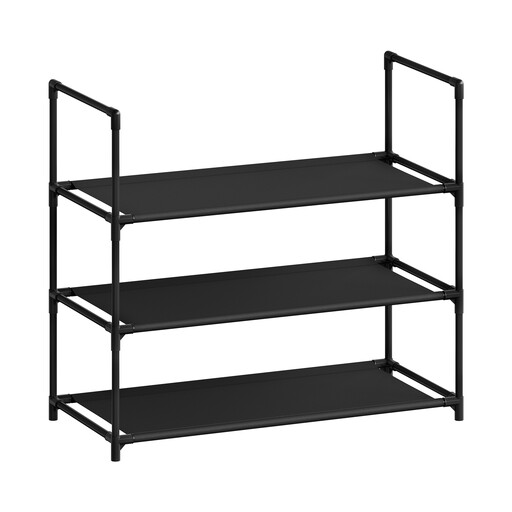
Why it's a match: Perfect for a first apartment, dorm room, or as a secondary rack in the basement. It provides basic storage for up to 9 pairs of shoes without a large investment and fits into almost any niche thanks to its slim design.
The construction of metal tubes and non-woven fabric is fit for purpose at this price point and more stable than all-plastic models. The open design prevents any odour or mould build-up.
Tool-free assembly with a simple plug-in system. The tiers can be removed if needed to create space for boots.
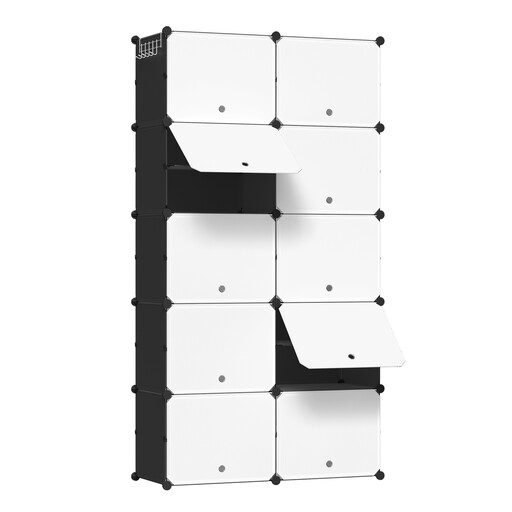
Why it's a match: Families need a lot of storage. According to the manufacturer, this modular system offers space for up to 40 pairs of shoes and can be flexibly adapted to the available space—whether tall, wide, or split into several smaller units.
The combination of a metal frame, PP panels, and ABS connectors provides a robust structure. The dividers can be removed to create larger compartments for boots, solving the problem of impractical dimensions.
High capacity and flexible DIY assembly. The doors ensure a tidy look in the hallway, and the waterproof material is easy to clean.
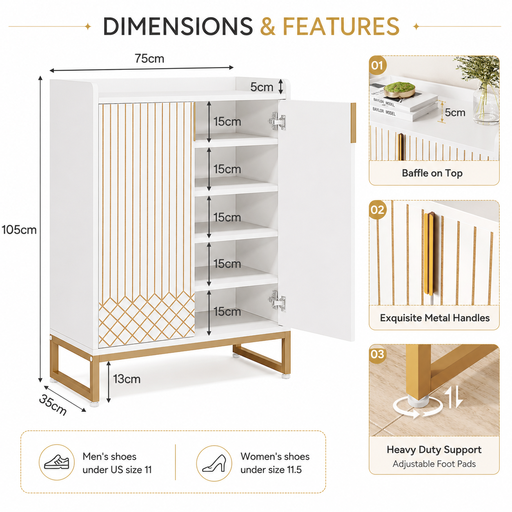
Why it's a match: For anyone who views their shoe storage as a proper piece of furniture. This model combines functionality with a modern, elegant design that blends seamlessly into a living room or entryway.
The sturdy engineered wood construction with metal legs avoids the 'wobbly' trap of cheap racks. As a closed shoe cabinet, it conceals shoe clutter while protecting them from dust.
Elegant, minimalist design with gold accents. The closed front ensures a consistently tidy appearance. The top surface can be used for decoration or to hold keys.
We've compiled a complete, up-to-date list of products that meet these strict selection criteria and relevant standards.
First, measure the available space in your hallway or room (width, height, depth), taking into account any doors that need to open. Second, make a realistic estimate of the number and type of shoes you own. You'll need deeper and taller compartments for boots or large men's shoes than for sandals. Check the internal dimensions of the compartments in the product you're considering.
Ensure the cabinet has ventilation holes in the back panel. Only store shoes when they are completely dry. Regularly airing out the cabinet and using cedar blocks or special shoe deodorisers can also help neutralise odours.
It depends on the model. Simple plug-in racks, like many from WOLTU, often require no tools and can be assembled in minutes. Larger shoe cabinets or chests made of engineered wood require assembly with screws and tools, similar to other pieces of furniture. The instructions are usually illustrated, and the parts are often numbered, which simplifies the process.