
Lieferung heute & morgen

Qualitätsgarantie

Willkommens-Angebote freischalten: KOSTENLOSE Lieferung | Bis zu 80 % RABATT | Kostenlose 30-Tage-JoyPlus-Testphase
App herunterladen
A cluttered entryway overflowing with shoes is a common problem in many homes. The right shoe storage not only creates order but also protects your footwear and can visually enhance your hallway. However, the market is flooded with products of widely varying quality and functionality. Before you make a decision, it's crucial to know the common pitfalls that often only reveal themselves after you buy.
As your Joybuy Product Recommendation Officer, I'm here to help you understand the essential criteria for making an informed and lasting choice.
Many products overpromise and underdeliver. Watch out for these three typical weaknesses to avoid a bad investment:
To find the right solution, you should focus on a few core features. These will help you objectively evaluate a product's functionality and durability.
Stability is paramount. For a metal shoe rack, powder-coated steel is a robust choice that is more resistant to bending than simple metal tubes. For closed furniture like a shoe cabinet or a shoe bench, materials such as MDF (Medium-Density Fibreboard) or particleboard with a solid thickness (typically 15 mm or more) provide the necessary stability. A crucial safety feature, especially in households with children, is an included anti-tip kit for securing the unit to the wall.
Consider how many pairs of shoes you need to store and of what types. For a narrow hallway, a narrow shoe rack or a tipper shoe cabinet makes optimal use of the space. Pay close attention to the internal dimensions of the compartments. The key to versatility is adjustable or removable shelves. This is the only way to flexibly adapt the storage space for sneakers, pumps, or high boots. It's a feature that separates basic space-saving shoe storage from a truly well-designed solution.
Here are some recommendations tailored to different needs and living situations.
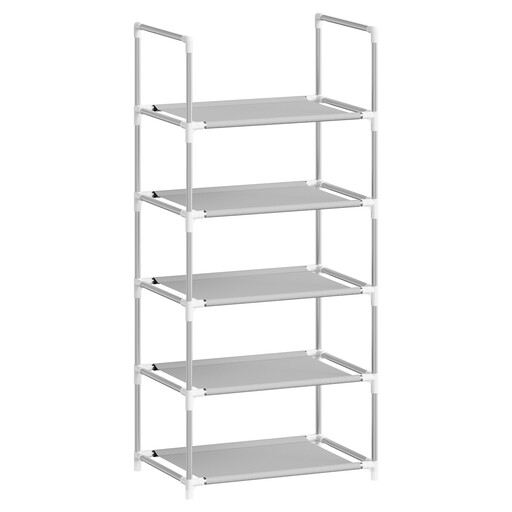
Why This Fits Their Persona: Ideal for those with limited hallway space. This narrow rack utilises vertical space to store multiple pairs of shoes on a minimal footprint (41x28 cm). The simple assembly is another plus for hassle-free use in rental apartments.
The construction of metal tubes and non-woven fabric is sufficiently stable for its intended purpose. Its open design completely bypasses the poor ventilation trap. The tiers can also be removed to make room for taller shoes, thus avoiding the lack-of-flexibility trap.
Very space-saving vertical design. Tool-free assembly allows for quick setup. The shelves are removable for greater flexibility.
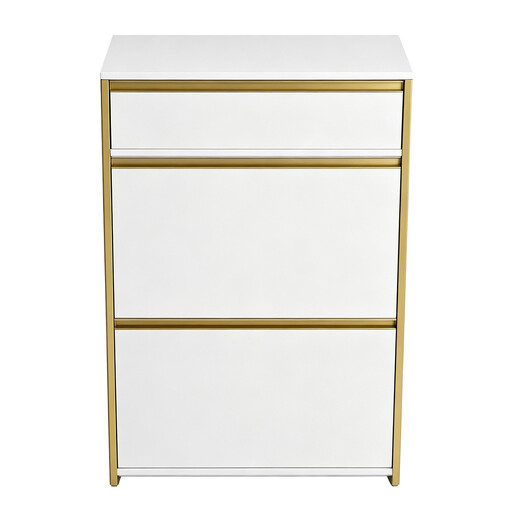
Why This Fits Their Persona: Families need a solution that tames hallway chaos. This closed white shoe cabinet with gold accents creates a tidy look. The extra drawer is practical for keys and other small items, while the slim 24 cm depth fits even in narrow hallways.
The high-density particleboard construction and the included anti-tip kit ensure the necessary stability (avoids trap 1). The internal dividers are adjustable and removable, solving the problem of inflexibility for different shoe sizes and types (avoids trap 2).
Closed, elegant design for a tidy hallway. Adjustable dividers for up to 12 pairs of shoes. Includes an anti-tip kit for added safety.
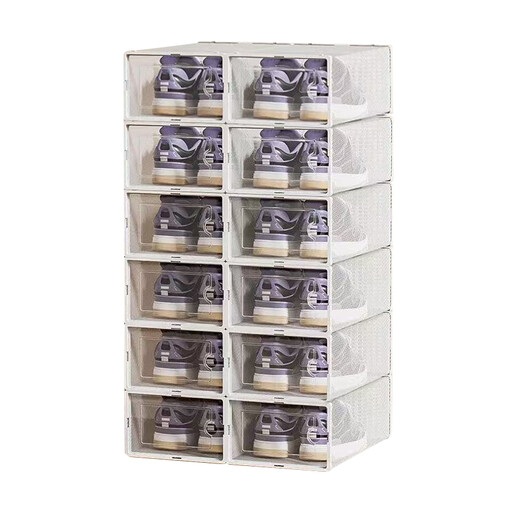
Why This Fits Their Persona: Sneaker collectors want to not only store their prized pieces but also protect and display them. These stackable boxes with transparent front doors offer a direct view of the collection. The magnetic doors provide convenient access and a premium feel.
These boxes are made of sturdy plastic and designed for stacking, which prevents instability (avoids trap 1). The "Extra-Large" dimensions are specifically designed for high-top sneakers and larger shoe sizes (avoids trap 2). Integrated ventilation holes ensure air circulation and prevent odours (avoids trap 3).
Sturdy, modular system for displaying and protecting shoes. Transparent doors with magnetic closure for easy access. Good ventilation.
We have compiled a complete, up-to-date list of products that fully meet these strict selection criteria and local safety regulations.
1. How much space should I plan for a shoe rack? Measure your available space—width, depth, and height—precisely. For the depth, plan for at least 30 cm to ensure most shoe sizes fit comfortably without overhanging. For very narrow hallways, models with a depth of less than 25 cm, such as tipper shoe cabinets, are a great alternative.
2. How do I prevent odours in a closed shoe cabinet? Ensure your shoes are completely dry before placing them in the cabinet. Choose a model with integrated ventilation slits or a perforated back panel. Additionally, cedar blocks or special shoe deodorisers can help absorb moisture and maintain freshness.
3. Are tipper shoe cabinets suitable for large shoe sizes (above EU 45 / US 11.5)? It depends on the specific model. Many standard tipper cabinets are designed for shoe sizes up to EU 44. For larger shoes, they may not fit completely into the flip-down compartments. Before buying, always check the manufacturer's specified maximum shoe size or the internal dimensions of the compartments. Models with adjustable or removable dividers offer more flexibility here.