
Lieferung heute & morgen

Qualitätsgarantie

Willkommens-Angebote freischalten: KOSTENLOSE Lieferung | Bis zu 80 % RABATT | Kostenlose 30-Tage-JoyPlus-Testphase
App herunterladen
A cluttered entryway, overflowing wardrobes, and the constant search for the other shoe—these are problems many households know all too well. A well-designed shoe storage system promises a solution, but the market is flooded with products whose weaknesses often only become apparent after purchase. To avoid disappointment and unnecessary expenses, it's crucial to know the typical pitfalls.
Many buyers invest in systems that quickly prove to be impractical or unstable. Pay special attention to these three common flaws:
A well-informed purchasing decision is based on evaluating objective criteria. Before you decide on a system, check the following three core parameters to ensure it meets your needs.
The longevity of a shoe storage solution depends directly on the materials used. Basic shoe storage boxes are often made of polypropylene (PP), a flexible plastic. However, for a stable, modular shoe rack, more robust materials are required. Look for systems that use ABS plastic for the connectors and have metal-reinforced frames. This combination provides significantly greater stability and load-bearing capacity, even when the rack is fully loaded. A space-saving shoe rack doesn't have to be unstable if the material quality is right.
Storage requirements are highly individual. A rigid shoe cabinet may be visually appealing but offers little flexibility. In contrast, a modular shoe rack or stackable boxes can be adapted to the available space and a growing shoe collection. Check the stated capacity (e.g., for 10, 18, or 32 pairs of shoes) and consider whether the system is expandable. With modular racks, it's often possible to remove dividers to create compartments for boots or bags.
For a clear overview, especially with a larger collection, transparent shoe boxes are a practical solution. The key difference lies in accessibility: systems with a front-facing door allow you to access any pair without having to unstack the boxes. This is a significant advantage over boxes with a simple lid. This feature is particularly relevant for sneaker storage, as it allows for protective yet presentable organisation. When choosing a box-style shoe organiser, also look for integrated ventilation holes to ensure the longevity of your shoes.
To make your choice easier, we have matched some products to different requirement profiles.
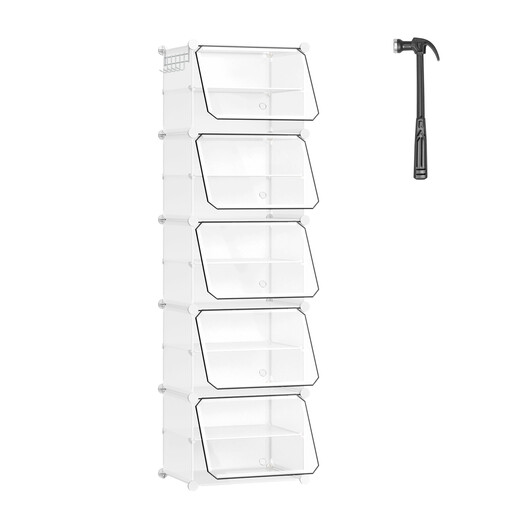
Why it's a great fit: Perfect for small apartments or narrow hallways where every inch counts. The modular DIY design allows the cubes to be flexibly adapted to fit into alcoves or under stairs, stacked either horizontally or vertically.
The interlocking design offers a more structured and stable solution than loosely scattered shoes. The included doors help maintain a tidy appearance and protect the contents from dust.
High flexibility in arrangement (horizontal/vertical) and simple assembly with the included rubber mallet. Additional hooks provide space for keys or small bags.
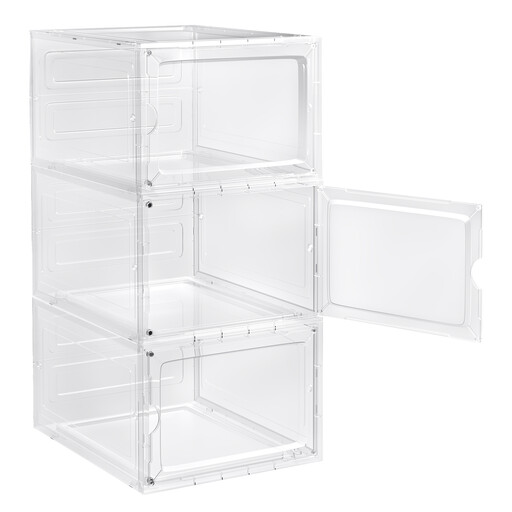
Why it's a great fit: Designed for sneaker enthusiasts or owners of high-end shoes who want to protect their collection while displaying it in style. The boxes are suitable for shoes up to size 11 (UK) / 12 (US).
The construction of robust ABS and hard PP is more dimensionally stable than simple folding boxes. The transparent front door with a magnetic closure allows quick access without having to dismantle the stack.
A stable, interlocking design for vertical and side-by-side stacking. The smooth, waterproof surface is easy to clean.
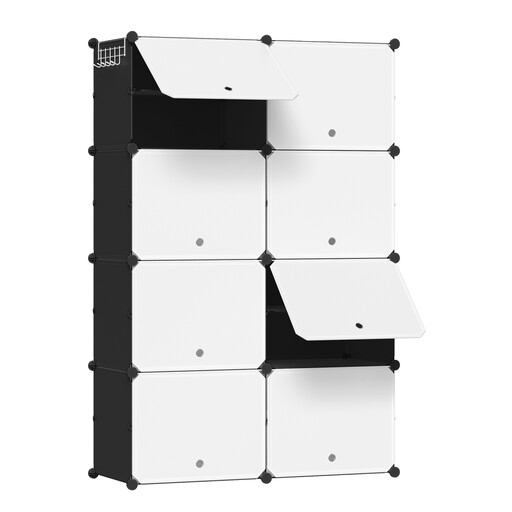
Why it's a great fit: With a capacity for up to 32 pairs of shoes, it offers ample space for the entire household. Its modularity allows for the storage of various shoe types, from children's shoes to boots.
This system tackles the stability problem with a solid construction of PP panels, metal frames, and ABS connectors. By removing dividers, boots can also be accommodated, thus avoiding the trap of impractical dimensions.
Large, customisable capacity and a robust structure designed for a high load. The waterproof panels are also easy to clean.
We have compiled a comprehensive, up-to-date list of products that fully meet these strict selection criteria and current standards.
1. How do you properly clean plastic shoe boxes? Most shoe boxes made of PP or ABS plastic are easy to care for. Simply wipe the surfaces with a damp cloth. Avoid aggressive chemical cleaners, as they can damage or discolour the material. Make sure the boxes are completely dry before putting your shoes back in to prevent moisture build-up.
2. Are modular shoe racks stable enough for heavy shoes like boots? Stability depends on the construction. Models with metal frames and connectors made of ABS plastic offer a higher load capacity than simple all-plastic systems. Many modular racks allow you to remove dividers to create larger, reinforced compartments for heavy boots or ankle boots. Before purchasing, check the manufacturer's specifications for the maximum load capacity per compartment.
3. What should I pay special attention to for sneaker storage? For long-term sneaker storage, three factors are crucial: protection, visibility, and ventilation. Choose stackable shoe boxes that have a transparent front door for quick access and good visibility. Be sure to look for integrated ventilation holes to ensure air circulation and prevent material fatigue or yellowing. If the boxes are exposed to direct sunlight, UV protection can be beneficial, although only a few models offer this feature.