
Lieferung heute & morgen

Qualitätsgarantie

Willkommens-Angebote freischalten: KOSTENLOSE Lieferung | Bis zu 80 % RABATT | Kostenlose 30-Tage-JoyPlus-Testphase
App herunterladen
A cluttered entryway filled with shoes is a common problem in many households. The right shoe storage not only creates order but also protects your footwear and can blend seamlessly into your decor. However, with a vast array of options—from slim cabinets and racks to modular boxes—making the right choice can be challenging.
This article serves as a practical guide. We'll introduce different systems and provide you with objective criteria to help you find the right solution for your needs, your space, and the number of shoes you own.
Before making a decision, you should consider three key aspects. These will help you narrow down your options and make a functional choice.
Measure the available space accurately. Are you looking for a solution for the hallway, which is often narrow? In this case, a slim shoe cabinet or a shallow tip-out shoe cabinet is an excellent choice. These models utilise the height of the room without blocking valuable floor space. For utility rooms, basements, or walk-in wardrobes, open shoe racks or stackable box systems are suitable, as aesthetics are less of a priority.
Consider how many pairs of shoes you need to accommodate, factoring in future purchases. The type of shoes you own is also important: tall boots, hiking shoes, or high heels require more height or depth than flat trainers or sandals. Some shelving systems offer adjustable shelves, while tip-out cabinets are usually designed for shoes up to a certain size. Check the internal dimensions of the compartments to ensure your footwear will fit.
The material affects not only the look but also the durability and maintenance required.
Also, pay attention to functional details like ventilation holes, which prevent odour build-up, or transparent fronts for a quick overview.
Here is a selection of different systems that meet various requirements for space, capacity, and design.
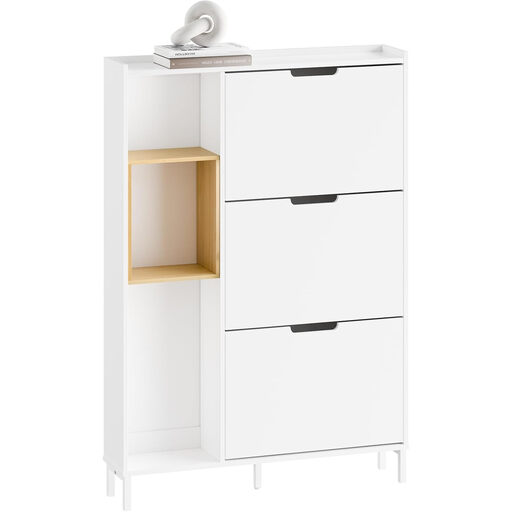
Why it stands out: This tip-out shoe cabinet combines closed storage with open shelving. With a depth of just 19 cm, it is extremely space-saving and perfect for narrow entryways. The mix of white-lacquered MDF and carbonised bamboo elements gives it a modern, Scandinavian look.
Pros:
Who is it for? For individuals and families looking for a stylish and very slim storage solution for their hallway, primarily for organising flat to medium-height shoes.

Why it stands out: This steel shoe rack is notable for its flexibility. It is expandable in width from 61 cm to 115 cm, adapting to your available space and the number of shoes. The minimalist design in black is unobtrusive and functional.
Pros:
Who is it for? For budget-conscious buyers who need a simple, adaptable, and open solution for organising shoes in the hallway, bedroom, or basement. Ideal for users whose shoe collection varies in size.
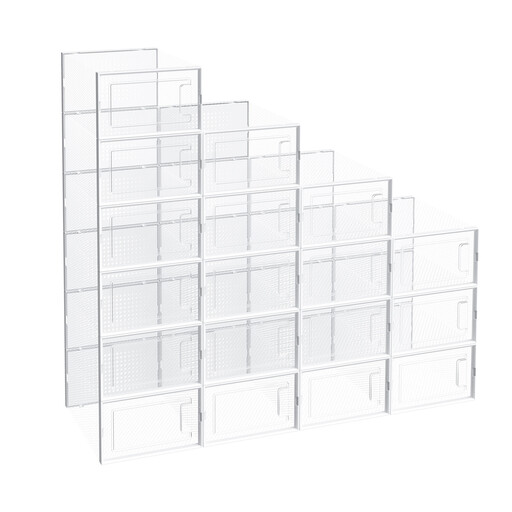
Why it stands out: This set of 18 individual shoe boxes offers maximum modularity. The boxes are stackable and can be arranged flexibly in a wardrobe, under the bed, or as a freestanding tower. The transparent front flaps allow for a quick glance at the contents without having to move the boxes.
Pros:
Who is it for? For shoe enthusiasts and collectors who want to store their trainers or other valuable shoes individually, protected, and visibly. Also ideal for anyone looking for a flexible and scalable solution for organising shoes in their wardrobe.
The products featured already cover a broad spectrum. However, if you are looking for particularly innovative or collapsible solutions that can be easily stored away when not in use, it's worth taking another look.
Discover our selection of collapsible shoe storage units to find more space-saving options.
1. What's the best way to store shoes to save space? To save space, vertical solutions are ideal. A tall, slim shoe cabinet or a tip-out shoe cabinet makes optimal use of wall height. Stackable shoe boxes are also very efficient, as they can be flexibly adapted to fit into alcoves or wardrobe space. For adjustable width, an expandable shoe rack is a great choice.
2. What is the difference between a tip-out shoe cabinet and a regular shoe cabinet? A classic shoe cabinet has doors and shelves where shoes stand upright normally. A tip-out shoe cabinet, on the other hand, features hinged compartments where shoes are stored at an angle or vertically. This gives tip-out cabinets a much shallower depth, making them exceptionally space-saving and a preferred solution for narrow hallways.
3. How can I prevent odours in my shoe storage? Ensure your shoes are completely dry before putting them away. Good ventilation is crucial. Open racks offer the best air circulation. For closed cabinets or boxes, look for models with integrated ventilation slits or holes. Regularly cleaning the storage unit and the shoes themselves also helps to minimise odour build-up.