
Lieferung heute & morgen

Qualitätsgarantie

Willkommens-Angebote freischalten: KOSTENLOSE Lieferung | Bis zu 80 % RABATT | Kostenlose 30-Tage-JoyPlus-Testphase
App herunterladen
By the Joybuy Product Recommendation Officer, July 04, 2026
Piles of shoes in the hallway are a common problem in many households. They take up valuable space and can quickly make an entryway look cluttered. A well-thought-out shoe storage solution is therefore not a luxury, but a practical necessity to create order and simplify daily life.
This article introduces various types of shoe storage systems and provides you with objective criteria to help you choose the right solution for your home. We will look at different models, from space-saving shoe racks to modular shoe cabinets, to give you a clear overview of the available options.
Before you decide on a model, there are a few basic considerations to make. The right choice depends on the number of shoes you own, the available space, and your personal organisational preferences.
The first question should be: How many shoes need to be stored, and how much space is available? Carefully measure the intended area in your hallway, bedroom, or dressing room (width, height, depth). Also, consider any doors that need to open or walkways that must remain clear. A tall, narrow shoe rack can be a great solution for many shoes if floor space is limited. A lower, wider model might fit well under a coat rack or a window.
Both systems have their specific pros and cons.
The most common materials for shoe storage solutions are metal, plastic, and wood. Metal is often sturdy and allows for sleek, minimalist designs. Plastic is lightweight, often modular, and easy to clean. Wood composites offer a classic look but can be heavier. Most systems are designed for self-assembly. Before purchasing, check if the necessary assembly hardware is included and if the instructions are clear.
Here, we present three different models that meet various needs for capacity, space, and design.

Why it stands out: This standing rack is designed for maximum capacity with a minimal depth. With space for up to 30 pairs of shoes, it's an efficient solution for those with an extensive shoe collection.
Advantages:
Who is it for? Ideal for families or individuals with a large number of shoes who are looking for a simple, open storage solution for a utility room, basement, or spacious dressing room.
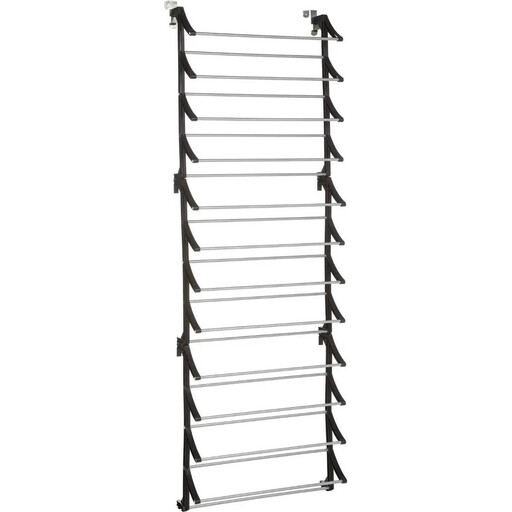
Why it stands out: This over-the-door shoe rack is an extremely space-saving solution as it utilises unused vertical space. It simply hangs over a door, creating storage without taking up any floor space.
Advantages:
Who is it for? Perfect for people living in small apartments or those who simply have no free floor space. It's a discreet and practical solution for bedroom, wardrobe, or utility room doors.
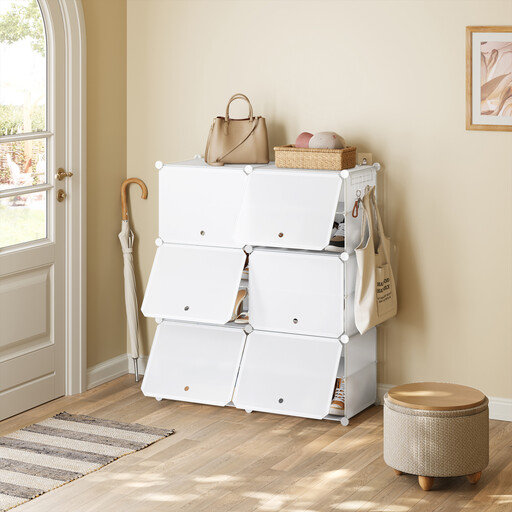
Why it stands out: This shoe organiser offers maximum flexibility thanks to its modular plug-in system. The 6 compartments can be arranged differently depending on space and needs, and the doors provide a closed, tidy look.
Advantages:
Who is it for? For anyone who prefers a customisable and enclosed storage solution. Ideal for the hallway or bedroom to maintain a clean look, and for people who enjoy assembling a system to their own specifications.
If you're looking for a particularly robust and easy-to-clean solution, a rack made from a different material might be of interest. Discover our range of plastic shelving units, which offer a durable and flexible alternative for your shoe storage.
There is no one-size-fits-all answer; the choice depends on your priorities. A shoe rack is ideal if you want quick access and good ventilation for your shoes and don't mind them being visible. A shoe cabinet is the better choice if you prefer a tidy, dust-free, and visually calm solution for your living space, especially the hallway.
To store shoes in a space-saving way, vertical solutions are particularly effective. These include tall, narrow racks, hanging systems for doors or wardrobe rails, and stackable boxes. Modular cabinet systems also allow you to make optimal use of available space, such as under a staircase.
The capacity varies greatly depending on the model. Compact tip-out shoe cabinets often hold 6-12 pairs. Medium-sized shoe cabinets offer space for 15-25 pairs. Large systems, such as open racks or modular cabinets, can accommodate 30, 40, or more pairs. Always check the manufacturer's specifications for capacity and remember that boots or high-heeled shoes require more space than flat shoes.