
Lieferung heute & morgen

Qualitätsgarantie

Willkommens-Angebote freischalten: KOSTENLOSE Lieferung | Bis zu 80 % RABATT | Kostenlose 30-Tage-JoyPlus-Testphase
App herunterladen
By Your Joybuy Product Recommendation Officer
A cluttered entryway with shoes blocking the path is a common frustration. Searching for the right pair in the morning wastes time and creates a mess. A smart shoe storage solution not only solves this problem but also protects your shoes from dust and damage, contributing to a more harmonious and organized home.
This guide is here to help. Instead of bombarding you with marketing hype, I'll introduce you to different types of solutions and specific product options. My goal is to provide you with objective information so you can make an informed decision for your home.
Before you decide on a model, it's helpful to consider a few key factors. The following points will help you select the right solution for your needs.
Measure your available space carefully. The depth of the furniture is especially critical in narrow hallways. A narrow shoe rack or a tilt-out cabinet can be an excellent space-saving option here. Also, consider how many pairs of shoes you need to store, and plan for a little extra room for future additions. Don't forget to account for different shoe types—boots require more height than flat sneakers.
Both options have their specific pros and cons.
The material affects not only the look but also the durability. Engineered wood with metal frames offers stability, while plastic solutions like stackable shoe boxes score points for their flexibility and light weight. Modular systems can adapt to a growing collection or a move, making them a future-proof investment.
Here is a selection of different products that meet various needs for space, design, and functionality.

Why it stands out: This cabinet combines a closed design with an open shelf at the bottom. The construction of engineered wood and a sturdy metal frame gives it a modern industrial look. The doors, featuring a decorative diamond pattern, conceal the contents and ensure a clean, organized appearance.
Pros:
Best for: Individuals and families who want to store a large number of shoes neatly and dust-free in a stylish piece of furniture for their hallway or bedroom.
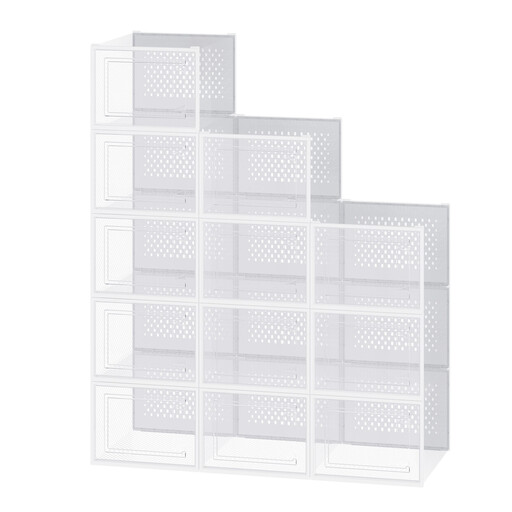
Why it stands out: This set of 12 individual boxes offers a flexible and expandable solution. The transparent front door allows for quick identification of the contents without having to unstack the boxes. Integrated vents ensure good air circulation.
Pros:
Best for: Sneaker enthusiasts who want to display and protect their collection, as well as anyone looking for a flexible and customizable sneaker storage solution.

Why it stands out: This entryway shoe cabinet stands out with its barn door-style design and fresh, light green color. With seven tiers and adjustable shelves, it offers great flexibility for various shoe types, from flat slippers to taller boots.
Pros:
Best for: Households that need a spacious yet decorative storage solution with a customizable interior for a diverse shoe collection.
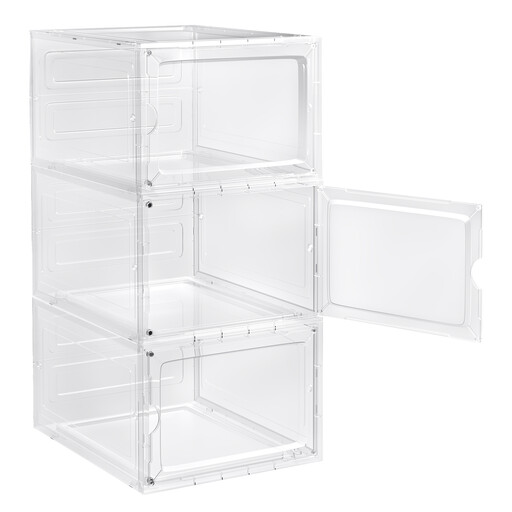
Why it stands out: This set from WOLTU consists of three sturdy plastic boxes with magnetic front doors. The fully transparent design makes your shoes visible, turning your storage into a display piece. An interlocking mechanism allows the boxes to be stacked securely.
Pros:
Best for: Users looking for a high-quality, modular, and transparent solution for their shoes up to size 12 (US Men's) / 46 (EU), who value a stable, long-lasting box system.
Stackable plastic shoe boxes offer a high degree of flexibility. You can expand or rearrange your shoe storage at any time as your needs change. They are ideal for making smart use of unused space in a closet or under the stairs.
Discover our full range of plastic shoe storage boxes with lids for more modular options.
The ideal depth of a shoe cabinet depends on your shoe size. For most shoe sizes up to 11 (US Men's) / 45 (EU), a depth of 35 cm (approx. 13.8 inches) is sufficient. For larger shoes or if you want to store shoeboxes inside the cabinet, a depth of 40 cm (approx. 15.7 inches) is recommended. For particularly narrow hallways, tilt-out cabinets are a great alternative, as they are often only 15 to 25 cm (6 to 10 inches) deep.
A shoe cabinet is primarily designed for the functional storage of shoes and often maximizes vertical space. A shoe console (or shoe bench) is typically lower and wider. In addition to shoe storage, it often provides a generous top surface and sometimes extra drawers, making it function more like a substantial piece of entryway furniture.
To save space, leveraging vertical storage is key. Tall, narrow shoe racks or stacked shoe boxes make the most of a room's height. Tilt-out cabinets are ideal for tight corridors due to their shallow depth. Another option is to use over-the-door or hanging organizers inside a closet.