
Lieferung heute & morgen

Qualitätsgarantie

Willkommens-Angebote freischalten: KOSTENLOSE Lieferung | Bis zu 80 % RABATT | Kostenlose 30-Tage-JoyPlus-Testphase
App herunterladen
Shoes in the hallway, in front of the wardrobe or under the bed can take up more space than you expect. The right shoe storage can help you stay organised, make good use of the space available and keep your everyday footwear within easy reach. But product photos and marketing claims don’t always show whether a shoe rack, shoe cabinet or shoe organiser will work in your home.
A piece of furniture may look narrow in photos but still take up several centimetres too much space in your hallway. Before buying, measure the available depth, width and height. Remember to account for skirting boards, door openings and the space needed to move around in front of the furniture.
For hallway shoe storage, depth is often the deciding factor. A slim shoe cabinet that’s 19 to 24 cm deep may be better suited to a narrow passageway than an open rack that’s 30 cm deep.
Claims such as ‘holds 16 pairs’ are only useful if shoe size and style are taken into account. Trainers, flats and sandals need less room than ankle boots or boots. Very wide soles can also reduce the number of pairs that will fit.
With shoe boxes, check the internal dimensions. A product may be designed for certain shoe sizes, while larger or bulkier styles may not fit. Transparent fronts make it easier to find the pair you want, but they’re no substitute for checking the dimensions.
A lightweight shoe rack is easy to move, but it can become unstable if the weight isn’t distributed evenly. Check the construction, the maximum load per tier and the overall weight limit. Wall fixing is especially important for tall cabinets.
Any anti-tip kit supplied must be fitted according to the instructions. Children should not climb on or pull at furniture. The solutions described here aren’t automatically suitable for outdoor use; for example, the JOYFURNOS 4-Tier Shoe Stand is specifically intended for indoor use.
First, measure the space where the furniture will go and note the maximum depth. For a narrow hallway, for example, a depth of 19 to 24 cm can save space. An open rack that’s 30 cm deep needs more floor space, but gives you direct access to your shoes.
The height should also suit the layout of your room. Tall models make good use of wall space, but shouldn’t block sockets, light switches or doors.
An open shoe rack for small spaces is a good choice if you wear your shoes often and don’t mind keeping them on display. A shoe cabinet with flaps or doors keeps shoes out of sight, and the top can also be used as a handy surface.
For larger collections, stackable shoe boxes offer flexibility. You can add individual boxes or arrange them differently. Check that the boxes will stack securely and that the front door can open with the space available.
Metal tubes with plastic connectors are lightweight and usually straightforward to assemble. MDF and bamboo can give a warmer, more homely look; follow the manufacturer’s instructions for caring for the surface. Plastic boxes can usually be cleaned with a slightly damp cloth.
Check the weight limit per tier and the overall weight limit separately. Neither should be exceeded. If furniture comes with anti-tip protection, don’t treat it as optional: it’s part of using the furniture safely.
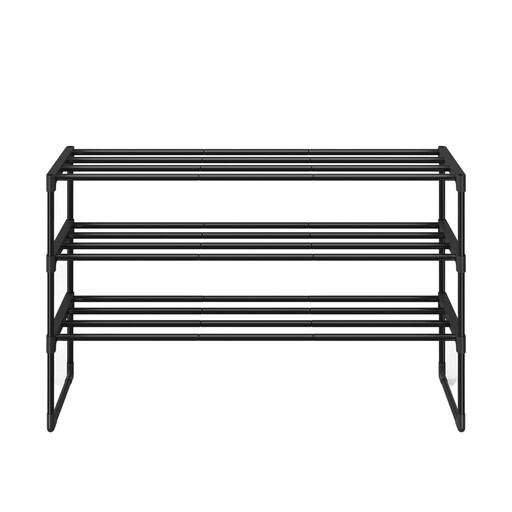
Why it suits this profile: This open shoe rack is a straightforward solution for the hallway, wardrobe or living room. At 30 x 92 x 55 cm, it has a compact footprint and can be positioned, turned or stacked to suit your needs.
The dimensions and weight limits are clearly stated: 10 kg per tier and 30 kg overall. This makes it easier to plan how you’ll use the rack before buying.
Metal tubes, plastic connectors, tool-free assembly and flexible placement.
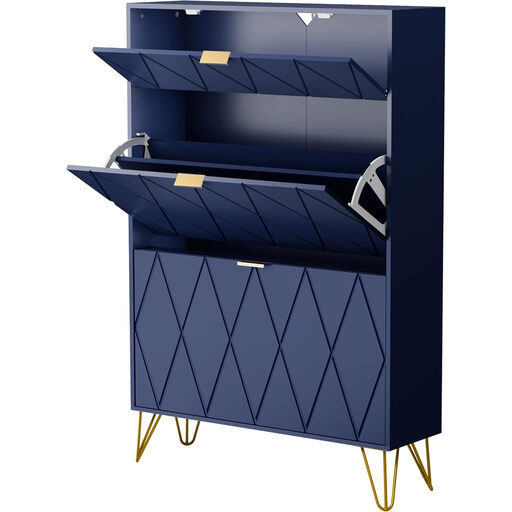
Why it suits this profile: This shoe cabinet is 80 cm wide and 24 cm deep, combining concealed storage with a top shelf. According to the product details, it holds up to 16 pairs of shoes.
The stated maximum load of 10 kg and integrated anti-tip protection give you useful figures to plan around. The wall fixing must be fitted.
MDF body, metal legs, two flaps, a drawer and a 24 cm depth suited to narrow hallways.
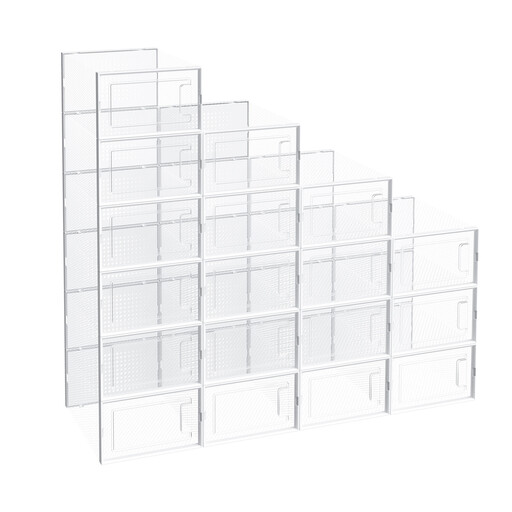
Why it suits this profile: These 18 boxes are a good fit if you have several pairs of shoes but limited wardrobe or hallway storage. Front doors and transparent panels make it easier to identify what’s inside.
The product details give the dimensions of each box as 35 x 25,2 x 19 cm and advise checking your shoe size against the box dimensions before buying.
18 boxes, stackable design, transparent doors and ventilation openings.
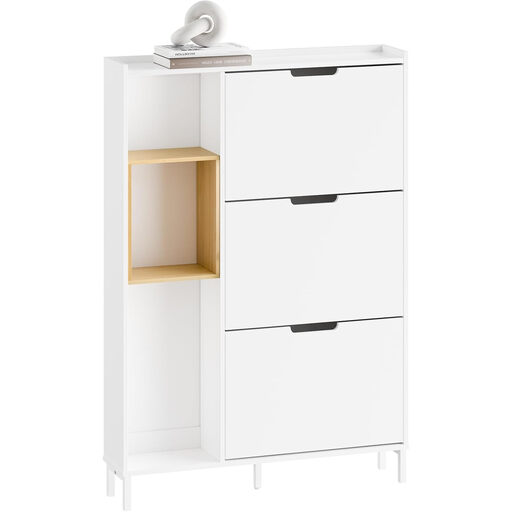
Why it suits this profile: At just 19 cm deep, this slim shoe cabinet is designed for narrow entrances and flats. According to the product details, its three flaps hold up to nine pairs of shoes.
The shallow depth is clearly stated. Before buying, also check that the 90 cm width and 129,5 cm height will fit your space.
19 cm depth, three flaps, an open compartment and a combination of MDF and carbonised bamboo.
We’ve put together a complete, regularly updated list of products that meet these strict selection criteria and fully comply with the safety regulations in force in the EU.
It depends on the model and the type of shoe. Slim shoe cabinets around 19 to 24 cm deep are suitable for narrow hallways, while open shoe racks need around 30 cm of floor space. Check the internal dimensions if you’re storing boots or larger shoes.
Shoe boxes provide flexible, individual storage and can be stacked. A shoe cabinet keeps shoes out of sight without requiring you to arrange each pair on display. An open shoe rack can make it easier to reach shoes you wear often.
Avoid overloading it, distribute the weight evenly and tighten screw or push-fit connections as needed, following the instructions. Clean surfaces with suitable products and protect items not designed for outdoor use from moisture.