
Lieferung heute & morgen

Qualitätsgarantie

Willkommens-Angebote freischalten: KOSTENLOSE Lieferung | Bis zu 80 % RABATT | Kostenlose 30-Tage-JoyPlus-Testphase
App herunterladen
A crowded hallway can quickly look untidy: shoes pile up by the door, pairs disappear into the wardrobe and seasonal footwear needs extra storage space. When choosing suitable shoe storage, it is therefore not just the design and price that matter. Dimensions, load capacity, accessibility and whether the unit suits your available space are all crucial.
A tall shoe cabinet may appear to offer plenty of storage at first glance. However, the internal layout determines its actual capacity. Flaps, shelves and depth all affect whether trainers, boots or larger men’s shoes will fit inside. While a shallow design saves floor space, it can restrict the storage of bulkier footwear.
Capacity figures such as “18 pairs” or “36 pairs” should be treated as a guide. High-top shoes, wide trainers and shoe boxes require more space than flat shoes. With a shoe rack for 18 to 36 pairs of shoes, you should therefore check whether the compartments are open, how many tiers there are and whether pairs sit side by side or partly offset.
A shoe rack for the door generally takes up no floor space, but it can affect the door’s weight and opening angle. With a wall-mounted shoe rack, the wall type, wall plugs and screws must be compatible. A freestanding shoe cabinet should also be placed on a level surface and secured against tipping if it is sufficiently tall.
Do not just measure the available width. Also check:
Space-saving shoe storage is only practical if it is easy to access in everyday use.
Check the officially stated pair capacity and compare it with your actual needs. For a small household, a shoe storage cabinet for 18 pairs may be sufficient. Families or people with lots of seasonal and sports footwear, on the other hand, are likely to need a taller solution with greater capacity.
Shoes should not be kept tightly compressed for long periods. This can affect ventilation and make them harder to remove. Open racks make it easier to see your footwear, while closed flaps conceal the contents and create a calmer look in the hallway.
For furniture made from chipboard, proper assembly, a level position and an appropriate load are important. Any moisture should be removed promptly. Metal and plastic models can generally be cleaned with a dry or slightly damp cloth; the manufacturer’s specific care instructions always take precedence.
The FSC mark is listed for some of the models below. It describes the relevant certification of the material or supply chain, but does not automatically indicate the load capacity or service life of the individual piece of furniture. Also check whether self-assembly is required and whether suitable fixings for your wall type are included.
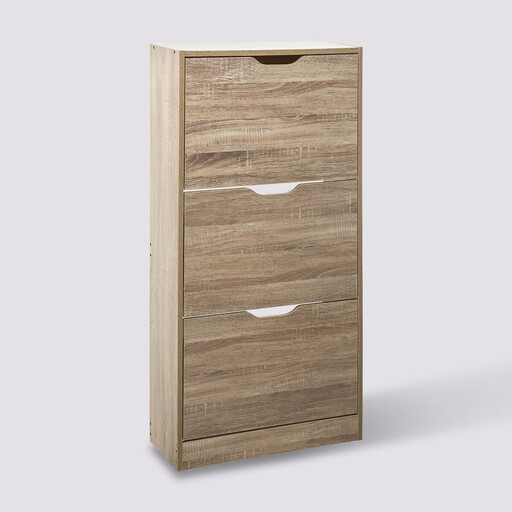
Why this product suits this profile: Measuring 60 cm wide and 23.3 cm deep, this shoe cabinet is suitable for hallways or bedrooms. Its stated capacity is 18 pairs, and it also includes a drawer.
The pair capacity, external dimensions and number of compartments — six in total — are clearly stated. This makes it easy to check before buying whether 18 pairs will fit the available space.
Six compartments, a drawer, FSC certification information and a chipboard construction; designed for indoor use and self-assembly.
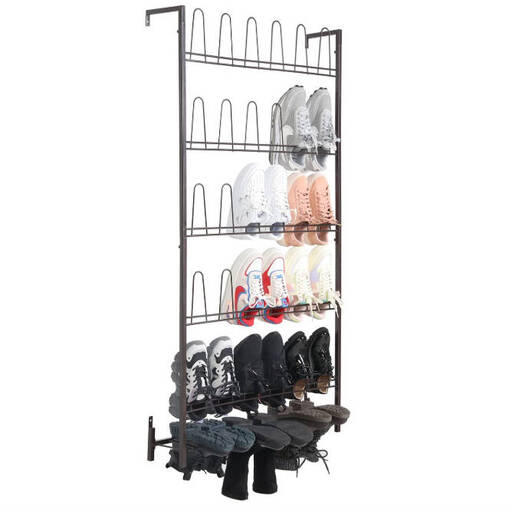
Why this product suits this profile: This five-tier wall-mounted shoe rack is made from metal and designed to hold up to 18 pairs of shoes and boots. It is suitable for entrance halls, utility rooms, bedrooms or garages.
Wall mounting does not require any additional floor space. Important: the supplied wall plugs and screws are intended for plasterboard; suitable fixings are required for other wall surfaces.
Five tiers, a metal construction, 16 wire loops and a stated capacity of up to 18 pairs.
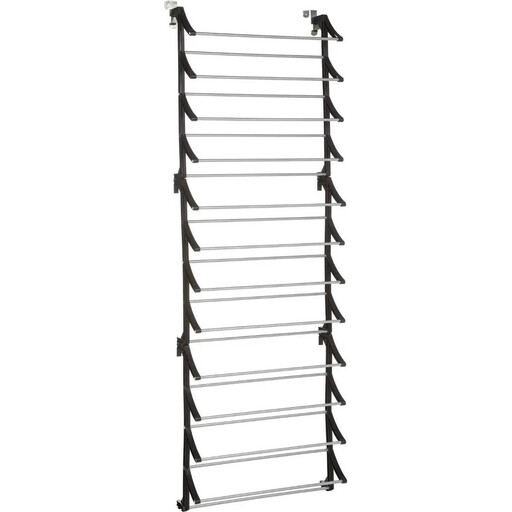
Why this product suits this profile: This over-the-door rack makes use of vertical space and, according to the product information, can hold 36 pairs of shoes. The hooks can be adjusted to fit doors between 3 and 5 cm thick.
Its shallow depth of 19 cm and adjustable hooks address two key buying considerations. Before installation, check the door thickness, door frame and available clearance.
Capacity for 36 pairs, steel shelves, a polypropylene frame and a height of 181 cm; self-assembly required.
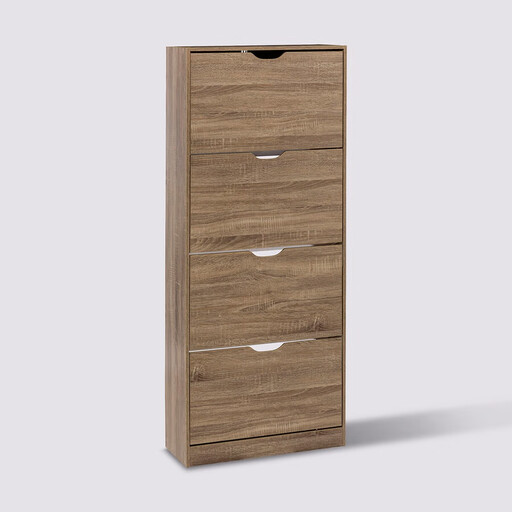
Why this product suits this profile: With eight compartments and a height of 155.4 cm, this tall shoe storage cabinet provides vertical storage for indoor spaces. Its closed design is suitable for hallways, dressing rooms or utility rooms.
The dimensions and weight of 24.26 kg are provided in advance. Due to its height, the unit should stand on a level surface and should not be overloaded, in accordance with the safety instructions.
Eight compartments, chipboard material, FSC certification information, a closed front and a design intended for indoor use.
We have put together a complete, regularly updated list of products that fully meet these strict selection criteria and the safety regulations applicable in the EU.
That depends on its width, depth and internal layout. A model measuring 60 cm wide and around 23 cm deep may be suitable for a hallway, provided the compartments are high enough and the passage remains clear. Measure the required space, including doors and skirting boards.
No. Check the door thickness, the clearance from the frame and the available opening space. On the model mentioned, the hooks are designed for doors between 3 and 5 cm thick. For glass, sliding or particularly lightweight doors, the unit should not be installed without checking its suitability first.
Avoid overloading it, regularly check the screws and fittings, and place chipboard furniture on a dry, level surface. Shoes should be as free as possible from moisture and heavy dirt before being stored. For wall- and door-mounted models, occasional checks of the fixings are recommended.